

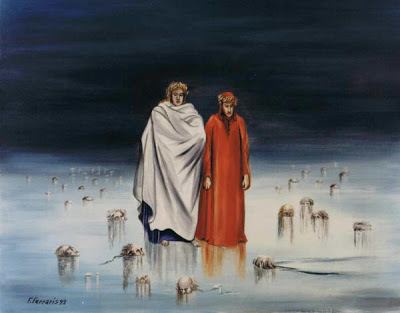
In the previous canto, Dante and Virgil had been lifted down from the eighth circle of Hell to the ninth circle, the last one, the pit of Hell. They find themselves on the edge of a large frozen lake, Lake Cocytus. The lake contains sinners frozen in various positions. These are the betrayers. The first ones he sees are those who are frozen up to their neck but their heads are downcast in a zone called Caina. They betrayed families. The next ones he sees are betrayers of countries with their heads facing outward in a zone called Antenora. Now Dante and Virgil have come to two men frozen together. One is tearing and gnawing at the neck of the other in a frenzy.
We had left him, moving on,
When I saw two shades frozen in a single hole –
Packed so close, one head hooded the other one;
The way the starving devour their bread, the soul
Above had clenched the other with his teeth
Where the brain meets the nape. And at the skull
And other parts, as Tydeus berserk with wrath
Gnawed at the head of Menalippus, he chewed,
“You, showing such bestial hatred for him beneath,
Whom you devour: tell me your reason.” I cried, – Canto 32


Galatians 5:14-15 (BSB) 14 The entire law is fulfilled in a single decree: “Love your neighbor as yourself.” 15 But if you keep on biting and devouring one another, watch out, or you will be consumed by one another.
In this circle, Dante uses comparisons to animals to strengthen the image of bestiality and how animalistic these sinners are.
“Better for you to be born a sheep or goat” – Canto 32, 15
“As a frog lies snout above water to croak” – Canto 32, 29-30
“Teeth chattering the note a stork’s beak makes” – Canto 32, 24
“All purple as a dog’s lips from frost” – Canto 32, 68
“And shook his scruff”; “he was barking” – Canto 32, 97, 104
Passing in his savage meal, the sinner raised
His mouth and wiped it clean along the hair
Left on the head whose back he had laid waste.
Then he began: “You ask me to endure
Reliving a grief so desperate, the thought
Torments my heart even as I prepare
To tell it. But if my words are seeds, with fruit
Of infamy for this traitor that I gnaw,
I will both speak and weep within your sight.
I don’t know who you are that come here, or how,
But you are surely Florentine to my ear.
I was Count Ugolino, you must know:
Ruggieri degli Ubaldini was born circa 1271 in Mugello to the powerful family of the counts of Pila, Ruggieri was the son of Ubaldino and the nephew of cardinal Ottaviano degli Ubaldini. He began his clerical career in the archepiscopal curia of the archdiocese of Bologna, then in 1271 the Ghibelline inhabitants of Ravenna made him archbishop of Ravenna-Cervia, in rivalry to another prelate appointed by the Guelphs. The conflicts between them convinced the pope to exclude them both from the office. In 1278 he became archbishop of Pisa, a city then governed by the Guelphs Ugolino della Gherardesca and Nino Visconti. Ruggieri initially settled the conflict between the two tried to promote Ghibellines, but soon (posing as Nino’s friend) played them off against each other in an attempt to finish off them both. He led the revolt which finally deposed count Ugolino and the Gualandi, Sismodni and Lanfranchi families. According to contemporary chroniclers, followed by Dante, he captured Ugolino by deception. After Ugolino’s death in 1289, Ruggieri had himself nominated as podestà of Pisa, but was unable to sustain the conflict with the Visconti and had to forfeit the office. He continued to live in his archdiocese, retaining the title until his death in 1295 in Viterbo, where he had recently moved. It was Nino Visconti who denounced Ruggieri’s cruelty to the pope. The pope entrusted the sentence to Cardinal Colonna who sentenced him to life in prison but he died.
Ugolino della Gherardesca (c. 1220 – March 1289), Count of Donoratico, was an Italian nobleman, politician and naval commander. Ugolino was born in Pisa into the della Gherardesca family, a noble family of Germanic origins whose alliance with the Hohenstaufen Emperors had brought to prominence in Tuscany and made them the leaders of the Ghibellines in Pisa. The Ghibellines sided with the Holy Roman Emperor and his rule of Italy, while the Guelphs sided with the Pope, who supported self-governing city-states. Pisa was controlled by the Ghibellines. Ugolino was appointed governor of Sardinia in 1252 and remained in this position until 1259, when the island was conquered by Genoa. After his term in Sardinia, Ugolino inherited the title of a Count of Donoratico. As head of his family, the Ghibelline party and podestà of Pisa, Ugolino took action to preserve his power in the face of the political hostility of Pisa’s neighbours. In 1271, through a marriage of his sister with Giovanni Visconti, judge of Gallura, he allied himself with the Visconti, the leaders of the Guelphs in Pisa. In doing so, he aroused the suspicions of his fellow Ghibellines. The subsequent disorders in the city in 1274 led to the arrest of both Ugolino and Giovanni, who were accused of plotting to undermine Pisa’s government and, with the support from Tuscany’s Guelphs, share power among themselves. Ugolino was imprisoned and Giovanni banished from Pisa. Giovanni Visconti died soon afterwards, and Ugolino, no longer regarded as a threat, was set free and banished. In exile, Ugolino immediately began to intrigue with the Guelph cities of Florence and Lucca. With the help of Charles I of Anjou, he attacked his native city and forced it to make peace on humiliating terms, pardoning him and all the other Guelph exiles. After his return, Ugolino at first remained aloof from politics but quietly worked to reassert his influence. In 1284, war broke out between Pisa and Genoa and both Ugolino and Andreotto Saracini were appointed as captains of two divisions of fleets by Alberto Morosini, the Podestà of Pisa. The two fleets met in August in the Battle of Meloria where Ugolino was defeated. When Florence and Lucca took advantage of the naval defeat to attack Pisa, Ugolino was appointed podestà for a year. It was in this period that Ugolino, out of political expediency, ceded the Pisan castles to Lucca and Florence, a decision that caused a rift between him and his grandson and between their Guelph followers. When Genoa suggested peace on similar terms, Ugolino was less eager to accept, for the return of the Pisan prisoners, including most of the leading Ghibellines, would have diminished his power. Ugolino, now appointed capitano del popolo for ten years, was now the most influential man in Pisa but was forced to share his power with his nephew Nino Visconti, son of Giovanni. The duumvirate did not last, as Ugolino and Nino soon quarrelled. In 1287, Nino, striving to become Podestà, entered into negotiations with Ruggieri degli Ubaldini, Archbishop of Pisa, and the Ghibellines. Taking advantage of resurgent Ghibelline fortunes in Tuscany, Ugolino connived with the Pisan Ghibellines, led by the Archbishop Ruggieri degli Ubaldini by agreeing to Ghibelline demands that his grandson Nino, and other Ghibelline families, were driven from the city, an order that was carried out – with Ugolino purposefully absent from the city – in 1288. He destroyed their palaces and occupied the town hall, where he had himself proclaimed lord of the city. Upon Ugolino’s return to Pisa, Ruggieri began plotting against him. In April of that year, Ugolino again refused to make peace with Genoa, even though the enemy was willing to be content itself with financial reparations. Ugolino still feared the return of the captured Pisans, who saw Ugolino as the cause for their prolonged captivity and had sworn to get their revenge for this. In 1288, Pisa was hit by a dramatic increase in prices, resulting in food shortage and riots among the bitter populace. During one of these riots, Ugolino killed a nephew of the Archbishop, turning the latter against him. On 1 July 1288, after leaving a council-meeting discussing peace with Genoa, Ugolino and his followers were attacked by a band of armed Ghibellines. Ugolino withdrew into the town hall and repelled all attacks. The Archbishop, accusing Ugolino of treachery, aroused the citizens. When the town hall was set on fire, Ugolino surrendered. While his illegitimate son was killed, Ugolino himself – together with his sons Gaddo and Uguccione and his grandsons Nino (surnamed “the Brigand”) and Anselmuccio – were detained in the Muda, a tower belonging to the Gualandi family. In March 1289, on orders of the Archbishop, who had proclaimed himself podestà, the keys were thrown into the Arno river and the prisoners left to starve. Their corpses were buried in the cloister of Saint Francis Church and remained there until 1902, when they were exhumed and transferred to the Gherardesca family chapel. The remains were DNA tested and examined fairly recently. Although there were signs of the starvation, there was no sign he cannibalized his children/grandchildren. Being about 79 yrs old he probably was one of the first to die.

I was Count Ugolino, you must know:
This is Archbishop Ruggieri. You will hear
Why I am such a neighbor to him as this:
How, through my trust and his devices, I bore
First being taken, then killed, no need to trace;
But things which you cannot have heard about –
The manner of my death, how cruel it was –
I shall describe, and you can tell from that
If he has wronged me. A slit in the Tower Mew
(Called Hunger’s Tower after me, where yet
Others will be closed up) had let me view
Several moons already, when my bad dream
Came to me, piercing the future’s veil right through:
This man appeared as lord of the hunt; he came
Chasing a wolf and whelps, on that high slope
That blocks the Pisans’ view of Lucca. With him
His lean hounds ran, well trained and eager; his troop –
Gualandi, Sismondi, Lanfranchi – had been sent
To ride in front of him. With no escape,
After a short run, father and sons seemed spent;
I saw their flanks, that sharp fangs seemed to tear,
I woke before dawn, hearing the complaint
Of my own children, who were with me there,
Whimpering in their sleep and asking for bread.
You grieve already, or truly cruel you are,
As you think of what my heart began to dread –
And if not now, then when do you shed a tear?
They were awake now, with the hour when food
Was usually brought us drawing near,
And each one apprehensive from his dream.
And then I heard them nailing shut the door
Into that fearful tower – a pounding that came
From far below. Hearing that noise, I stared
Into my children’s faces, not speaking to them.
Inside me I was turned to stone, so hard
I could not weep; the children wept. And my
Little Anselmo, peering at me, inquired:
‘Father, what ails you?’ And still I did not cry,
Nor did I answer, all that day and night
Until the next sun dawned. When one small ray
Found its way into our prison, and I made out
In their four faces the image of my own,
I bit my hands for grief; when they saw that,
They thought I did it from hunger’s pain,
And suddenly rose, ‘Father: our pain,’ they said
‘Will lessen if you eat us – you are the one
Who clothed us in this wretched flesh: we plead
For you to be the one who strips it away.’
I calmed myself to grieve them less. We stayed
Silent through that and then the following day.
O you hard earth, why didn’t you open then?
When we had reached the fourth day, Gaddo lay
Stretched at my feet where he had fallen down:
‘Father, why don’t you help me?’ he said, and died.
And surely as you see me, so one by one
I watched the others fall till all were dead,
Between the fifth day and the sixth. And I,
Already going blind, groped over my brood –
Calling to them, though I had watched them die,
For two long days. And then the hunger had more
Power than even sorrow had over me.”
When he had finished, with a sideways stare
He gripped the skull again in his teeth, which ground
Strong as a dog’s against the bone he tore.
Ah, Pisa! You shame the peoples of the fair land
Where si is spoken: slow as your neighbors are
To punish you, may Gorgona shift its ground,
And Capraia, till those islands make a bar
To dam the Arno, and drown your populace –
Every soul in you! Though Ugolino bore
The fame of having betrayed your fortresses,
Still it was wrong in you to so torment
His helpless children. You Thebes of latter days,
Their youthful ages made them innocent! –
Uguccione, Brigata, and the two
My song has named already.
Gualandi is a family from Pisa. In the Middle Ages this family supported the Ghibellines and it was one of the family that the archbishop Ruggieri degli Ubaldini incited against Ugolino della Gherardesca. – Wikipedia
The Sismondi family is an ancient family from Pisa. Traditionally, Sigismondo was a Lombard dignitary who came to Pisa from Germany; in 774 he became prior of the Republic of Pisa. The Sismondi became judges of the Giudicato of Agugliastra (Ogliastra), in Sardinia. He supported the Ghibelline Party and it was among the families that Archbishop Ruggieri degli Ubaldini incited Ugolino della Gherardesca , having him captured during a popular uprising. – Wikipedia
The Lanfranchi are an ancient family of the Bergamo coterie of the Republic of Pisa. he Lanfranchi were originally from San Casciano in Val di Pesa and descended from the warrior Lanfranco, who lived in the 9th century and came to Italy together with Otto I of Saxony. During the period of the Pisan Republic, they held the highest municipal offices, distinguishing themselves for their glorious exploits in the wars for Pisa’s independence. The Bergolina faction together with the Raspanti faction therefore constituted the Pisan Ghibelline faction. It was therefore among the families that Archbishop Ruggieri degli Ubaldini incited Ugolino della Gherardesca, having him captured during a popular uprising, before being locked up to starve in the Torre della Muda with four other descendants (1289). – Wikipedia
Gorgona is the northernmost island in the Tuscan Archipelago, a group of islands off the west coast of Italy. Between Corsica and Livorno, this diminutive island has been valued most for its wildlife, especially marine birds, and its isolation. The latter quality resulted in the foundation of Gorgona Abbey in the Middle Ages. After its closure the monastery grounds and buildings were appropriated in 1869, at the foundation of an agricultural penal colony, which is currently in use.
Capraia is an Italian island, the northwesternmost of the seven islands of the Tuscan Archipelago, and the third largest after Elba and Giglio.
“Ugolino was the Sardinian vicar of Re Enzo, son of Frederic II; Ugolino’s son Guelfo married Elena, Enzo’s daughter, and Ugolino’s grandchildren inherited Enzo’s Sardinian possessions. Ugolino’s son-in-law, Giovanni Visconti, was also a power on the island as judge of Gallura, as was Giovanni’s son, Ugolino’s grandson, Nino Visconti… Sardinia unites all these sinners as the object of their greed and strife, and Ugolino was as rapacious a player (not for nothing does he see himself as a wolf in his dream) as the others. (The Undivine Comedy, pp. 96-7)” – DigitalDante.columbia.edu
“The Guelph Visconti and Ghibelline Gherardesca families, traditionally opposed, became allies to protect their Sardinian holdings. Their alliance led to the ill-fated shared magistracy of Ugolino and his grandson Nino Visconti…” – DigitalDante.columbia.edu
“Ugolino’s career was marked by continuous switching back and forth of party allegiance. Originally Ghibelline, Ugolino was exiled from Ghibelline Pisa in 1275. He returned with the help of Florentine Guelphs. In 1284 he became podestà of Pisa.” – DigitalDante.columbia.edu
In 1285 Ugolino’s grandson, Guelph Nino Visconti, was called to share the office of chief magistrate with his Ghibelline grandfather. However, as well summarized by Guy Raffa, Ugolino apparently “connived with the Pisan Ghibellines, led by the Archbishop Ruggieri degli Ubaldini; Ugolino agreed to Ghibelline demands that his grandson Nino be driven from the city, an order that was carried out — with Ugolino purposefully absent from the city — in 1288”. The Archbishop then turned on his co-conspirator: “upon Ugolino’s return to Pisa, Ruggieri incited the public against him (by cleverly exploiting Ugolino’s previous ‘betrayal of the castles’) and had the count — along with two sons (Gaddo and Uguiccione) and two grandsons (Anselmo and Brigata) — arrested and imprisoned” – http://danteworlds.laits.utexas.edu/circle9.html#ugolino
“In Dante’s view, Ugolino used and abused his family members in securing and consolidating power over Pisa. However murky the politics and history of the Ugolino episode, the story as Dante tells it is devastatingly clear: it portrays the exploitation of family bonds for political ends. This form of exploitation, while taken to the extreme in Ugolino’s case, was systemic in Dante’s society. Such exploitation is built into the dynastic model: family members are expressions of power to be leveraged for the maintenance and survival of the dynasty.” – DigitalDante.columbia.edu
Ugolino withholds any language at the time his sons and grandsons need it the most. There were no words of consolation, comfort, love. They spoke, he did not: “Hearing that noise, I stared into my children’s faces, not speaking to them. Inside me I was turned to stone, so hard I could not weep; the children wept”; “And still I did not cry, nor did I answer, all that day and night”; “We stayed silent through that and then the following day”.
Language can be used to edify, exhort, encourage, comfort, console, teach, mentor, sooth, communicate love. Or language can be used to do the exact opposite. To tear down, to instill hatred, to destroy another person, to slander and gossip, to curse, to teach evil, to lie.
James 3:1-11 (NLT) 1 Dear brothers and sisters, not many of you should become teachers in the church, for we who teach will be judged more strictly. 2 Indeed, we all make many mistakes. For if we could control our tongues, we would be perfect and could also control ourselves in every other way.
3 We can make a large horse go wherever we want by means of a small bit in its mouth. 4 And a small rudder makes a huge ship turn wherever the pilot chooses to go, even though the winds are strong. 5 In the same way, the tongue is a small thing that makes grand speeches. But a tiny spark can set a great forest on fire. 6 And among all the parts of the body, the tongue is a flame of fire. It is a whole world of wickedness, corrupting your entire body. It can set your whole life on fire, for it is set on fire by hell itself.
7 People can tame all kinds of animals, birds, reptiles, and fish, 8 but no one can tame the tongue. It is restless and evil, full of deadly poison. 9 Sometimes it praises our Lord and Father, and sometimes it curses those who have been made in the image of God. 10 And so blessing and cursing come pouring out of the same mouth. Surely, my brothers and sisters, this is not right! 11 Does a spring of water bubble out with both fresh water and bitter water?
1 Corinthians 14:3 (GWT) But when a person speaks what God has revealed, he speaks to people to help them grow, to encourage them, and to comfort them.
1 Corinthians 14:26 (HCSB) What then is the conclusion, brothers? Whenever you come together, each one has a psalm, a teaching, a revelation, another language, or an interpretation. All things must be done for edification.
Ephesians 4:29 (BSB) Let no unwholesome talk come out of your mouths, but only what is helpful for building up the one in need and bringing grace to those who listen.
Ephesians 5:19-20 (BSB) 19 Speak to one another with psalms, hymns, and spiritual songs. Sing and make music in your hearts to the Lord, 20 always giving thanks to God the Father for everything in the name of our Lord Jesus Christ.
Ecclesiastes 10:12-13 (BSB) 12 The words of a wise man’s mouth are gracious, but the lips of a fool consume him. 13 The beginning of his talk is folly, and the end of his speech is evil madness.
Matthew 12:22-28;33-37 (ESV, parenthesis mine) 22 Then a demon-oppressed man who was blind and mute was brought to him, and he healed him, so that the man spoke and saw. 23 And all the people were amazed, and said, “Can this be the Son of David?” 24 But when the Pharisees heard it, they said, “It is only by Beelzebul, the prince of demons, (Beelzebul/Beelzebub, a name of Satan, the chief of evil spirits. Of Chaldean origin meaning dung-god) that this man casts out demons.” 25 Knowing their thoughts, he said to them, “Every kingdom divided against itself is laid waste, and no city or house divided against itself will stand. 26 And if Satan casts out Satan, he is divided against himself. How then will his kingdom stand? 27 And if I cast out demons by Beelzebul, by whom do your sons cast them out? Therefore they will be your judges. 28 But if it is by the Spirit of God that I cast out demons, then the kingdom of God has come upon you… 33 “Either make the tree good and its fruit good, or make the tree bad and its fruit bad, for the tree is known by its fruit. 34 You brood of vipers! How can you speak good, when you are evil? For out of the abundance of the heart the mouth speaks. 35 The good person out of his good treasure brings forth good, and the evil person out of his evil treasure brings forth evil. 36 I tell you, on the day of judgment people will give account for every careless word they speak, 37 for by your words you will be justified, and by your words you will be condemned.”
When I read this story, I felt his horror at what happened. But re-reading it, you will note that it’s all about him. Ugolino wastes little time on how his sons and grandsons felt. It’s all about how he felt. His suffering is paramount, his focus is on himself. He kept his stoic silence while they were alive but he sure talks enough now to Dante. His speech is the longest by a sinner in the entire Inferno.
The “wolf and whelps” are Ugolino and his sons/grandsons. They were trapped by the “lord of the hunt”, Ruggieri. Ugolino was finally bested by Ruggieri in a very Ugolino-style machination. He was hoisted by his own petard. In William Shakespeare’s play, Hamlet, this saying has become proverbial. The phrase means a bomb-maker is blown up (“hoist” off the ground) by his own bomb (a “petard” is a small explosive device), and indicates an ironic reversal, or poetic justice. Ugolino spent his life in political intrigues, machinations, switching sides for convenience, cunningly snaking through the politics of his times for his own enrichment and power. Family meant nothing to him except as a means to an end. They were pieces in his game to use. But he was bested in the end by Ruggieri. He met his match in Ruggieri. Ruggieri hounded the Wolf and his Whelps using “his lean hounds” “well trained and eager”, the Gualandi, Sismondi, and Lanfranchi families, to “ride in front of him”. More animal comparisons.
Dante seems to indicate that Ugolino’s sons and grandsons were children but that probably wasn’t true as Ugolino was in his late 70’s. But Dante wanted to show his sympathy was for the sons and grandsons, rather than for Ugolino. He even has the scene of where they offer their flesh to their father to eat, “‘Father: our pain,’ they said, ‘will lessen if you eat us – you are the one who clothed us in this wretched flesh: we plead for you to be the one who strips it away.'” Ugolino didn’t offer to sacrifice himself for his family. He didn’t even offer them comfort and love in the end. He really was like a wolf, an animal. He has no real sympathy or feeling for his own children. He “stared into my children’s faces, not speaking to them, inside me I was turned to stone, so hard I could not weep; the children wept”. Even as Gaddo dies, Gaddo asks Ugolino, “Father, why don’t you help me?” But he still offers nothing in consolation or love. It wasn’t until after they were all dead that Ugolino, “groped over my brood – calling to them”. A little late and indicative that Ugolino was only calling for them because he was alone. It’s still all about him. So Ugolino is merely using his words to manipulate Dante, the pilgrim, into feeling sorry for him. He even leads Dante, the pilgrim, by telling Dante he should feel sorry for him: “‘You ask me to endure reliving a grief so desperate, the thought torments my heart even as I prepare to tell it.'” Yet, tell it he will! “You grieve already, or truly cruel you are, as you think of what my heart began to dread – and if not now, then when do you shed a tear?” So if Dante isn’t feeling sorry for Ugolino, Dante is the “truly cruel” one.
As one human to another, Dante, the pilgrim, does not verbally judge Ugolino. In fact, he treats Ugolino as Ugolino treated his children, with silence. He gives him a taste of his own medicine. We cannot judge another as we weren’t in his shoes in that tower, nailed shut and starving. (In reality, this happened but we don’t have any idea of what really went on inside the tower until they died. This was Dante, the poet’s, imagination of what happened.) On the other hand, Dante, the poet, leaves us no doubt of his feelings about Ugolino. Without saying it, he has produced a picture in our head of Ugolino and those last seven days in that tower and it’s not a pretty picture or a flattering picture of Ugolino despite Ugolino’s attempts to manipulate the story for a more flattering picture of himself. This is the genius of Dante.
Let’s compare Ugolino to another father, King David. King David had an affair with a married woman. She became pregnant and King David and Bathsheba were in a predicament. Her husband, Uriah, had been away at war for David and would know the child was not his. So David connived to have him killed. Then Bathsheba had the baby. Let’s pick up the story.
2 Samuel 11:14-27 (NLT) 14 So the next morning David wrote a letter to Joab and gave it to Uriah to deliver. 15 The letter instructed Joab, “Station Uriah on the front lines where the battle is fiercest. Then pull back so that he will be killed.” 16 So Joab assigned Uriah to a spot close to the city wall where he knew the enemy’s strongest men were fighting. 17 And when the enemy soldiers came out of the city to fight, Uriah the Hittite was killed along with several other Israelite soldiers.
18 Then Joab sent a battle report to David. 19 He told his messenger, “Report all the news of the battle to the king. 20 But he might get angry and ask, ‘Why did the troops go so close to the city? Didn’t they know there would be shooting from the walls? 21 Wasn’t Abimelech son of Gideon killed at Thebez by a woman who threw a millstone down on him from the wall? Why would you get so close to the wall?’ Then tell him, ‘Uriah the Hittite was killed, too.’”
22 So the messenger went to Jerusalem and gave a complete report to David. 23 “The enemy came out against us in the open fields,” he said. “And as we chased them back to the city gate, 24 the archers on the wall shot arrows at us. Some of the king’s men were killed, including Uriah the Hittite.”
25 “Well, tell Joab not to be discouraged,” David said. “The sword devours this one today and that one tomorrow! Fight harder next time, and conquer the city!”
26 When Uriah’s wife heard that her husband was dead, she mourned for him. 27 When the period of mourning was over, David sent for her and brought her to the palace, and she became one of his wives. Then she gave birth to a son. But the LORD was displeased with what David had done.
2 Samuel 12:1-25 (NLT) 1 So the LORD sent Nathan the prophet to tell David this story: “There were two men in a certain town. One was rich, and one was poor. 2 The rich man owned a great many sheep and cattle. 3 The poor man owned nothing but one little lamb he had bought. He raised that little lamb, and it grew up with his children. It ate from the man’s own plate and drank from his cup. He cuddled it in his arms like a baby daughter. 4 One day a guest arrived at the home of the rich man. But instead of killing an animal from his own flock or herd, he took the poor man’s lamb and killed it and prepared it for his guest.”
5 David was furious. “As surely as the LORD lives,” he vowed, “any man who would do such a thing deserves to die! 6 He must repay four lambs to the poor man for the one he stole and for having no pity.”
7 Then Nathan said to David, “You are that man! The LORD, the God of Israel, says: I anointed you king of Israel and saved you from the power of Saul. 8 I gave you your master’s house and his wives and the kingdoms of Israel and Judah. And if that had not been enough, I would have given you much, much more. 9 Why, then, have you despised the word of the LORD and done this horrible deed? For you have murdered Uriah the Hittite with the sword of the Ammonites and stolen his wife. 10 From this time on, your family will live by the sword because you have despised me by taking Uriah’s wife to be your own.
11 “This is what the LORD says: Because of what you have done, I will cause your own household to rebel against you. I will give your wives to another man before your very eyes, and he will go to bed with them in public view. 12 You did it secretly, but I will make this happen to you openly in the sight of all Israel.”
13 Then David confessed to Nathan, “I have sinned against the LORD.”
Nathan replied, “Yes, but the LORD has forgiven you, and you won’t die for this sin. 14 Nevertheless, because you have shown utter contempt for the word of the LORD by doing this, your child will die.”
15 After Nathan returned to his home, the LORD sent a deadly illness to the child of David and Uriah’s wife. 16 David begged God to spare the child. He went without food and lay all night on the bare ground. 17 The elders of his household pleaded with him to get up and eat with them, but he refused.
18 Then on the seventh day the child died. David’s advisers were afraid to tell him. “He wouldn’t listen to reason while the child was ill,” they said. “What drastic thing will he do when we tell him the child is dead?”
19 When David saw them whispering, he realized what had happened. “Is the child dead?” he asked.
“Yes,” they replied, “he is dead.”
20 Then David got up from the ground, washed himself, put on lotions, and changed his clothes. He went to the Tabernacle and worshiped the LORD. After that, he returned to the palace and was served food and ate.
21 His advisers were amazed. “We don’t understand you,” they told him. “While the child was still living, you wept and refused to eat. But now that the child is dead, you have stopped your mourning and are eating again.”
22 David replied, “I fasted and wept while the child was alive, for I said, ‘Perhaps the LORD will be gracious to me and let the child live.’ 23 But why should I fast when he is dead? Can I bring him back again? I will go to him one day, but he cannot return to me.”
24 Then David comforted Bathsheba, his wife, and slept with her. She became pregnant and gave birth to a son, and David named him Solomon. The LORD loved the child 25 and sent word through Nathan the prophet that they should name him Jedidiah (which means “beloved of the LORD”), as the LORD had commanded.
King David did a terrible thing. He coveted another man’s wife, had an adulterous affair with her and had her husband murdered. It doesn’t hardly get any worse than that. He was breaking all the Ten Commandments. BUT, when God sent Nathan to confront King David, King David truly, sincerely repented. He saw his sins and knew that his only hope was in the Lord. “I have sinned against the Lord.”
Repentance is when we change our mind. We realize our sins are beyond our ability to make right. We cannot pay for our sins. We are helplessly caught in our sins. We are in need of a Savior and Jesus Christ is the only Savior. So we turn to Him and beg His mercy and forgiveness. If our heart remains as stone and we continue to justify and deny our sins and think we can save ourselves some other way, we are still lost. King David must have truly changed. His heart of stone must have melted and he turned to God in desperation begging His forgiveness because God says, through Nathan, “Yes, but the Lord has forgiven you.” And AFTER this, David falls on his face before God, fasting and praying. He was not forced to do it because the door was locked and nailed shut and he was not given food like Ugolino. David really repented, Ugolino didn’t. For seven days, King David “begged God to spare the child. He went without food and lay all night on the bare ground.” For seven days Ugolino said nothing, repented of nothing, never offered a prayer to save his children and grandchildren. Even after his death, he is frozen in Hell, because he never repented. It was all someone else’s fault and he still tries to justify and manipulate to Dante, the pilgrim.
No matter how bad our sins are, when we repent, God is immediately there to forgive and to help us. That’s His love. Let’s look at another father. Jesus tells this parable:
Luke 11:5-13 (BSB) 5 Then Jesus said to them, “Suppose one of you goes to his friend at midnight and says, ‘Friend, lend me three loaves of bread, 6 because a friend of mine has come to me on a journey, and I have nothing to set before him.’
7 And suppose the one inside answers, ‘Do not bother me. My door is already shut, and my children and I are in bed. I cannot get up to give you anything.’
8 I tell you, even though he will not get up to provide for him because of his friendship, yet because of the man’s persistence, he will get up and give him as much as he needs.
9 So I tell you: Ask, and it will be given to you; seek, and you will find; knock, and the door will be opened to you. 10 For everyone who asks receives; he who seeks finds; and to him who knocks, the door will be opened.
11 What father among you, if his son asks for a fish, will give him a snake instead? 12 Or if he asks for an egg, will give him a scorpion? 13 So if you who are evil know how to give good gifts to your children, how much more will your Father in heaven give the Holy Spirit to those who ask Him!”
Matthew 7:7-12 (BSB) 7 Ask, and it will be given to you; seek, and you will find; knock, and the door will be opened to you. 8 For everyone who asks receives; he who seeks finds; and to him who knocks, the door will be opened.
9 Which of you, if his son asks for bread, will give him a stone? 10 Or if he asks for a fish, will give him a snake? 11 So if you who are evil know how to give good gifts to your children, how much more will your Father in heaven give good things to those who ask Him!
12 In everything, then, do to others as you would have them do to you. For this is the essence of the Law and the Prophets.
In this parable a man needs bread to feed an unexpected guest. He goes to his neighbor in the middle of the night and pounds on the door asking for help. The man asks for “three loaves,” one for himself, one for the unexpected guest and one for reserve. At first his neighbor refuses to get up, but after much pounding, he goes down and gives him what he needs.
Jesus instructed His disciples on how to pray and we have the Lord’s Prayer as a result. In the Lord’s Prayer, we are to ask for our “daily bread”. “Give us this day our daily bread.” We are taught to go to the Lord in prayer about all our daily needs. DAILY. That means the constant knocking on the door, praying constantly for our constant needs. The parable does not mean God doesn’t immediately answer when we knock with prayer. It means we are to constantly come to God with all our needs knowing He will help us. The man had enough relationship with his neighbor to trust his neighbor would help and the neighbor did. Jesus was teaching His disciples to be in constant prayer not only about our needs, but about the needs of others in our bubble of the world – family, extended family, friends, co-workers, fellow students, the cashier who checks us out, the waitress at our table, etc. We come into contact with so many people and there never is a person who doesn’t need prayer about something. So we should be in constant, consistent prayer for our needs, the needs of our family, friends and people we come into contact with.
The beauty of this parable is God’s response to our continued, constant needs. As our Father, He gives what we need. He never withholds and He never gives us a stone for bread. Ugolino couldn’t give his heart to his own children. His heart was “stone”. But God gives us every good gift, fulfills our needs and delights in helping us as we constantly pray for our daily needs.
Let’s look at another example in the Bible.
Luke 22:14-20 (BSB) 14 When the hour had come, Jesus reclined at the table with His apostles. 15 And He said to them, “I have eagerly desired to eat this Passover with you before My suffering. 16 For I tell you that I will not eat it again until it is fulfilled in the kingdom of God.”
17 After taking the cup, He gave thanks and said, “Take this and divide it among yourselves. 18 For I tell you that I will not drink of the fruit of the vine from now on until the kingdom of God comes.”
19 And He took the bread, gave thanks and broke it, and gave it to them, saying, “This is My body, given for you; do this in remembrance of Me.”
20 In the same way, after supper He took the cup, saying, “This cup is the new covenant in My blood, which is poured out for you.
Ugolino’s children offered for their father to eat their flesh so that he might live longer. Ugolino did not make the same offer to his children.
Our Father offered His only begotten Son on our behalf to pay for our sins. Jesus voluntarily submitted His body and blood so that we might be saved. He offered Himself on the cross to save us who will accept His gift. We remember the Lord’s loving sacrifice and gift with the Lord’s Supper, or Communion. We remember how He gave His life for us and we worship Him for it. His body is the Bread of Life and His blood is the Living Water.
This story also reminds us of how, at the moment of death on the cross, Jesus takes on all our sins which separates Him from the Father temporarily. He cries, “My God, my God, why hast thou forsaken Me?” For the first time ever, the Son and the Father were separated because of our sins. Thank God, it was only for a time and it was for the purpose of taking the judgment and punishment for our sins so we could be saved and free from judgment!!! It was all for us! Jesus paid the price so we will can be free!
Ugolino, the wolf, the animal, with the stone heart, could not and would not help his sons and grandsons. He offered them no sacrifice on his part. Despite their love for him, his love for himself stayed primary. Like an animal trapped in a trap, all he can think of is his own survival and suffering. Now, in Hell, his only focus is also bestial and animalistic – hatred and vengeance on his enemy.
Before we leave Ugolino, Ruggieri, was just as bestial and animalistic. What must be in a man’s heart to nail a door shut and throw the key away and let a family starve to death? He had also become just as stony hearted as Ugolino. Dante does not give a voice to Ruggieri but he paints a picture of horror with Ugolino cannibalizing Ruggieri for eternity.
As Ugolino ends his story, Dante leaves him without a word. His thoughts are recorded. He makes a radical statement for his times. “Though Ugolino bore the fame of having betrayed your fortresses, still it was wrong in you to so torment his helpless children. You Thebes of latter days, their youthful ages made them innocent.” In the times, family alliances with family feuds, and vendettas, were intrinsic in the fabric of Dante’s society. Family members were used as needed. Dante’s sympathy with Ugolino’s children and grandchildren is stating that a family’s posterity shouldn’t hold responsibility for what their father or ancestors did. Revenge shouldn’t be exacted on the next generation with blood feuds being carried on and on through generations.
“Dante counters the logic of tribe and family and insists that youth guarantees innocence. In a society where dynastic politics inevitably leads to the imprisonment and murder of children, this is a radical statement.” – DigitaDante.columbia.edu
On we went,
To where frost roughly swathes a people who,
Instead of downward, turn their faces up.
There, weeping keeps them from weeping – for as they do,
Grief finds a barrier where the eyes would weep
But forced back inward, adds to their agonies:
A crystal visor of prior tears fills the cup
Below the eyebrow with a knot of ice.
And though, as when a callus has grown numb,
The cold had sucked all feeling from my face
I sensed a wind, and wondered from where it came:
“Master, who moves this? Is it not the case
All vapors are extinguished in this realm?”
“Soon,” he responded, “you will reach a place
where your own eyes – beholding what source this blast
Is poured by from above – will answer this.”
And then one wretch encased in the frozen crust
Cried out to us, “O souls so cruel that here,
Of all the stations, you’re assigned the last –
Lift the hard veils away from my face, I implore,
So that before the weeping freezes again
I can release a little of this despair
And misery that swell my heart.” Where on
I said, “If you would have me help you, disclose
To me who you are: if I don’t help you then,
May I be sent to the bottom of the ice.”
He answered, “I am Fra Alberigo, the man
Of fruit from the evil garden; in this place
I get my payment, date for fig.” “Oh then,”
I said to him, “you are already dead?”
“I do not know what state my body is in,
Nor how it fares in the world above,” he said,
“For Ptolomea’s privilege is this:
Down to this place a soul is often conveyed
Before it is sent forth by Atropos.
So that you may more willingly scrape the cowl
Of tears made hard as glass that coats my face,
Know that as soon as a soul commits betrayal
The way I did, a devil displaces it
And governs inside the body until its toll
Of years elapses. Meanwhile, down to this vat
The soul falls headlong – so it could be true
That this shade, wintering here behind me, yet
Appears above on earth too: you must know,
If you were sent down only a short time past.
He is Ser Branca d’Oria; it’s year ago
He first arrived here to be thus encased.”
“How you deceive me, for I am one who knows
That Branca d’Oria is not deceased:
He eats and drinks and sleeps and puts on clothes,”
I told him. And he answered, “In the ditch
Ruled by the Malbranche above, that seethes
And bubbles with the lake of clinging pitch,
The shade of Michel Zanche had not arrived
When this, his killer, had a devil encroach
His body (as did his kinsman, when they contrived
Together to perform their treachery)
And take his place in it. Now, as I craved,
Reach out your hand and open my eyes for me.”
I did not open them – for to be rude
To such a one as him was a courtesy.
Ah Genoese! – to every accustomed good,
Strangers; with every corruption, amply crowned:
Why hasn’t the world expunged you as it should?
For with Romagna’s worst spirit I have found
One of you – already, for deeds he was guilty of,
Bathed in Cocytus: in soul now underground
Who in body still appears alive, above.
Ptolomea is the next ripple in the frozen Lake Cocytus where those who betrayed guests are punished. Ptolemy, was the son of Abubus. He was appointed governor of the Jericho region of Israel by the Seleucid king Antiochus VII Sidetes. He married a daughter of Simon Maccabaeus, military commander of the Maccabees and founder of Israel’s Hasmonean dynasty. According to 1 Maccabees 16:11-24, Ptolemy held a banquet for his father-in-law Simon and two of Simon’s sons during which he had them all killed. He then attempted to have Simon’s third son, John Hyrcanus, killed also, but failed. – Wikipedia
Fra Alberigo – Alberigo di Ugolino dei Manfredi da Faenza, known as Frate Alberigo (c.1240 – c.1309), was a 13th-century Italian from Faenza. He married Beatrice and had 4 daughters and 3 sons: Rigo, Giovanni and Ugolino). His family, the Guelph Manfredi family, were banished in 1274 from Faenza by their rivals, the Accarisis. The Manfredis returned in 1280, with the aid of a traitor, the Ghibelline Tebaldello del Zambrasi. Later in his life Alberigo is said to have joined the Jovial Friars. The Order of the Blessed Virgin Mary, aka the Jovial Friars, was a military order founded in 1261.They were nicknamed the Jovial Friars because of their compromise with the comfortable and worldly life of its members. I.e., they were well known for their hypocrisy. The order received its rule from Pope Urban IV, who expressly states the purpose of the organisation, “to bear arms for the defence of the catholic faith and ecclesiastical freedom, when specifically required to do so by the Roman church. For subduing civil discords they may carry only defensive weapons, provided they have the permission of the diocesan.” The rule of the order was based on that of the Augustinians, but by a precedent set by the Order of Santiago and the Militia of Jesus Christ, members could marry and did not live in communal poverty. The order did have some success at building bridges between the Guelphs and Ghibellines. Two founding members, Loderingo degli Andalò, a Ghibelline from Bologna, and Catalano di Guido of the Catalani family of Guelphs, were given the government of Bologna in 1265 during a period of civil strife between the two factions. Though less than successful there, the two knights were appointed by Pope Clement IV the very next year (1266) to govern Florence in the aftermath of the Battle of Benevento. Fra Alberigio invited two relatives (his cousin and his son, Manfredo and Alberghetto dei Manfredi) to his home for a conciliatory banquet on 5/2/1285. He had made a pre-arranged signal with the killers, his son Ugolino and his nephew Francesco Manfredi. When it came time to serve the fruit, he would call for the fruit, and the killers would spring out and kill the men. – Wikipedia and Trecanni.it
Atropos was one of the three Moirai, goddesses of fate and destiny. Her Roman equivalent was Morta. Atropos was the oldest of the Three Fates, and was known as “the Inflexible One. She worked along with her two sisters, Clotho, who spun the thread, and Lachesis, who measured the length. Atropos snips the thread which ends life.
Fra Alberigo explains that the souls of Ptolomea die the moment they commit their act of betrayal, and their bodies, now inhabited by demons, only appear to be still alive on earth. They are the walking dead, the undead. Bodies animated by demons while their shades are already in Hell.
“Frate Alberigo’s language plays up the ambiguous ‘undead’ status of these souls. On the one hand, at the moment of the act of betrayal the soul vacates the body and falls to Hell, and the body is inhabited by a devil (Inf. 33.124-35). On the other, Atropos has not yet pushed the soul away (126), cutting the thread of life; thus the devil takes over the body ‘until its years have run their course completely’: ‘mentre che ’l tempo suo tutto sia vòlto’ (Inf. 33.132). We infer that the body has a temporal ‘set-point’, and that the violence of the sin is sufficient to disrupt the foreOrdained life span, a life span that yet cannot be fully deleted.” – DigitalDante.columbia.edu
Alberigo points to another near him, Branca D’Oria, who is still alive on earth but whose spirit is already frozen in Lake Cocytus. This confuses Dante, the Pilgrim, who knows Branca as still alive, “How you deceive me, for I am one who knows that Branca d’Oria is not deceased: He eats and drinks and sleeps and puts on clothes.” Branca Doria is a Genovese nobleman condemned for the murder of his father-in-law, Michele Zanche, a Sardinian whom Dante placed among the grafters in Inferno 22. He didn’t die until 1325 four years after Dante’s own death in 1321.
Up until now, Dante, the Poet, has been writing about dead people who are living their eternity in Hell. Now he brings up the subject of living people who are dead. The living dead. There are theological issues here. We believe that people have a chance to repent and accept Jesus Christ even up to their last moment. Once dead, they are no longer able to make the choice. But, until they are dead, they have a choice. But, Dante seems to be saying that there are those whose soul has died, even though their bodies are still animated. Therefore, they don’t have a choice to repent any more, even though their bodies are still living. Their bodies are inhabited by demons. Demon possessed. This is a sticky subject with some deep theological issues. I’m not a trained scholar so please bear with me and realize that I could be wrong on some points. There are also issues that are too deep for any man to understand. We are not God and we don’t have His capacities, wisdom, knowledge and nor do we live outside of time as He does. So some things we have to take on faith and trust that God knows what’s best in the big picture.
First, do we have a set number of days? Let’s see what the Bible says about it.
Psalm 139:16 (ESV) Your eyes saw my unformed substance;
in your book were written, every one of them,
the days that were formed for me,
when as yet there was none of them.
Job 12:10 (ESV) In his hand is the life of every living thing and the breath of all mankind.
Job 14:5 (ESV) Since his days are determined, and the number of his months is with you, and you have appointed his limits that he cannot pass,
Matthew 6:27 (ESV, Jesus speaking) And which of you by being anxious can add a single hour to his span of life?
Psalm 39:4 (ESV) “O Lord, make me know my end and what is the measure of my days; let me know how fleeting I am!”
Jeremiah 29:11 (ESV) For I know the plans I have for you, declares the Lord, plans for welfare and not for evil, to give you a future and a hope.
I would like to sit on Psalm 139 for a moment. Let’s read it in it’s entirety first.
Psalm 139 (NLT) 1 O LORD, you have examined my heart
and know everything about me.
2 You know when I sit down or stand up.
You know my thoughts even when I’m far away.
3 You see me when I travel
and when I rest at home.
You know everything I do.
4 You know what I am going to say
even before I say it, LORD.
5 You go before me and follow me.
You place your hand of blessing on my head.
6 Such knowledge is too wonderful for me,
too great for me to understand!
7 I can never escape from your Spirit!
I can never get away from your presence!
8 If I go up to heaven, you are there;
if I go down to the grave, you are there.
9 If I ride the wings of the morning,
if I dwell by the farthest oceans,
10 even there your hand will guide me,
and your strength will support me.
11 I could ask the darkness to hide me
and the light around me to become night—
12 but even in darkness I cannot hide from you.
To you the night shines as bright as day.
Darkness and light are the same to you.
13 You made all the delicate, inner parts of my body
and knit me together in my mother’s womb.
14 Thank you for making me so wonderfully complex!
Your workmanship is marvelous—how well I know it.
15 You watched me as I was being formed in utter seclusion,
as I was woven together in the dark of the womb.
16 You saw me before I was born.
Every day of my life was recorded in your book.
Every moment was laid out
before a single day had passed.
17 How precious are your thoughts about me, O God.
They cannot be numbered!
18 I can’t even count them;
they outnumber the grains of sand!
And when I wake up,
you are still with me!
19 O God, if only you would destroy the wicked!
Get out of my life, you murderers!
20 They blaspheme you;
your enemies misuse your name.
21 O LORD, shouldn’t I hate those who hate you?
Shouldn’t I despise those who oppose you?
22 Yes, I hate them with total hatred,
for your enemies are my enemies.
23 Search me, O God, and know my heart;
test me and know my anxious thoughts.
24 Point out anything in me that offends you,
and lead me along the path of everlasting life.
For a Christian, this psalm brings us so much peace and joy. To know that we were planned far in advance of our birth. God knows everything about us – we are planned, designed, created, scheduled. In my own imagination I can see the Father, Son and Holy Spirit sitting at a conference room table with all the accoutrements on the table. There is my file with my name on it. They have already decided I will be named Sharon. They choose my parents, they choose the time of my birth and the time of my death. They plan my DNA sequence, my genes, every cell. They decide that I will be a brunette, tall, with the Huneycutt nose and the Reese sensitivity, etc, etc. They put the whole package that makes up me into a box with my name and date of birth on it and shelve it in the library behind them. When the day came for my birth, my box was pulled out. God breathed on me and I was quickened into a living human being.
This scripture tells me that I was planned, lovingly and wonderfully crafted by a God who loves me. He is intimately involved and aware of everything going on in my life. Every human being is so designed, crafted, planned by the Godhead. They worked in unity and harmony to create each and every single human being. They, alone, know our days. They know the day of birth and the day of death. It should not be up to us to step in and tell God that He doesn’t know what He’s doing. “Step aside, God, it’s obvious You are incompetent. So let me be the one to decide that this person should die. My reason for this decision is based on a future that I don’t know. But I still think I know better than You. So just get out of the way and let me take over.” Murder, abortion, euthanasia, suicide are all ways that human beings have of pushing God aside; taking on the role of God; and deciding the death of another human being – whom God created in His image and whom God quickened with His own breath.
This brings up our next subject. If God plans us and knows us so well, are we pre-destined to salvation or being lost. Do we really have a free will and a choice? Predestination is a disputed topic. I believe we have a choice but I also believe that God knows what we will choose. Remember, He lives outside of time and therefore there is no past, present, future. It’s all present to Him and He knows what are choice will be. Even though He lovingly creates us and has provided the way of salvation through Jesus Christ, He knows that some of those beloved human beings will choose not to accept Jesus Christ and will be lost. How this grieves the Father. To know that children whom He lovingly created; children whom He gave His breath of life to; children whom He gave His Son to die on the cross to save them; children whom He sent the Holy Spirit into the world to try and reach them with this message; children whom He gave every chance to be saved… these children will choose not to accept Jesus Christ.
So, on the one side, God who knows all (omniscient); He is all powerful (omnipotent), and He is sovereign over all things. He lives outside of time. His Word says He designs, creates, plans every detail for each human being. So He, alone, knows what our thoughts are, what are choices will be, what shapes us in our environment, etc. The Bible says, “In Him we were also chosen as God’s own, having been predestined according to the plan of Him who works out everything by the counsel of His will, in order that we, who were the first to hope in Christ, would be for the praise of His glory”(Ephesians 1:11-12). God told the Israelites “For you are a people holy to the LORD your God. The LORD your God has chosen you to be a people for his treasured possession, out of all the peoples who are on the face of the earth” (Deuteronomy 7:6).
So do we really have free will and a choice? I guess my answer would be “yes and no”. We have a choice but God knows what our ultimate choice will be. It’s not a surprise to Him when someone accepts Jesus Christ or rejects Jesus Christ.
Now, to come back to the place of Ptolomea in Lake Cocytus, my question is, if God knows someone will never repent and never accept Jesus Christ, then their soul might as well already be in Hell, right? But their body may still have time left on the clock, so to speak? Maybe this is what Dante is bringing up. If they would repent, even with their last minutes, God would not allow their soul to have been cast down into Hell early. But, if He knows they won’t repent, then what keeps Him from turning His back on them? There is nothing more He can do.
Let me add a note: if someone is worried about whether or not they can be saved? That means the Holy Spirit is working on your heart. You have a choice to make and no matter what sins you have committed, Jesus can, and will, forgive you and you can be saved. So stop worrying and make the choice. It’s the ones who aren’t worried, aren’t afraid, who never think about it, that are the most apt to be lost. If they don’t care… that’s a scary place to be because they aren’t aware of the danger they are in. Always pray for them as we don’t know if they may turn even at the last. Only God knows. We are to be obedient to present the message of salvation and to pray for them. But if it bothers you; you struggle with it; you are worried and afraid… the Holy Spirit is working on your heart. Your heart is soft enough that sin bothers you, hell makes you afraid. Your heart is not yet stone. You are not beyond salvation. Do not put a limit on Jesus Christ’s work on the cross. Any, and all sin, can be forgiven and wiped clean if you will but repent and ask for Him to forgive you and be the Lord of your life. You are not too damaged that He cannot save you and if you are struggling with it, then it means you want it and are hearing the call of the Holy Spirit so reach out and take it. Don’t hesitate any longer. You do not have to be afraid or worried about your salvation any more.
Now, for another subject Dante brings up: demonic possession which means a demon controls a person’s actions. Christianity has held that possession derives from the devil, i.e. satan, and his lesser demons, the fallen angels.
Mark 5:1-20 (BSB) 1 On the other side of the sea, they arrived in the region of the Gerasenes. 2 As soon as Jesus got out of the boat, He was met by a man with an unclean spirit, who was coming from the tombs. 3 This man had been living in the tombs and could no longer be restrained, even with chains. 4 Though he was often bound with chains and shackles, he had broken the chains and shattered the shackles. Now there was no one with the strength to subdue him. 5 Night and day in the tombs and in the mountains he kept crying out and cutting himself with stones.
6 When the man saw Jesus from a distance, he ran and fell on his knees before Him. 7 And he shouted in a loud voice, “What do You want with me, Jesus, Son of the Most High God? I beg You before God not to torture me!” 8 For Jesus had already declared, “Come out of this man, you unclean spirit!”
9 “What is your name?” Jesus asked.
“My name is Legion,” he replied, “for we are many.” 10 And he begged Jesus repeatedly not to send them out of that region.
11 There on the nearby hillside a large herd of pigs was feeding. 12 So the demons begged Jesus, “Send us to the pigs, so that we may enter them.”
13 He gave them permission, and the unclean spirits came out and went into the pigs, and the herd of about two thousand rushed down the steep bank into the sea and drowned in the water.
14 Those tending the pigs ran off and reported this in the town and countryside, and the people went out to see what had happened. 15 When they came to Jesus, they saw the man who had been possessed by the legion of demons sitting there, clothed and in his right mind; and they were afraid.
16 Those who had seen it described what had happened to the demon-possessed man and also to the pigs. 17 And the people began to beg Jesus to leave their region.
18 As He was getting into the boat, the man who had been possessed by the demons begged to go with Him. 19 But Jesus would not allow him. “Go home to your own people,” He said, “and tell them how much the Lord has done for you, and what mercy He has shown you.”
20 So the man went away and began to proclaim throughout the Decapolisc how much Jesus had done for him. And everyone was amazed.
Matthew 12:22 (BSB) Then a demon-possessed man who was blind and mute was brought to Jesus, and He healed the man so that he could speak and see.
Matthew 8:16 (BSB) When evening came, many who were demon-possessed were brought to Jesus, and He drove out the spirits with a word and healed all the sick.
Mark 1:32-34 (BSB) 32 That evening, after sunset, people brought to Jesus all who were sick and demon-possessed, 33 and the whole town gathered at the door. 34 And He healed many who were ill with various diseases and drove out many demons. But He would not allow the demons to speak, because they knew who He was.
We see, from these verses, that demon possession is real. Jesus, Himself, dealt with it and cast out demons. His disciples were also able to cast out demons in His Name.
Luke 9:1 One day Jesus called together his twelve disciples and gave them power and authority to cast out all demons and to heal all diseases… Luke 10:17 The seventy-two returned with joy, saying, “Lord, even the demons are subject to us in your name!”
Mark 16:16-18 (ESV) Whoever believes and is baptized will be saved, but whoever does not believe will be condemned. And these signs will accompany those who believe: in my name they will cast out demons; they will speak in new tongues; they will pick up serpents with their hands; and if they drink any deadly poison, it will not hurt them; they will lay their hands on the sick, and they will recover.”

So we can see from these scriptures that demon possession is real and Jesus had the power to cast out demons. He also said that those of us who are believers have the power to cast out demons IN HIS NAME! Not our power, not our strength, it is only the power of God done in Jesus’ Name. He said we could do it in His Name. He has given us that authority. We have His permission and commission. As true believers; acknowledging it is only by His Power; using His Name, we can cast out demons. But here is a cautionary word in the Bible to those who are not true believers and who try to use the Name of Jesus to cast out demons:
Acts 19:13-20 (BSB) 13 Now there were some itinerant Jewish exorcists who tried to invoke the name of the Lord Jesus over those with evil spirits. They would say, “I bind you by Jesus, whom Paul proclaims.” 14 Seven sons of Sceva, a Jewish chief priest, were doing this.
15 Eventually, one of the evil spirits answered them, “Jesus I know, and I know about Paul, but who are you?” 16 Then the man with the evil spirit jumped on them and overpowered them all. The attack was so violent that they ran out of the house naked and wounded.
17 This became known to all the Jews and Greeks living in Ephesus, and fear came over all of them. So the name of the Lord Jesus was held in high honor. 18 Many who had believed now came forward, confessing and disclosing their deeds. 19 And a number of those who had practiced magic arts brought their books and burned them in front of everyone. When the value of the books was calculated, the total came to fifty thousand drachmas. 20 So the word of the Lord powerfully continued to spread and prevail.
You will notice that these seven sons of Sceva were Jewish. They knew the one true God, Jehovah. They came from a religious background and were raised knowing the Old Testament. But they evidently were NOT believers in Jesus Christ as the Messiah and Son of God. For some reason, though they were not believers, they used the “Name of Jesus whom Paul proclaims” to try and cast out demons. It sure came back on them! The demons knew Jesus and Paul but not them and they got beat up for their trouble.
In watching some of the reality “ghost” TV shows, I’ve seen people who don’t seem to believers, true Christians, yet they try to invoke the Name of Jesus in casting out demons. They must not have read about the Seven Sons of Sceva. A non-believer using Jesus’ Name is dangerous. They don’t have His permission and He has not given them His authority. Can an unbeliever cast out a demon at all? I have my reservations. Jesus was accused of casting out demons by the power of Beelzebub (satan, the devil).
Matthew 12:22-30 (BSB) 22 Then a demon-possessed man who was blind and mute was brought to Jesus, and He healed the man so that he could speak and see. 23 The crowds were astounded and asked, “Could this be the Son of David?”
24 But when the Pharisees heard this, they said, “Only by Beelzebul, the prince of demons, does this man drive out demons.”
25 Knowing their thoughts, Jesus said to them, “Every kingdom divided against itself will be laid waste, and every city or household divided against itself will not stand. 26 If Satan drives out Satan, he is divided against himself. How then can his kingdom stand? 27 And if I drive out demons by Beelzebul, by whom do your sons drive them out? So then, they will be your judges. 28 But if I drive out demons by the Spirit of God, then the kingdom of God has come upon you.
29 Or again, how can anyone enter a strong man’s house and steal his possessions, unless he first ties up the strong man? Then he can plunder his house.
30 He who is not with Me is against Me, and he who does not gather with Me scatters.
But even if an unbeliever seems to cast out a demon, it would only be for satan’s purpose. He loves to confuse, entice and deceive. So if a demon were to leave a person because an unbeliever tells him to, it’s only because leaving the possessed creates more confusion and doubt in those who witness it. They will be lured away from belief in Jesus Christ because they think this person has some power stronger than God. Satan would have effectively deceived and lured others away from God.
People, who are not believers, and who allow unbelievers to try to cast out demons in them, are running a very dangerous game. You don’t play with satan. He plays with you. You may think you can use satan for power but he is the one using you. He has effectively taught this whole generation that ghosts are really the spirits of dead people. People are making a fortune off of ghost hunting TV shows and movies. They are running “Haunted Houses” and have museums of evil. They are charging ghost hunters to stay at their haunted B and B or spend the night “locked down” in a “haunted” place they own. Books are written and sold. It’s become another way to make money. But they are playing with fire. They really don’t have any idea what kind of horror they are unleashing on themselves and others.
Let me explain to you what the Bible says. When a person dies, they go to Hades, the place of the dead. If they are believers in Jesus Christ, they go to that part of Hades reserved for Christians called Paradise. If they are unbelievers, they go to that part of Hades called Punishment or Torment. Hades is a temporary place. In the end, the Day of Judgment, those who are believers will be with Jesus through His Millennial Reign and then go on to live forever in the New Heaven and New Earth. Unbelievers will go to the Lake of Fire for eternity. The spirits of dead people do NOT roam the earth. We cannot “send them to the light”. So what are people seeing and hearing? Demonic activity. Demons dressed up as “ghosts”. It’s demons, nothing but demons. I don’t doubt that people can hear or see something but it’s not kindly spirits of dead people. It’s demons and demons want nothing but evil and destruction. So playing around with it is very dangerous. You could become possessed. You could bring demonic activity into your life and it could affect those around you. Demons love disguising themselves so that a human being believes something other than believing in Jesus Christ. People will believe in what they see so if they see a “ghost” they may believe in ghosts rather than in Jesus Christ. It’s always funny to me that people won’t believe in Jesus Christ but will believe in anything else. They’ll believe in Big Foot, elves, angels, Native American spirits, ghosts, fairies, Santa Claus, zombies, conspiracy theories, etc. but won’t believe in Jesus.
My point is that satan is strong enough to have created a whole generation who believes in ghosts. They think they know all about ghosts because of what they’ve seen on TV. It’s become quite a cult religion. They have their own equipment, their own terminology, their own how-to books and videos, places to gather, haunted sites, networking. And, yet, this generation knows less about Jesus Christ, the Bible and Christianity than probably any other generation since Christ walked this earth. The ignorance about Jesus, the Bible and Christianity is shocking. Even among true believers, ignorance about God’s Word and true doctrine is shocking. How can this be?!? Because satan is powerful and an expert at deception and manipulation. So, yes, people can be possessed by the devil. They can be used by him. They can be used to deceive and confuse others. Demons are experts at it.
The body essentially becomes the “temple” where the demon dwells. The Christian’s body is the Temple of the Holy Spirit.
1 Corinthians 6:19-20 (BSB) 19 Do you not know that your body is a temple of the Holy Spirit who is in you, whom you have received from God? You are not your own; 20 you were bought at a price. Therefore glorify God with your body.
Likewise the victim’s body becomes a “temple” where the demon dwells. It controls, influences, comes and goes, speaks through, takes over. The victim is no longer in control of their own body.
By ourselves we are helpless against satan’s power. It’s why we needed a Savior! I have tried to convince you of the power satan has in his area of expertise. He is cunning, subtle, deceiving, lying, creating confusion and doubt, and he is a master of disguise. His power is very strong. BUT…
A Christian does not have to be afraid. A true believer cannot be demon possessed. We can be demon harassed but not demon possessed.
“In Colossians 1:13, Paul says God ‘delivered us from the domain of darkness, and transferred us to the kingdom of His beloved Son.’ Salvation brings true deliverance and protection from Satan. In Romans 8:37, Paul says we overwhelmingly conquer through Christ. In 1 Corinthians 15:57, he says God gives us the victory. In 2 Corinthians 2:14, he says God always leads us in triumph. In 1 John 2:13, John says we have overcome the evil one. And, in 4:4, he says the indwelling Holy Spirit is greater than Satan. How could anyone affirm those glorious truths, yet believe demons can indwell genuine believers?” – John MacArthur
Demons are subject to us because of the Holy Spirit within us and the power of God is much stronger than the power of satan. As I said above, we have been given Jesus Christ’s permission to use His Name to cast out demons. We have been given the authority to use the power of His Name. Can I use His Name to get what I want? Depends on what you want! If it’s within God’s Will, yes. But if it’s for selfish, evil, lustful things, then no.
James 4:2-3 (BSB) 2 You crave what you do not have; you kill and covet, but are unable to obtain it. You quarrel and fight. You do not have, because you do not ask. 3 And when you do ask, you do not receive, because you ask with wrong motives, that you may squander it on your pleasures.
We read in the scripture above that Jesus Christ cast out demons. So we know it is God’s Will for demons to be cast out. In humility, we can use Jesus’ Name to cast out demons. We do not do it for profit, for fame, for power, in pride, or for any other selfish reasons… we do it because it needs to be done in order to help someone. It is a service and should be done by a believer, as Jesus directs and using His Name.
James 4:7-8 (BSB) 7 Submit yourselves, then, to God. Resist the devil, and he will flee from you. 8 Draw near to God, and He will draw near to you. Cleanse your hands, you sinners, and purify your hearts, you double-minded.
If we think we are being demon harassed, “resist the devil and he will flee from you”. You do NOT have to argue or dialogue with the demon. Just use the Name of Jesus, in faith, and believe that God’s power has dealt with it. Some people get demon-obsessed because they focus too much on satan, demons and their power. But to those of us who are saved, we have God on our side and His power far exceeds any satan has. So focus on God, not on the devil and his demons. We don’t have to argue with the devil.
Jude 1:9 (NLT) But even Michael, one of the mightiest of the angels, did not dare accuse the devil of blasphemy, but simply said, “The Lord rebuke you!” (This took place when Michael was arguing with the devil about Moses’ body.)
Mark 1:34 (ESV) And he healed many who were sick with various diseases, and cast out many demons. And he would not permit the demons to speak, because they knew him.
So to conclude with Dante’s Canto 33, can a person go so far as to lose their chance to repent and their soul be consigned to Hell even before their bodies are dead and their bodies be inhabited by a demon? I’m still not sure we came to that conclusion. We’ve talked about predestination (predestined to be saved or lost) and how it’s not lack of free will and choice, but God knows what you will choose before you do. We live in a progression of time and we don’t know future events. But God lives outside of time and He knows all things. We’ve talked about demon possession and how it is very possible according to the scripture. But can a person’s soul already be in Hell before they die? That’s what I have an issue with. And I’m afraid, at this time, I don’t have an answer for that one. Dante seemed to think it was possible and in his imagination of Hell, they were in the lowest pit of Hell, frozen in lake Cocytus in the area called Ptolomea. It may be “above my pay grade” to know the answer but I don’t have to worry about it either because I’m saved through Jesus Christ and I don’t have to worry, or be afraid, of going to Hell or being demon possessed. Thank You Jesus! He has taken those concerns off the table for me. Have you accepted Him so that you don’t have those worries?
Excerpts from Dante’s Inferno are from a new translation by Robert Pinsky.


No comments:
Post a Comment