
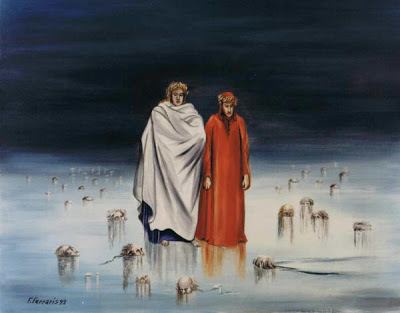
In our previous canto, Dante and Virgil have reached the pit of Hell, the bottom, the ninth circle where there is a frozen lake called Lake Cocytus. Within the lake, betrayers are punished. We’ve seen three areas of betrayal in the lake: betrayers of family, betrayers of country and betrayers of friends and guests. Such treachery has them frozen for eternity.
“And now, Vexilla regis prodeunt
Inferni – therefore, look,” my master said
As we continued on the long descent.
“And see if you can make him out, ahead.”
As though, in the exhalation of heavy mist
Or while night darkened our hemisphere, one spied
A mill – blades turning in the wind, half-lost
Off in the distance – some structure of that kind
I seemed to make out now. But at a gust
Of wind, there being no other shelter at hand,
I drew behind my leader’s back again.
By now (and putting it in verse I find
Fear in myself still) I had journeyed down
To where the shades were covered wholly by ice,
Showing like straw in glass – some lying prone,
And some erect, some with the head toward us,
And others with the bottoms of the feet;
Another like a bow, bent feet to face.
When we had traveled forward to the spot
From which it pleased my master to have me see
That creature whose beauty once had been so great,
He made me stop, and moved from in front of me.
“Look: here is Dis,” he said, “and here is the place
Where you must arm yourself with the quality
Of fortitude.” How chilled and faint I was
On hearing that, you must not ask me, reader –
I do not write it; words would not suffice:
I neither died, nor kept alive – consider
With your own wits what I, alike denuded
Of death and life, became as I heard my leader.

“Of these, frauds against kin, country, and guests constitute the lighter end of the scale, for they violate only socially obligated bonds—our culture expects us to love our family and our homeland and to be a good host. But fraud against a benefactor constitutes the worst fraud of all, according to Dante, for it violates a love that is purely voluntary, a love that most resembles God’s love for us. Correspondingly, one who betrays one’s benefactor comes closest to betraying God directly. Thus, the ultimate sinner, Judas Iscariot, was a man who betrayed both simultaneously, for his benefactor was Jesus Christ.” – SparkNotes.com
These souls constitute the most evil of all sinners—the betrayers of their benefactors. Their part of Lake Cocytus is called Judecca or Giudecca which means quarters of the Jews. Because they rejected Jesus Christ as their Messiah and the Son of God they betrayed Him to be crucified by the Romans. Judas Iscariot was a Jew and was His betrayer. He had been one of the Disciples but betrayed Jesus in the end.
In the center is Lucifer, Dis, Satan, Beelzebub, the Devil. Lucifer, once the most beautiful of created beings, betrayed his Creator. God had created him as one of the most beautiful angels and he was in the highest hierarchy of the angels. But he decided he wanted to be God and he rebelled, taking 1/3 of the angels with him (they became his demons). These scripture describe the fall of satan after his rebellion.
Isaiah 14:3-21 3 In that wonderful day when the LORD gives his people rest from sorrow and fear, from slavery and chains, 4 you will taunt the king of Babylon. You will say,
“The mighty man has been destroyed.
Yes, your insolence is ended.
5 For the LORD has crushed your wicked power
and broken your evil rule.
6 You struck the people with endless blows of rage
and held the nations in your angry grip
with unrelenting tyranny.
7 But finally the earth is at rest and quiet.
Now it can sing again!
8 Even the trees of the forest—
the cypress trees and the cedars of Lebanon—
sing out this joyous song:
‘Since you have been cut down,
no one will come now to cut us down!’
9 “In the place of the dead there is excitement
over your arrival.
The spirits of world leaders and mighty kings long dead
stand up to see you.
10 With one voice they all cry out,
‘Now you are as weak as we are!
11 Your might and power were buried with you.
The sound of the harp in your palace has ceased.
Now maggots are your sheet,
and worms your blanket.’
12 “How you are fallen from heaven,
O shining star, son of the morning!
You have been thrown down to the earth,
you who destroyed the nations of the world.
13 For you said to yourself,
‘I will ascend to heaven and set my throne above God’s stars.
I will preside on the mountain of the gods
far away in the north.
14 I will climb to the highest heavens
and be like the Most High.’
15 Instead, you will be brought down to the place of the dead,
down to its lowest depths.
16 Everyone there will stare at you and ask,
‘Can this be the one who shook the earth
and made the kingdoms of the world tremble?
17 Is this the one who destroyed the world
and made it into a wasteland?
Is this the king who demolished the world’s greatest cities
and had no mercy on his prisoners?’
18 “The kings of the nations lie in stately glory,
each in his own tomb,
19 but you will be thrown out of your grave
like a worthless branch.
Like a corpse trampled underfoot,
you will be dumped into a mass grave
with those killed in battle.
You will descend to the pit.
20 You will not be given a proper burial,
for you have destroyed your nation
and slaughtered your people.
The descendants of such an evil person
will never again receive honor.
21 Kill this man’s children!
Let them die because of their father’s sins!
They must not rise and conquer the earth,
filling the world with their cities.”
Ezekiel 28:1-19 (NLT) 1 And the word of the LORD came to me, saying, 2 “Son of man, tell the ruler of Tyre that this is what the Lord GOD says:
Your heart is proud,
and you have said,
‘I am a god;
I sit in the seat of gods
in the heart of the sea.’
Yet you are a man and not a god,
though you have regarded your heart
as that of a god.
3 Behold, you are wiser than Daniel;
no secret is hidden from you!
4 By your wisdom and understanding
you have gained your wealth
and amassed gold and silver
for your treasuries.
5 By your great skill in trading
you have increased your wealth,
but your heart has grown proud
because of it.
6 Therefore this is what the Lord GOD says:
Because you regard your heart
as the heart of a god,
7 behold, I will bring foreigners against you,
the most ruthless of nations.
They will draw their swords
against the beauty of your wisdom
and will defile your splendor.
8 They will bring you down to the Pit,
and you will die a violent death
in the heart of the seas.
9 Will you still say, ‘I am a god,’
in the presence of those who slay you?
You will be only a man, not a god,
in the hands of those who wound you.
10 You will die the death of the uncircumcised
at the hands of foreigners.
For I have spoken,
declares the Lord GOD.”
11 Again the word of the LORD came to me, saying, 12 “Son of man, take up a lament for the king of Tyre and tell him that this is what the Lord GOD says:
‘You were the seal of perfection,
full of wisdom and perfect in beauty.
13 You were in Eden,
the garden of God.
Every kind of precious stone adorned you:
ruby, topaz, and diamond,
beryl, onyx, and jasper,
sapphire, turquoise, and emerald.
Your mountings and settings were crafted in gold,
prepared on the day of your creation.
14 You were anointed as a guardian cherub,
for I had ordained you.
You were on the holy mountain of God;
you walked among the fiery stones.
15 From the day you were created
you were blameless in your ways—
until wickedness was found in you.
16 By the vastness of your trade,
you were filled with violence, and you sinned.
So I drove you in disgrace
from the mountain of God,
and I banished you, O guardian cherub,
from among the fiery stones.
17 Your heart grew proud of your beauty;
you corrupted your wisdom because of your splendor;
so I cast you to the earth;
I made you a spectacle before kings.
18 By the multitude of your iniquities
and the dishonesty of your trading
you have profaned your sanctuaries.
So I made fire come from within you,
and it consumed you.
I reduced you to ashes on the ground
in the eyes of all who saw you.
19 All the nations who know you
are appalled over you.
You have come to a horrible end
and will be no more.’”

Vexilla regis prodeunt inferni – The royal banners Hell appear. This is a play upon a Latin hymn by the Christian poet and saint Venantius Fortunatus, Bishop of Poitiers. The hymn was first sung in the procession on November 19, 569 when a relic of the True Cross, sent by the Byzantine Emperor Justin II from the East at the request of St. Radegunda, was carried in great pomp from Tours to her monastery of Saint-Croix at Poitiers. – Wikipedia
The vexilla regis is translated as royal banner but the word vexilla is actually for “little sail”. Satan’s wings are like windmill sails. So his “royal banners” are his bat-like wings, “I have never seen so broad a sail”.
Vexilla regis prodeunt, (The Banners of the King issue forth,)
fulget crucis mysterium, (the mystery of the Cross does gleam,)
quo carne carnis conditor (where the Creator of flesh, in the flesh,)
suspensus est patibulo. (from the cross-bar is hung.)
O Crux ave, spes unica, (O Cross! all hail! sole hope, abide)
Hoc passionis tempore (With us now in this Passion-tide:)
Auge piis justitiam, (New grace in pious hearts implant,)
Reisque dona veniam. (And pardon to the guilty grant.)
Te, summa Deus Trinitas, (Thee, mighty Trinity! One God!)
Collaudet omnis spiritus: (Let every living creature laud;)
Quos per crucis mysterium (Whom by the Cross Thou dost deliver,)
Salvas, rege per saecula. Amen. (O guide and govern now and ever! Amen.)
Dante has imagined Hell NOT as fire and brimstone, as in the Lake of Fire. But He envisions it as the opposite of God, the total absence of God – ice cold, frozen death. Total lack of God, alienation from God and all that goes with God (love), is cold and frozen death.
Notice that “Lucifer”, which means Light Bearer, is no longer bearing light. It’s hard for Dante to see what is in the center of the Lake. Virgil has to tell him to look and see if he can see him yet. Dante looks and tries to see through the heavy mist or fog and the darkness. He begins to see “a mill – blades turning in the wind, half-lost off in the distance – some structure of that kind I seemed to make out now.” But the wind that is generated by satan’s wings causes him to draw back behind Virgil for protection from the cold hurricane winds. This wind is created by satan’s windmilling wings and is symbolic of the wind of the Holy Spirit.
Acts 2:1-4 (BSB) 1 When the day of Pentecost came, they were all together in one place. 2 Suddenly a sound like a mighty rushing wind came from heaven and filled the whole house where they were sitting. 3 They saw tongues like flames of fire that separated and came to rest on each of them. 4 And they were all filled with the Holy Spirit and began to speak in other tongues as the Spirit enabled them.
Yet satan’s wind do not light fires in people’s hearts and bring life. His wind is frigid cold that hardens hearts and brings death. Lucifer doesn’t have just two wings, but six, two for each head, an inverted image of the six-winged seraphim.
Isaiah 6:1-3 (BSB) 1 In the year that King Uzziah died, I saw the Lord seated on a throne, high and exalted; and the train of His robe filled the temple. 2 Above Him stood seraphim, each having six wings: With two wings they covered their faces, with two they covered their feet, and with two they were flying. 3 And they were calling out to one another:
“Holy, holy, holy is the LORD of Hosts;
all the earth is full of His glory.”
Seraphim means “burning ones”. They are described as having each of them three pairs of wings, with one of which they covered their faces (a token of humility); with the second they covered their feet (a token of respect); while with the third they flew. The prophet Isaiah, Isaiah 6:2-3, represents them as reverently adoring the triune God, and burning with zeal to fly and execute his will. In the hierarchy of angels, the Cherubim are closer to God, being supporters of His Throne. The Seraphim are next as always attendant to do His Will.
Prior to his rebellion, Satan was a cherub (Ezekiel 28:12-15). The cherubim are first mentioned in the Bible in Genesis 3:24, “After He drove the man out, He placed on the east side of the Garden of Eden cherubim and a flaming sword flashing back and forth to guard the way to the tree of life.” Ezekiel 1 and Ezekiel 10 describe the “four living creatures” as the same beings as the cherubim (Ezekiel 10). Each had four faces—that of a man, a lion, an ox, and an eagle (Ezekiel 1:10; also 10:14)—and each had four wings. In their appearance, the cherubim “had the likeness of a man” (Ezekiel 1:5). Ezekiel’s cherubim are clearly related to the seraphim in Isaiah’s inaugural vision (Isaiah 6). Like the cherubim, the seraphim are the attendants on God as He is seated upon a throne high and exalted. They are attendants of God, bearers and movers of the Divine Throne. They are represented as four living creatures, each with four faces, man, lion, ox (replaced in the parallel chapter by cherub), and eagle (Ezekiel 1:10; Ezekiel 10:14), having the figure and hands of men (Ezekiel 1:5,8), and the feet of calves (Ezekiel 1:7). Each has four wings, two of which are stretched upward (Ezekiel 1:11), meeting above and sustaining the “firmament,” that is, the bottom of the Divine throne (Ezekiel 1:22; Ezekiel 10:1), while two are stretched downward, conformable the one to the other, so as to cover their bodies (Ezekiel 1:11,23). In appearance, the living creatures resemble coals of fire. The cherubim do not turn as they change direction, but always go straight forward (Ezekiel 1:9, 17; Ezekiel 10:11), as do the wheels of the cherubic chariot with rings full of eyes round about (Ezekiel 1:18; Ezekiel 10:12). The cherubim represent the spirit, or will, in the wheels: at the direction of the spirit, the wheels are lifted up from the bottom and the chariot moves upward (Ezekiel 1:19; Ezekiel 10:16). The cherubim are thus the moving force of the Throne. – Taken from International Standard Bible Encyclopedia (Cherubim) (The ophanim, also called galgalim, are the fiery, eye-covered wheels within a wheel because each is composed of two nested wheels, described in Ezekiel 1:15-21 with the Cherubim.)
Then Dante notices the figures frozen in the lake are completely submerged but Dante can still see them so the lake is clear as glass. He says, “the shades were covered wholly by ice, showling like straw in glass – some lying prone, and some erect, some with the head toward us, and others with the bottoms of the feet; another like a bow, bent feet to face”.
Finally they get to a point where Virgil stops Dante again and tells him to look, “Look, here is Dis.” He warns Dante to “arm yourself with the quality of fortitude.” Dante looks and for a minute he experiences animated death. His body is living but his mind cannot move, cannot proceed in thought. With shock he is neither dead nor alive for that moment, “I neither died, nor kept alive – consider with your own wits what I, alike denuded of death and life.”
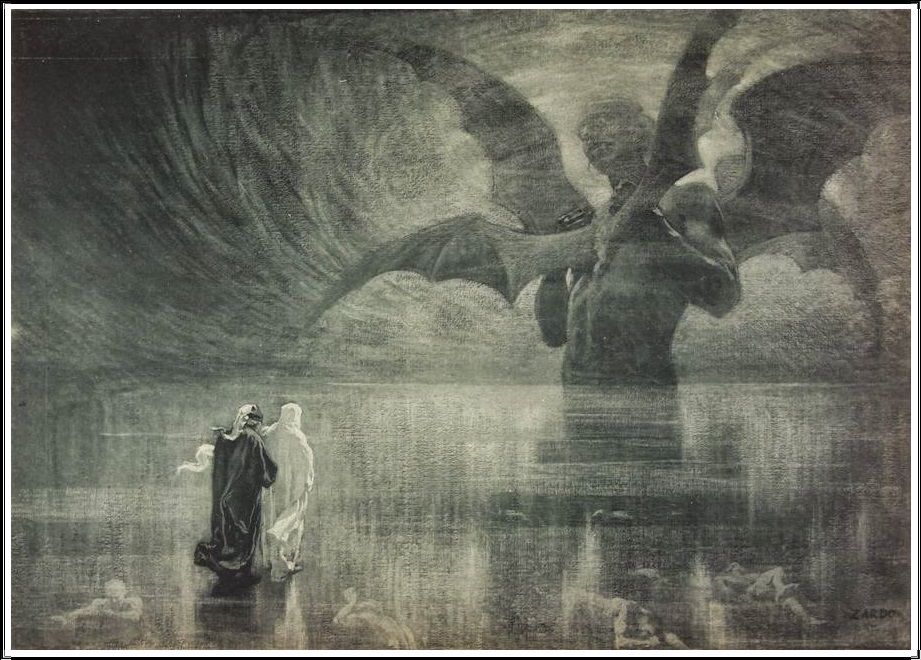
The emperor of the realm of grief protruded
From mid-breast up above the surrounding ice.
A giant’s height, and mine, would have provided
Closer comparison than would the size
Of his arms and a giant. Envision the whole
That is proportionate to parts like these.
If he was truly once as beautiful
As he is ugly now, and raised his brows
Against his Maker – then all sorrow may well
Come out of him. How great a marvel it was
For me to see three faces on his head:
In front there was a red one; joined to this,
Each over the midpoint of the shoulder, he had
Two others – all three joining at the crown.
That on the right appeared to be a shade
Of whitish yellow; the third had such a mien
As those who come from where the Nile descends.
Two wings spread forth from under each face’s chin,
Strong, and befitting such a bird, immense –
I have never seen at sea so broad a sail –
Unfeathered, batlike, and issuing three winds
That went forth as he beat them, to freeze the whole
Realm of Cocytus that surrounded him.
He wept with all six eyes, and the tears fell
Over his three chins mingled with bloody foam.
The teeth of each mouth held a sinner, kept
As by a flax rake: thus he held three of them
In agony. For the one the front mouth gripped,
The teeth were as nothing to the claws, which sliced
And tore the skin until his back was stripped.
“That soul,” my master said, “who suffers most,
Is Judas Iscariot, head locked inside,
He flails his legs. Of the other two, who twist
With their heads down, the black mouth holds the shade
Of Brutus: writing, but not a word will he scream;
Cassius is the sinewy one on the other side
Judas Iscariot was a disciple and one of the original Twelve Apostles of Jesus Christ. Although a specific scene of Jesus calling Judas is not included in the Gospels, as it is for others such as Philip, Nathaniel, and Peter, he is included in the list of the 12 from early on (Mark 3:19). The Bible says was the treasurer for the disciples (John 12:6; John 13:29). The Bible also reveals that Judas would take advantage of his position and steal. John 12:6 states, “he was a thief; as keeper of the money bag, he used to help himself to what was put into it.” Jesus’ friend Mary took a large quantity of expensive perfume, poured it over Jesus’ feet, and wiped His feet with her hair as an act of worship. Judas objected. “’Why wasn’t this perfume sold and the money given to the poor? It was worth a year’s wages.’ He did not say this because he cared about the poor but because he was a thief.” (John 12:5-6). Though his intentions seemed pure on the surface, he really wanted the money in the coffers so he could steal it. It was directly after this that Judas decided to betray Jesus.
Matthew 26:1-4 (BSB) 1 When Jesus had finished saying all these things, He told His disciples, 2 “You know that the Passover is two days away, and the Son of Man will be handed over to be crucified.”
3 At that time the chief priests and elders of the people assembled in the courtyard of the high priest, whose name was Caiaphas, 4 and they conspired to arrest Jesus covertly and kill Him. 5 “But not during the feast,” they said, “or there may be a riot among the people.”
Matthew 26:14-16 (BSB) 14 Then one of the Twelve, the one called Judas Iscariot, went to the chief priests 15 and asked, “What are you willing to give me if I hand Him over to you?” And they set out for him thirty pieces of silver. 16 So from then on Judas looked for an opportunity to betray Jesus.
Mark 14:10-22 (BSB) 10 Then Judas Iscariot, one of the Twelve, went to the chief priests to betray Jesus to them. 11 They were delighted to hear this, and they promised to give him money. So Judas began to look for an opportunity to betray Jesus.
Luke 22:3-6 (BSB) 3 Then Satan entered Judas Iscariot, who was one of the Twelve. 4 And Judas went to discuss with the chief priests and temple officers how he might betray Jesus to them. 5 They were delighted and agreed to give him money. 6 Judas consented, and began to look for an opportunity to betray Jesus to them in the absence of a crowd.
Mark 14:43-46 (BSB) 43 While Jesus was still speaking, Judas, one of the Twelve, arrived, accompanied by a crowd armed with swords and clubs, sent from the chief priests, scribes, and elders.
44 Now the betrayer had arranged a signal with them: “The One I kiss is the man; arrest Him and lead Him away securely.” 45 Going directly to Jesus, he said, “Rabbi!” and kissed Him. 46 Then the men seized Jesus and arrested Him.
Luke 22:47-48 (BSB) 47 While He was still speaking, a crowd arrived, led by the man called Judas, one of the Twelve. He approached Jesus to kiss Him. 48 But Jesus asked him, “Judas, are you betraying the Son of Man with a kiss?”
Matthew 27:3-8 (BSB) 3 When Judas, who had betrayed Him, saw that Jesus was condemned, he was filled with remorse and returned the thirty pieces of silver to the chief priests and elders. 4 “I have sinned by betraying innocent blood,” he said.
“What is that to us?” they replied. “You bear the responsibility.”
5 So Judas threw the silver into the temple and left. Then he went away and hanged himself.
6 The chief priests picked up the pieces of silver and said, “It is unlawful to put this into the treasury, since it is blood money.” 7 After conferring together, they used the money to buy the potter’s field as a burial place for foreigners. 8 That is why it has been called the Field of Blood to this day.


Marcus Junius Brutus (85BC – 23 October 42BC) was the son of Marcus Junius Brutus and Servilia. Marcus Brutus belonged to the last generation of Roman nobiles who came of age and began a political career before the collapse of the Republic. His peers included Mark Antony, Publius Licinius Crassus, Decimus Junius Brutus Albinus and Gaius Cassius Longinus. Brutus’ father was killed by Pompey the Great. His mother was the half-sister of Cato the Younger, and later Julius Caesar’s mistress. Although Julius Caesar was only 15 at the time Brutus was born, it was rumoured that Caesar was really Brutus’ father. Brutus’ uncle, Quintus Servilius Caepio, adopted him posthumously in about 59 BC, and Brutus was known officially for a time as Quintus Servilius Caepio Brutus before he reverted to using his birth-name. Brutus held his uncle in high regard and his political career started when he became an assistant to Cato, during his governorship of Cyprus. During this time, he enriched himself by lending money at high rates of interest. Brutus was also active in the province of Cilicia, in the year before Marcus Tullius Cicero was proconsul there; Cicero documents how Brutus profited from money lending. He returned to Rome a rich man, where he married Claudia Pulchra. From his first appearance in the Senate, Brutus aligned with the Optimates (the conservative faction). When Caesar’s Civil War broke out in 49 BC between Pompey and Caesar, Brutus followed his old enemy and the present leader of the Optimates, Pompey. At the time Brutus and Julius Caesar had a close relationship. When the Battle of Pharsalus began on August 9, Caesar ordered his officers to take Brutus prisoner if he gave himself up voluntarily, but to leave him alone and do him no harm if he persisted in fighting against capture. Caesar’s concern, given that he and Brutus’ mother Servilia had been lovers in their youth, was that Brutus might be his biological son. Even when Brutus joined Pompey the Great to fight with Caesar and his soldiers, Caesar’s main focus was Pompey, but he demanded Brutus be captured alive. After the defeat of the Optimates at the Battle of Pharsalus, Brutus surrendered and wrote to Caesar with apologies. Caesar immediately forgave him. Caesar then accepted him into his inner circle and made him governor of Gaul when he left for Africa in pursuit of Cato and Metellus Scipio. In 45 BC, Caesar nominated Brutus to serve as urban praetor for the following year. Also, in June 45 BC, Brutus divorced his wife and married his first cousin, Porcia Catonis, Cato’s daughter. Brutus failed to state a valid reason for his divorce from Claudia other than he wished to marry Porcia. Around this time many senators began to fear Caesar’s growing power, following his appointment as dictator in perpetuity. The other senators persuaded Brutus to join the conspiracy against Caesar. Eventually, Brutus decided to move against Caesar after Caesar’s alleged king-like behavior prompted him to take action. His wife was the only woman privy to the plot. The conspirators planned to carry out their plot on the Ides of March (March 15) that same year. On that day, Caesar was delayed going to the Senate because his wife Calpurnia tried to convince him not to go. The conspirators feared the plot had been found out. Brutus persisted, however, waiting for Caesar at the Senate, and allegedly still chose to remain even when a messenger brought him news that would otherwise have caused him to leave. When Caesar finally did come to the Senate, he was distracted by Tillius Cimber, who presented Caesar with a request to free his exiled brother. Caesar dismissed him, and Cimber subsequently grabbed his toga. “Why this violence?” Caesar asked. At this, the conspirators attacked Caesar. Publius Servilius Casca Longus was allegedly the first to attack him, with a stab to the shoulder, which Caesar blocked. However, upon seeing Brutus was with the conspirators, Caesar covered his face with his toga and resigned himself to his fate. The conspirators attacked in such numbers that they even wounded one another. Brutus is said to have been wounded in the hand and in the legs. After the assassination, the Senate passed an amnesty on the assassins. This amnesty was proposed by Caesar’s friend and co-consul Mark Antony. Nonetheless, uproar among the population against the assassins caused Brutus and the conspirators to leave Rome. Brutus settled in Crete from 44 to 42 BC. In 43 BC, after Octavian received his consulship from the Roman Senate, one of his first actions was to have the people who had assassinated Julius Caesar declared murderers and enemies of the state. icero, angry at Octavian, wrote a letter to Brutus explaining that the forces of Octavian and Mark Antony were divided. Antony had laid siege to the province of Gaul, where he wanted a governorship. In response to this siege, Octavian rallied his troops and fought a series of battles, culminating in the Battle of Mutina, in which Antony was defeated. Upon hearing that neither Mark Antony nor Octavian had an army large enough to defend Rome, Brutus rallied his troops, which totalled about 17 legions. When Octavian heard that Brutus was on his way to Rome, he made peace with Antony. Their armies, which together totalled about 19 legions, marched to meet Brutus and his ally, fellow assassin Gaius Cassius Longinus, thus beginning the Liberators’ civil war. The two sides met in two engagements known as the Battle of Philippi. The first was fought on October 3, 42 BC, in which Brutus defeated Octavian’s forces, although Cassius was defeated by Antony’s forces, and subsequently committed suicide. The second engagement was fought on October 23, and ended in Brutus’ defeat. After the defeat, Brutus fled into the nearby hills with only about four legions. Knowing his army had been defeated and that he would be captured, he committed suicide by running into his own sword, which was held by two of his men. – Wikipedia
Gaius Cassius Longinus (c. 86BC – 3 October 42BC) came from a very old Roman family, gens Cassia, which had been prominent in Rome since the 6th century BC. He studied philosophy at Rhodes under Archelaus of Rhodes and became fluent in Greek. He was married to Junia Tertia, who was the daughter of Servilia and thus a half-sister of his co-conspirator Brutus. They had one son, who was born in about 60 BC. Cassius returned to Rome in 50 BC, when civil war was about to break out between Julius Caesar and Pompey. Cassius was elected tribune of the Plebs for 49 BC, and threw in his lot with the Optimates. In 48 BC, Cassius sailed his ships to Sicily, where he attacked and burned a large part of Caesar’s navy. News of Pompey’s defeat at the Battle of Pharsalus caused Cassius to head for the Hellespont, with hopes of allying with the king of Pontus, Pharnaces II. Cassius was overtaken by Caesar en route, and was forced to surrender unconditionally. Caesar made Cassius a legate, employing him in the Alexandrian War against the very same Pharnaces whom Cassius had hoped to join after Pompey’s defeat at Pharsalus. However, Cassius refused to join in the fight against Cato and Scipio in Africa, choosing instead to retire to Rome. Cassius spent the next two years in office, and apparently tightened his friendship with Cicero. In 44 BC, he became praetor peregrinus with the promise of the Syrian province for the ensuing year. The appointment of his junior and brother-in-law, Marcus Brutus, as praetor urbanus deeply offended him. Although Cassius was “the moving spirit” in the plot against Caesar, winning over the chief assassins to the cause of tyrannicide, Brutus became their leader. Though they succeeded in assassinating Caesar, the celebration was short-lived, as Mark Antony seized power and turned the public against them. In letters written during 44 BC, Cicero frequently complains that Rome was still subjected to tyranny, because the “Liberators” had failed to kill Antony. Later Cassius was defeated and overrun by Antony and, unaware of Brutus’ victory, gave up all hope and killed himself with the very same dagger he had used against Julius Caesar. – Wikipedia

Isaiah 14:12 (BSB) “How you are fallen from heaven,
O shining star, son of the morning!
You have been thrown down to the earth,
you who destroyed the nations of the world.”
Luke 10:18 (BSB, Jesus speaking to his disciples) So He told them, “I saw Satan fall like lightning from heaven.
When satan was thrown to earth after his rebellion, this is where he landed. He was thrown with such force it created this crater, or funnel, of Hell with him frozen in the center of earth, the pit of Hell. What earth he displaced piled up on the other side to form Mount Purgatory.
Satan’s three faces symbolize the perversion of the Holy Trinity. The Trinity is God the Father, Jesus the Son and the Holy Spirit. The three are distinct but work in such unity and harmony together that they act as one, the Godhead three in one. Satan’s 3 faces are red, whitish yellow and black. Each head has a mouth with teeth like a “flax rake” that are devouring Judas Iscariot, Brutus and Cassius. The teeth flailing the skin off their backs. In comparison to the previous giants, he was huge! “If he was truly once as beautiful as he is ugly now, and raised his brows against his Maker – then all sorrow may well come out of him”. What he once was in beauty, he has now transitioned to it’s opposite.
Ezekiel 28:12b-14 (BSB) 12b ‘You were the seal of perfection,
full of wisdom and perfect in beauty.
13 You were in Eden,
the garden of God.
Every kind of precious stone adorned you:
ruby, topaz, and diamond,
beryl, onyx, and jasper,
sapphire, turquoise, and emerald.
Your mountings and settings were crafted in gold,
prepared on the day of your creation.
14 You were anointed as a guardian cherub,
for I had ordained you.
You were on the holy mountain of God;
you walked among the fiery stones.
Such beauty was lost with the ugliness of sin. Dante says he doesn’t wonder then that all sorrow progressed from satan’s downfall, “then all sorrow may well come out of him”. How could a created being, so beautiful and in such contact with God, betray God? If a Cherubim could, what hope did mankind have? We also betray our Creator and God and have since Adam and Eve. We fell to the same pride and desire to be God as satan did. But there is a difference and it’s a big one. God threw satan out of Heaven to earth and his end result will be the Lake of Fire for eternity. But God sent a Savior to save human beings from that same fate. He sent His Son, Jesus Christ, to take on the whole weight of sin and take the punishment for that sin and then Jesus rose again! He paid the price for us to be saved! I know that God knows what He is doing. I know that God knows all things past, present and future. So He had the plan of salvation from the ages past in order to save us. I deserve Hell but God planned for salvation. Jesus Christ wasn’t Plan B. He was always Plan A. I have no idea why God chose us to save. In the huge big picture of the universe, God had this plan of love to save you and I. Maybe we are to be a picture of God’s love, power and mercy to others in the universe and in eternal time? Maybe we are an example that He shows over and over again to others somewhere that He is a God of love, mercy and grace? Whatever the reason, it is above my pay grade and above my puny mind to comprehend. I am humbled and thankful for Jesus Christ and what He has done for me. I am thankful and full of worship and praise that I am saved and my eternity with Him is secured. Yours can be too!
Satan does not speak. All he does is flap his wings, cry and masticate on the 3 greatest betrayers. His teeth flail Judas’ back like the back of Jesus was flailed by the Roman soldiers.
Matthew 13:36-43 (BSB) 36 Then Jesus dismissed the crowds and went into the house. His disciples came to Him and said, “Explain to us the parable of the weeds in the field.”
37 He replied, “The One who sows the good seed is the Son of Man. 38 The field is the world, and the good seed represents the sons of the kingdom. The weeds are the sons of the evil one, 39 and the enemy who sows them is the devil. The harvest is the end of the age, and the harvesters are angels.
40 As the weeds are collected and burned in the fire, so will it be at the end of the age. 41 The Son of Man will send out His angels, and they will weed out of His kingdom every cause of sin and all who practice lawlessness. 42 And they will throw them into the fiery furnace, where there will be weeping and gnashing of teeth. 43 Then the righteous will shine like the sun in the kingdom of their Father.
His red face indicates his anger and hatred. His whitish yellow face indicates impotence and his black face indicates ignorance. He cannot move from this place. He is animated death. As satan transitioned from a beautiful Cherubim into this horrible monstrosity, so now Dante, the poet, transitions Dante, the pilgrim and Virgil.

But night is rising again, and it is time
That we depart, for we have seen the whole.”
As he requested, I put my arms round him,
And waiting until the wings were opened full
He took advantage of the time and place
And grasped the shaggy flank, and gripping still,
From tuft to tuft descended through the mass
Of matted hair and crusts of ice. And then,
When we had reached the pivot of the thighs,
Just where the haunch is at it’s thickest, with strain
And effort my master brought around his head
To where he’d had his legs: and from there on
He grappled the hair as someone climbing would –
So I supposed we were heading back to Hell.
“Cling tight, for it is stairs like these,” he sighed
Like one who is exhausted, “which we must scale
To part from so much evil.” Then he came up
Through a split stone, and placed me on it’s sill,
And climbed up toward me with his cautious step.
I raised my eyes, expecting I would see
Lucifer as I left him – and saw his shape
Inverted, with his legs held upward. May they
Who are too dull to see what point I had passed
Judge whether it perplexed me.
Dante and Virgil had begun the trek down through the circles of Hell and made it all the way to the bottom where satan is encased in Lake Cocytus. Now Virgil has to take Dante past satan and the center of the earth. He takes hold of Dante and waits for the rhythm of the wings to give them a clear spot and he dashes to satan and begins to climb down, “from tuft to tuft descended through the mass of matted hair and crusts of ice.” But at satan’s haunches, Virgil turns around. Dante, holding onto to Virgil, thinks Virgil has turned to climb back to Lake Cocytus. But it’s the center of the earth, so when Virgil turns and begins ascending and climbing up, he’s actually climbing towards the opposite side of the earth, “and from there on he grappled the hair as someone climbing would”. When he reaches the end of the climb on satan’s person, Dante gets off and looks to find satan inverted. Instead of his head and chest, Dante is looking at Satan’s feet. They passed the center of gravity and experience inversion. What was upside down is now right side up.
Dante is not only transitioning from Hell back to earth, but he is passing from a state of death to the state of living in God’s forgiveness. He is transitioning from fear of Hell to fear of God. Dante’s thinking has transitioned from upside down to right side up. He was in a state of becoming from sinner to saint. He is making that transition. Having seen Hell and it’s punishments has changed his mind about sin and this is repentance.

“Come – the way
Is long, the road remaining to be crossed
Is hard: rose to your feet,” the master said,
“The sun is at mid-tierce.” We had come to rest
In nothing like a palace hall; instead
A kind of natural dungeon enveloped us,
With barely any light, the floor ill made.
…
There is below,
As far from Beelzebub as one can be
Within his tomb, a place one cannot know
By sight, but by the sound a little runnel
Makes as it wends the hollow rock its flow
Has worn, descending through its winding channel:
To get back up to the shining world from there
My guide and I went into that hidden tunnel;
And following its path, we took no care
To rest, but climbed: he first, then I – so far,
Through the round aperture I saw appear
Some of the beautiful things that Heaven bears,
Where we came forth, and once more saw the stars.
Everything is righted now through Jesus Christ, “Now you are on the opposite continent beneath the opposite hemisphere to that which canopies the great dry land therein: under the zenith of that one is the site whereon the Man was slain who without sin was born and lived”. He left and descended into Hell in the evening but now he’s coming out and it’s morning. He is no longer in satan’s upside down world. While satan, his demons and the unrepentant sinners are fixed in Hell forever, Dante has transitioned spiritually and left Hell behind. He is born again!
“Notable is Dante’s myth-making at the end of Inferno, as he explains how Lucifer’s fall creates both Hell and Purgatory. Lucifer’s fall is the sin that created Hell, but God, simultaneously, used that fall to create the remedy: Purgatory. Lucifer fell and the earth fled him, leaving an ’empty space’ where it had been: ‘per fuggir lui lasciò loco vòto’ (to flee from him it left this empty space [Inf. 34.125]). Thus Lucifer excavated the earth and created the empty cone of Hell. Having fled Lucifer, the displaced earth became Mount Purgatory, a cone of earth that rises up in the middle of the southern hemisphere. Dante is the first to conceive of Purgatory as a mountain.” – DigitalDante.columbia.edu
Excerpts from Dante’s Inferno are from a new translation by Robert Pinsky


No comments:
Post a Comment