

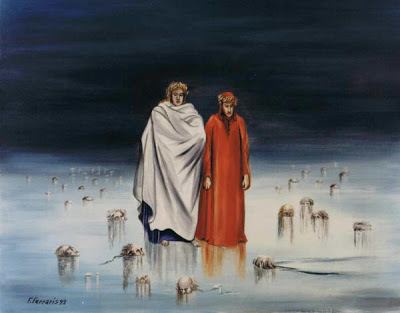
In Canto 31, Virgil and Dante came upon a ring of giants on the edge of the eighth circle. One of the giants, Antaeus, lifted them down to the bottom of the universe and this is where we find them in Canto 32. In the ninth circle of Hell, Lake Cocytus, Dante has trouble finding the words to describe the horror.

If I had harsh and grating rhymes, to befit
That melancholy hole which is the place
All the other rocks converge and thrust their weight
Then I could more completely press the juice
From my conception. But since I lack such lines,
I feel afraid as I come to speak of this:
It is not jokingly that one begins
To describe the bottom of the universe –
Not a task suited for a tongue that whines
Mamma and Dadda. May the muses help my verse
As when they helped Amphion wall Thebes, so that
Word not diverge from fact as it takes its course.
Dante wishes he had language that would describe what he sees. He wishes his language could effectively represent the raw harshness he sees around him. The poet wants his language to be commensurate with the reality described. Dante will attempt to use language to express what he’s seeing but the language of humans, of children, of love and life, is inappropriate to such a scene. “If I had harsh and grating rhymes, to befit that melancholy hole”. Another translation is, “Had I the crude and scrannel rhymes so suit the melancholy hole”. Henry Wadsworth Longfellow translated it as, “If I had rhymes both rough and stridulous, as were appropriate to the dismal hole”. I had to look up those two words:
Scrannel – slight; thin; lean; poor; producing a weak, screeching noise; squeaking
Stridulous – Characterized by or making a harsh, shrill grating sound or noise
This makes me think of “speaking in tongues”. Of course it’s the opposite of what Dante is talking about. As a Christian baptized in the Holy Spirit, I have been given the gift of speaking in tongues. We believe it is the language used in Heaven. There is the gift of speaking in a human language that you hadn’t grown up speaking. If I can learn a different language than my own, it is a gift from God. He has gifted me with the ability to easily learn and use different languages. Or God may even give me a sudden ability to speak in a different human language for His specific purposes. But “speaking in tongues” is a heavenly language, not a human language. We believe it is our spirit communicating with God in His own language. Human language is inadequate to express the wonders, the love, the unity, the purity of communicating with God. So we slip into our Heavenly language. We don’t understand, with our intellect, what we are saying because it’s our spirit responding and communicating directly to God. While it is between us and God, there isn’t a need for any interpretation. We are communing with our Father. But if it’s done loudly in a public setting, there is need of interpretation so others can be edified with understanding. God sometimes uses others to speak to the congregation in His language, He will also give an interpretation so that we may understand. But if it’s a private communication with God, there is no need for interpretation. It is just our spirit communing with our God. My dog doesn’t speak English and I don’t speak dog. But he can sit in my lap and we communicate our love back and forth without understanding a word we are saying. Our body language, our voice modulation, our eye contact, everything is flowing in a back and forth river of love. And it’s the same with your children. When they are babies, they don’t understand what you are saying and they can’t speak and talk to you. But you can hold your child and the love flows back and forth between the two of you in some type of unspoken language. That’s what speaking in tongues is with our God.
Acts 10:46-47 46 For they heard them speaking in tongues and exalting God. Then Peter said, 47 “Can anyone withhold the water to baptize these people? They have received the Holy Spirit just as we have!”
Romans 8:26 Likewise the Spirit helps us in our weakness. For we do not know what to pray for as we ought, but the Spirit himself intercedes for us with groanings too deep for words.
1 Corinthians 14:1-5;14-15;18 1 Earnestly pursue love and eagerly desire spiritual gifts, especially the gift of prophecy. 2 For he who speaks in a tongue does not speak to men, but to God. Indeed, no one understands him; he utters mysteries in the Spirit. 3 But he who prophesies speaks to men for their edification, encouragement, and comfort. 4 The one who speaks in a tongue edifies himself, but the one who prophesies edifies the church. 5 I wish that all of you could speak in tongues, but I would rather have you prophesy. He who prophesies is greater than one who speaks in tongues, unless he interprets so that the church may be edified… 14 For if I pray in a tongue, my spirit prays, but my mind is unfruitful. 15 What then shall I do? I will pray with my spirit, but I will also pray with my mind. I will sing with my spirit, but I will also sing with my mind… 18 I thank God that I speak in tongues more than all of you.
Amphion, son of Zeus and Antiope, and twin brother of Zethus. Together they are famous for building Thebes.
O horde, beyond all others ill-begot,
Who dwell in that place so hard to speak about:
Better for you to be born a sheep or goat!
When we were deep in the darkness of the pit
Beneath the giant’s feet, much farther down,
And I still gazed back up the high wall of it:
“Watch how you step,” I heard a voice intone,
“Be careful that you do not set your feet
On the weary, wretched brothers’ heads.” Whereon
I turned, and saw before me and underfoot
A lake that ice made less like water than glass;
In Austria, never has the Danube set
So thick a veil above its current as this,
Nor, under its cold sky, has the far-off Don:
Had Mount Tambernic fallen to strike that ice,
Or Pietrapana, it would not even then
Creak, even at its edge. As the frog lies
Snout above water to croak in the season when,
The peasant woman often has reveries
Of gleaning, spirits – livid to where the cheeks
Turn color with shame – were locked inside the ice,
Teeth chattering the note a stork’s beak makes.
Each held his face turned down; they testified
Cold by their mouths, and misery by the looks
Their eyes bore.


Mount Tambernic has not been identified. Mount The lake ice is so thick that mountains of rock could fall upon it’s edge and still not crack the ice. The ice is like glass, mirror-like. The shades are frozen in place with their heads looking down. They are forced to see themselves in the mirror of ice, forced to see the sin in themselves. The whole atmosphere is one of cold – ice cold, stone cold. It’s frigid, lacking any warmth of life or love.

Mount Pietrapana has been identified as the mountain now called Pania Della Croce.

The ninth circle is a continuation of the eighth, which features sinners who deceived people with whom they shared special bonds of trust; fraud practiced on those who trusted; betrayal; treachery. Betrayal, by definition, is based on a lack of love. Lake Cocytus contains four kinds of betrayals: betrayal of family, betrayal of country, betrayal of friends and guests, betrayal of benefactors. Like ripples in a pool, there are four subtle divisions that bleed into each other. Their bodily positions determine where they are in the circles of Lake Cocytus.
After a time while I surveyed
The scene around me, I glanced down at my feet,
And saw two shades there packed in head to head
So tightly that their hair was interknit
“O you whose breasts are pressed together,” I said,
“Who are you?” They bent back their necks at that,
And having raised their faces to me, they shed
Tears, welling now from eyes already moist
To flow down over their lips, where the frost glued
Each to the other, ever more tightly fused:
Iron clamps never held beam to beam so fast –
And like two goats, each butted the one he faced
In a helpless rage. Another, who had lost
Both ears to frost, spoke with his face still down:
“Why stare at us so long? If you insist
On knowing who these two are, the valley wherein
Bisenzio’s stream begins its long descent
Once was their father Albert’s and their own,
They issue from one body, and if you went
All over Caina you could not find a shade
Worthier to be frozen in punishment:
Not him whose breast and shadow the impaling blade
In Arthur’s hand pierced with one stroke; nor him
They called Focaccia; nor this other whose head
So blocks me I can see no farther: his name,
Sassol Mascheroni, is one you recognize
If you are Tuscan. And – so you need not claim
Any more speech of me – my own name was
Camiscion de’ Pazzi and this is where I await
Carlino’s coming to make my sin seem less.”
I saw a thousand faces after that,
All purple as a dog’s lips from the frost:
I still shiver, and always will, at the sight
Of a frozen pond. All through the time we progressed
Toward the core where all gravity convenes,
I quaked in that eternal chill; and next –
The first section of Cocytus, devoted to the betrayal of family, is called “Caina” after biblical Cain who killed his brother Abel, committing fratricide. Caina is first mentioned in Inferno, Canto 5. In Canto 5, Francesca da Rimini refers to her husband, Gianciotto Malatesta, who was guilty of killing her and his brother, her lover Paolo, and was thus destined to join the traitors of family. “Caina waits for him who took our life”. Gianciotto’s son Ramberto would later kill Paolo’s son Uberto by inviting him to dinner and attacking him.



The two sons of the Florentine noble Alberto degli Alberti V and Gualdrada Guidi were Napoleon and Alessandro, Counts of Mangona. Guglielmo was a third brother. Napoleon was probably the eldest and embraced the Ghibelline cause. Alessandro who was a Guelph. They always fought. Among other holdings, they inherited a castle in the Val di Bisenzio from their father in 1250. Count Alberto, for reasons that are not known to us, left the greater part of his patrimony and possessions to his two younger sons, disinheriting Napoleon, the eldest. He bequeathed only one tenth of his estate to Napoleon and the remaining nine tenths to Alexander and Guglielmo. They disputed over their inheritance. An oath of peace imposed on the two brothers by Cardinal Latino Malabranca Orsini in 1280 was of no use. They killed each other in a fight after 1282. Peace was made between the children in 1286. – Wikipedia
“Not him whose breast and shadow the impaling blade in Arthur’s hand pierced with one stroke” – Mordred was a character who is variously portrayed in the Arthurian legend. The earliest known mention of a possibly historical Medraut is in the Welsh chronicle Annales Cambriae, wherein he and Arthur are ambiguously associated with the Battle of Camlann in a brief entry for the year 537. This brief entry gives no information as to whether Mordred killed or was killed by Arthur, or even if he was fighting against him. Later, Mordred was depicted as Arthur’s traitorous nephew and a legitimate son of King Lot in Geoffrey of Monmouth’s pseudo-historical work Historia Regum Britanniae which then served as the basis for the following evolution of the legend since the 12th century. Later variants most often characterised him as Arthur’s villainous bastard son, born of an incestuous relationship with his half-sister, the Queen of Orkney named either Anna, Orcades or Morgause. In The Death of Arthur, Arthur is told prophecy by Merlin about a just-born child that is to be his undoing, and so he tries to avert the fate by ordering the killing of all the May Day newborns. This episode leads to a war between Arthur and the furious King Lot, believing he was Mordred’s father, in which the latter king dies at the hands of Arthur’s vassal king Pellinore. Yet, unknown to both kings, the baby Mordred actually miraculously survived. As told by Malory, Mordred is accidentally found and rescued by a man who then raises him until he is 14. The 14th-century Scottish chronicler John of Fordun claimed that Mordred was the rightful heir to the throne of Britain, as Arthur was an illegitimate child (in his account, Mordred was the legitimate son of Lot and Anna, who here is Uther’s sister). In Le Morte d’Arthur, Mordred is knighted by Arthur and joins the fellowship of the Round Table. In this narrative, he eventually becomes the main actor in Arthur’s downfall as he helps his half-brother Agravain to expose Guinevere’s and Lancelot’s affair and then takes advantage of the resulting war to make himself the high king of Britain. He becomes a friend and companion of the great knight Lancelot. His turning point toward evil is hearing an old priest’s prophecy for him and Lancelot, revealing his true parentage and predicting their roles in the ruin of the kingdom. However, the angry Mordred kills the priest before he could warn Arthur, and while Lancelot does tell Guinevere, she refuses to believe in it and does not banish Mordred. The Prose Lancelot indicates Mordred was about 22 years old at the time (two years into his knighthood). In Le Morte d’Arthur features the Battle of Camlann scene where they meet on foot as Arthur charges Mordred and runs a spear through him. With the last of his strength, Mordred impales himself even further to be within striking distance, and lands a mortal blow with his sword to King Arthur’s head. – Wikipedia
Focaccia was the nickname for Vanni de’ Cancellieri. He was a White Guelph of Pistoia who killed his cousin, Detto de’ Cancellieri.
Sassol Mascheroni – of the Florentine family of Toschi, killed his nephew (or possibly his brother) to obtain an inheritance.
Alberto Camicione de ‘Pazzi – belonging to the Pazzi family of Valdarno (different from that of the Pazzi of Florence). He treacherously killed Ubertino de ‘Pazzi, his relative, to obtain some castles that they held in common. He took a bribe to surrender it treacherously. He died in 1302.
Caina was named after Cain in the Biblical story of Cain and Abel.
Genesis 4:1-17 (NLT) 1 Now Adam had sexual relations with his wife, Eve, and she became pregnant. When she gave birth to Cain, she said, “With the LORD’s help, I have produced a man!” 2 Later she gave birth to his brother and named him Abel.
When they grew up, Abel became a shepherd, while Cain cultivated the ground. 3 When it was time for the harvest, Cain presented some of his crops as a gift to the LORD. 4 Abel also brought a gift—the best portions of the firstborn lambs from his flock. The LORD accepted Abel and his gift, 5 but he did not accept Cain and his gift. This made Cain very angry, and he looked dejected.
6 “Why are you so angry?” the LORD asked Cain. “Why do you look so dejected? 7 You will be accepted if you do what is right. But if you refuse to do what is right, then watch out! Sin is crouching at the door, eager to control you. But you must subdue it and be its master.”
8 One day Cain suggested to his brother, “Let’s go out into the fields.” And while they were in the field, Cain attacked his brother, Abel, and killed him.
9 Afterward the LORD asked Cain, “Where is your brother? Where is Abel?”
“I don’t know,” Cain responded. “Am I my brother’s guardian?”
10 But the LORD said, “What have you done? Listen! Your brother’s blood cries out to me from the ground! 11 Now you are cursed and banished from the ground, which has swallowed your brother’s blood. 12 No longer will the ground yield good crops for you, no matter how hard you work! From now on you will be a homeless wanderer on the earth.”
13 Cain replied to the LORD, “My punishment is too great for me to bear! 14 You have banished me from the land and from your presence; you have made me a homeless wanderer. Anyone who finds me will kill me!”
15 The LORD replied, “No, for I will give a sevenfold punishment to anyone who kills you.” Then the LORD put a mark on Cain to warn anyone who might try to kill him. 16 So Cain left the LORD’s presence and settled in the land of Nod, east of Eden.
17 Cain had sexual relations with his wife, and she became pregnant and gave birth to Enoch. Then Cain founded a city, which he named Enoch, after his son.
Why didn’t God accept Cain’s offering? Because Cain offered what Cain wanted to offer NOT what God required. Remember after Adam and Eve sinned, God covered them with animal skins. That meant God had to make an offering and kill the animals to get the animal skins (Genesis 3:21). He made the offering on their behalf. Adam and Even knew this and knew it had to be a blood offering. They would have taught this to their sons. Abel brought what God required, a blood sacrifice. It had to be the best and without any blemish. Cain knew this but brought from his crops, NOT a blood sacrifice.
God gave Cain the chance to repent by asking him, “Why are you angry?” But recalcitrant Cain did NOT repent, he just shifted blame to Abel. Basically, “You love Able more than me”. Which is ridiculous. Very childish and immature. When you have a child that is obedient and a child that is disobedient, you correct them. It has nothing to do with who you love more or less, it is about correcting bad behavior. And the correction is for their good in the long run. You wouldn’t be a good parent if you didn’t try to correct bad behavior that would cause them trouble. But how often does the disobedient child, in his truculence and sullenness, come back with a silly retort like, “You love him better than me.”
Cain did not repent and Cain misplaced his anger by focusing on Abel. He became so jealous and obsessed with hate that he planned his ruse and murdered him. Premeditated murder. God could have stricken Cain down right then and there but He went to Cain again and asked him a question to try and get Cain to repent. “Where is Abel? Where is your brother? What have you done?” Cain refuses to repent and just says, “Am I my brother’s keeper?” God confronts him with truth, “Your brother’s blood cries out to Me from the ground.” Still Cain refuses to repent. So God sentences him with the curse: “Now you are cursed and banished from the ground, which has swallowed your brother’s blood. No longer will the ground yield good crops for you, no matter how hard you work! From now on you will be a homeless wanderer on the earth.”
No one knows what the mark of Cain was.
A judgment on Cain and his descendants with respect to their labors. Their tillage of the ground was not to prosper, which ultimately, Bonar thinks, drove the Cainites to city-building and mechanical invention. – Pulpit Commentary
and next –
I don’t know whether by will or fate or chance –
Walking among the heads I struck my foot
Hard in the face of one, with violence
That set him weeping as he shouted out
“Why trample me? And if you have not come
To add more vengeance for Montaperti’s defeat,
Then why do you molest me?” I turned from him;
“Master,” I said, “I pray you: wait for me here
While I resolve a doubt concerning his name;
Then you shall hurry me on as you desire.”
My leader stopped, and I addressed the shade
What was still cursing as bitterly as before:
“And who are you who reviles another?” I said.
“Nay, who are you,” he answered, “who thus contrive
To go through Antenora striking the head
And cheeks of others – which even were you alive
Would be too much,” “Alive is what I am,”
I told him, “and if fame is what you crave,
Then you might value having me note your name
Among the others.” He answered, “What I desire
Is quite the opposite – get you gone, and come
To trouble me no more, inept as you are,
Not knowing how to flatter at this great depth.”
Then I reached out and seized him by the hair
And shook his scruff, “Now name yourself forthwith –
Or not a hair will remain,” I threatened him.
He answered, “Though you pluck me bald in your wrath,
I will not tell you nor show you who I am,
Not if you fall a thousand times on my pate,”
Already I had twisted round my palm
A length of hair, and pulled some clumps right out,
And he was barking, with his eyes held down,
When a new voice called: “Bocca, what is it –
What ails you? Are you so weary of the tune
Your jaws create that now you are barking, too?
What devil is at you?” “Now,” said I, “I am done:
I have no further need to speak with you,
Accursed traitor, for now, to your disgrace,
I will report about you what is true.”
“Then go away,” he answered, “tell what you choose –
But don’t be silent, if you do get out,
About that one so quick just now to use
His tongue. Here he laments the silver he got
From Frenchmen’s hands. ‘I saw him,’ you can declare,
‘The man of Duera, down where the sinners are put
To cool.’ And if they ask who else was there,
The man of Beccheria is at your side,
Whose gullet was slit by Florence. Also here
A little farther along your way, reside
Gianni de’ Soldanieri with Ganelon.
And Tebaldello who opened Faenza wide
While it was asleep.” We had left him, moving on,
Antenora is the second zone of Cocytus in which traitors to one’s party or homeland are found. Antenora is named after the Trojan Antenore who betrayed Troy to the Greeks. These political traitors’ faces look out whereas the ones in Caina looked downward.
The Battle of Montaperti occurred on September 4th, 1260. The battle, commonly known as the bloodiest day of the Italian Middle Ages. The Guelphs, who by 1260 had gained influence over Florence, aligned themselves with the Papacy, whereas the Ghibellines, who had power in Siena, supported the Holy Roman Empire. The two cities had signed ‘an eternal peace” on July 31st, 1255. But by early fall of 1260, the Florentines and their Tuscan allies assembled an army of 35,000 and marched towards Siena. Siena, led by a Ghibelline who had been exiled from Florence named Farinata degli Uberti, summoned only 20,000 men, but prepared to defend their city all the same. The armies met at a hill later called Montaperti (hill of death). In the traditional battle stratagem of the era, both armies focused on overtaking the opposing ‘Carroccio’, or, “the holy wagon that always accompanied medieval Italian armies, where priests celebrated mass during the battle.” The battle waged on for the entire day, proving to be a stalemate, despite the superior numbers of the Florentines. Bocca degli Abati was a Florentine nobleman of Ghibelline faction and it is said that he turned the tide. He fought among the Guelphs in the Battle of Montaperti (1260) and during the assault of Manfredi’s German troops he was in the ranks of the Guelph cavalry near Jacopo de ‘Pazzi who was holding the banner leading the line. Bocca degli Abati, although with the Florentine Guelphs, due to complicated interests and alliances, was actually a Ghibelline. Seeing the Sienese counterattack, Bocca degli Abati made his way across the Florentine line, found the standard bearer, Jacopo de ‘Pazzi, and cut off the hand holding the standard allowing the flag to fall to the ground. Panic ensued and the Sienese seized the moment. The battle swayed permanently in favor of Siena, and the Florentines were hurt with heavy losses. He returned to Florence; but after the revenge of the Guelph side when they returned to the city, he was simply exiled (in 1266), a sign that, at least at the time, there was not enough evidence to blame him for the betrayal of the standard. He had died by 1300. Dante believed he was a traitor and the story was true. Siena had 1,800 cavalry and 18,000 foot soldiers, while Florence had 3,000 cavalry and 30,000 foot soldiers. In the end the losses for Siena were 600 dead and 400 wounded and the losses for Florence were 10,000 dead and 15,000 prisoners. The Ghibelline commanders give the order to save the life of those who had surrendered, however killing all the Florentines who had been captured. The latter, having heard the commands of the other side, erased the signs of recognition from their clothes and mingled with their allies to save their lives. The sack at the Guelph camp allowed the Ghibellines to capture almost 18,000 animals including horses, oxen and pack animals. The flags and banners of the Florentines were taken and the banner of Florence itself was attached to the tail of a donkey and dragged through the dust. Among the booty that the Sienese captured after the battle there is also the well-known “Book of Montaperti”, a unique document for the entire European Middle Ages, given that in it all the writings were transcribed by dozens of notaries who accompanied the Guelph army on the mobilization, administration and government of the Florentine army during the march towards enemy territory. The “Book of Montaperti” was kept in the archives of the municipality of Siena until 1570, when Count Federico da Monteacuto, to ingratiate himself with Grand Duke Cosimo I, brought the manuscript to Florence, where, it now resides at the State Archives. On 13 September 1260 the Florentine Guelphs abandoned their city and took refuge in Bologna and Lucca , considering that they could no longer stay in Florence for fear of reprisals from the Ghibellines. The Guelphs of the other cities participating in the defeated league also took refuge in Lucca. All citizens were made to swear allegiance to King Manfred. The towers and houses of the Guelph Florentines were razed to the ground, as had been done against the Ghibellines in 1258. After Montaperti, on November 18, Pope Alexander IV excommunicated all supporters of King Manfredi in Tuscany. On May 25, 1261, Pope Alexander IV died. ithin a few years, the Guelph faction regained power in Tuscany and already in 1269, three years after the death of Manfredi in Benevento by the Angevins, Siena suffered a serious defeat by Florence in the Battle of Colle, during which the Sienese commander Provenzano Salvani himself died. – Wikipedia and Middlebury.edu


Buoso da Duera was son of Girardode Clochaferi. He was lord of Soncino and then, from 1247, of Cremona. He ruled Cremona with Uberto Pallavicino. He was first a friend and then an opponent of Ezzelino da Romano. In 1265 Manfred of Swabia, king of Sicily, commissioned him to gather militias against the French of Charles of Anjou to prevent them from passing the Oglio to Soncino: a passage that took place fifteen miles further north, in Palazzolo. But some chroniclers endorsed the rumor that in exchange for money he had given way to the French who were heading towards the battlefield of Benevento where the historic battle (in 1266) occurred which ended with the death of the same Manfred of Sicily. He was seduced by the gold of Guido di Monforte and opened the passage of Oglio to the French. – Wikipedia
“Dante offers both a Ghibelline traitor (Buoso da Duera) and a Guelph traitor (Bocca degli Abati), but his personal passionate hatred is reserved for the Guelph.” – DigitalDante.columbia.edu
Tesauro dei Beccheria was a descendant of the noble and important Pavia family of the Beccaria. Born in Pavio, he entered the community of Vallombrosani, a branch of the Benedictine order, becoming its abbot general. Pope Alexander IV sent him to Florence, as papal legate, with the task of seeking an agreement between the Guelph and Ghibelline factions of the city. After the death of Frederick II (1250), the Guelph faction had taken over Florence, carrying out a long series of vendettas and purges which culminated in the exile of the Ghibelline families and the destruction of their homes. He was possibly appointed Cardinal in 1255. In 1258 Tesauro Beccaria was arrested on the charge of having secretly negotiated with Manfredi to favor the return of the Ghibellines to Florence. Tried and sentenced to death, on 4 (or 12) September 1258 he was executed by beheading. – Wikipedia
Gianni de ‘Soldanieri was of a Florentine Ghibelline family who changed to the Guelph side after the defeat in the Battle of Benevento and the death of Manfred (1266). – Wikipedia
Ganelon was the betrayer of Roland. See Canto XXXI.
Tebaldello Zambrasi was an Italian nobleman belonging to a Ghibelline family. On 13 November 1280 he betrayed his city, Faenza, by throwing open its doors at night to the Bolognese of the Geremei family, apparently to take revenge for an offense received by the Ghibelline Lambertazzi from Bologna who had just taken refuge in Faenza. He died in 1282 attacking Forlì in the battle where the Ghibellines led by Guido da Montefeltro managed to defeat the French troops sent by the pope to conquer one of the last Ghibelline enclaves in Italy. – Wikipedia
We had left him, moving on,
When I saw two shades frozen in a single hole –
Packed so close, one head hooded the other one;
The way the starving devour their bread, the soul
Above had clenched the other with his teeth
Where the brain meets the nape. And at the skull
And other parts, as Tydeus berserk with wrath
Gnawed at the head of Menalippus, he chewed,
“You, showing such bestial hatred for him beneath,
Whom you devour: tell me your reason.” I cried,
“And, on condition that your grievance is right,
Knowing both who you are and what wrong deed
This one committed against you, I may yet
Repay you for whatever you may say,
Up in the world above – by telling it,
If that with which I speak does not go dry.”


Tydeus was a son of Oeneus and either Periboea, Oeneus’s second wife, or Gorge, Oeneus’s daughter. He was the husband of Deipyle, the mother of Diomedes.He was the father of Diomedes and one of the Seven against Thebes. Tydeus was banished from Calydon by his uncle Agrius for murder and it was here he met Deipyle. While housing Tydeus, King Adrastus of Argos also lodged Polynices, the exiled son of Oedipus who had shared the rule of Thebes with his brother Eteocles before he was expelled by the latter. Late one night, the two young exiles got into a fierce dispute over the guest room in Adrastus’s palace. Awakened by the clamor, Adrastus rushed to the hall to find the two men locked in a brawl. It was then that Adrastus recalled a prophecy that had instructed him to “yoke his daughters to a boar and a lion”. Adrastus recognized Tydeus as the boar and Polynices as the lion. He wed his daughters to them, keeping them as his sons-in-law in Argos. Through marriage into Adrastus’s family, Polynices and Tydeus became princes of Argos. Adrastus promised that he would help restore their kingdoms to them and he organized the expedition of the Seven against Thebes. When the expedition reached Cithaeron, Tydeus was sent ahead to demand that the Thebans reinstate Polynices. Frustrated with being ignored by Eteocles, Tydeus issued one-on-one challenges to multiple men and vanquished each one with power granted to him by Athena. While Tydeus returned to his allies, the Thebans amassed a force of fifty men, led by Maeon and Polyphontes, and ambushed him. Tydeus killed every man with the exception of Maeon, whom he allowed to live due to signs from the gods. Melanippus was a defender of Thebes in Aeschylus’ play Seven Against Thebes. In the play, he defended the Proitid gate against Tydeus. He killed two of the seven attacking champions, Mecisteus and Tydeus, but was killed by either Amphiaraus, or by Tydeus himself as he died. (In versions where Melanippus is killed by someone other than Tydeus, the slayer decapitates him and delivers his head to Tydeus). Tydeus broke Melanippus’ skull open and consumed his brain, which disgusted Athena so that she gave up her intent of making Tydeus immortal. – Wikipedia
In discussing betrayal and treachery, let’s look at the world’s greatest betrayal, Judas betraying Jesus Christ.
Matthew 26:1-5 When Jesus had finished all these sayings, he said to his disciples, 2 “You know that after two days the Passover is coming, and the Son of Man will be delivered up to be crucified.”
3 Then the chief priests and the elders of the people gathered in the palace of the high priest, whose name was Caiaphas, 4 and plotted together in order to arrest Jesus by stealth and kill him. 5 But they said, “Not during the feast, lest there be an uproar among the people.”
Matthew 26:14-16 Judas Iscariot, went to the chief priests 15 and said, “What will you give me if I deliver him over to you?” And they paid him thirty pieces of silver. 16 And from that moment he sought an opportunity to betray him.
Luke 22:1-6 Now the Feast of Unleavened Bread drew near, which is called the Passover. 2 And the chief priests and the scribes were seeking how to put him to death, for they feared the people.
3 Then Satan entered into Judas called Iscariot, who was of the number of the twelve. 4 He went away and conferred with the chief priests and officers how he might betray him to them. 5 And they were glad, and agreed to give him money. 6 So he consented and sought an opportunity to betray him to them in the absence of a crowd.
Matthew 26:19-25 19 And the disciples did as Jesus had directed them, and they prepared the Passover.
20 When it was evening, he reclined at table with the twelve. 21 And as they were eating, he said, “Truly, I say to you, one of you will betray me.” 22 And they were very sorrowful and began to say to him one after another, “Is it I, Lord?” 23 He answered, “He who has dipped his hand in the dish with me will betray me. 24 The Son of Man goes as it is written of him, but woe to that man by whom the Son of Man is betrayed! It would have been better for that man if he had not been born.” 25 Judas, who would betray him, answered, “Is it I, Rabbi?” He said to him, “You have said so.”
Luke 19:19-23 And he took bread, and when he had given thanks, he broke it and gave it to them, saying, “This is my body, which is given for you. Do this in remembrance of me.” 20 And likewise the cup after they had eaten, saying, “This cup that is poured out for you is the new covenant in my blood. 21 But behold, the hand of him who betrays me is with me on the table. 22 For the Son of Man goes as it has been determined, but woe to that man by whom he is betrayed!” 23 And they began to question one another, which of them it could be who was going to do this.
Matthew 26:45-50;55-56 45 Then he came to the disciples and said to them, “Sleep and take your rest later on. See, the hour is at hand, and the Son of Man is betrayed into the hands of sinners. 46 Rise, let us be going; see, my betrayer is at hand.”
47 While he was still speaking, Judas came, one of the twelve, and with him a great crowd with swords and clubs, from the chief priests and the elders of the people. 48 Now the betrayer had given them a sign, saying, “The one I will kiss is the man; seize him.” 49 And he came up to Jesus at once and said, “Greetings, Rabbi!” And he kissed him. 50 Jesus said to him, “Friend, do what you came to do.” Then they came up and laid hands on Jesus and seized him… 55 At that hour Jesus said to the crowds, “Have you come out as against a robber, with swords and clubs to capture me? Day after day I sat in the temple teaching, and you did not seize me. 56 But all this has taken place that the Scriptures of the prophets might be fulfilled.” Then all the disciples left him and fled.
Matthew 27:3-8 3 When Judas, who had betrayed Him, saw that Jesus was condemned, he was filled with remorse and returned the thirty pieces of silver to the chief priests and elders. 4 “I have sinned by betraying innocent blood,” he said.
“What is that to us?” they replied. “You bear the responsibility.”
5 So Judas threw the silver into the temple and left. Then he went away and hanged himself.
6 The chief priests picked up the pieces of silver and said, “It is unlawful to put this into the treasury, since it is blood money.” 7 After conferring together, they used the money to buy the potter’s field as a burial place for foreigners. 8 That is why it has been called the Field of Blood to this day.
When you read the parallels of the gospels like this, you get a picture of Judas’ betrayal of Christ. The one thing that stood out to me was Jesus knew Judas would betray Him. He knew it all along and yet He never responded in any way, other than love. When you look back at all this history in Italy (and it certainly was not contained only to Italy), you see hate, revenge, betrayal, blood, brother-against-brother, neighbor-against-neighbor, city-against-city, blood feuds, vendettas, misery. In this evil world, and in our human history, we have killed each other by the millions, if not billions, over centuries. It’s all been based on the sins of pride, hate, unforgiveness, power, money, lust, etc. Even those who called themselves Christians carried on those feuds, vendettas, hatreds and unforgiveness. Even today, we are seeing all this sinful filth running unchecked in our world, in our very own cities.
What if we responded as Jesus did to Judas Iscariot? What if we responded as Jesus did to His disciple Peter, who fled and denied Him three times? Jesus forgave Peter and commissioned Him to be a leader in the church! What if we responded as Jesus did to the rest of His disciples who fled that night in terror? He forgave them and commissioned them to start the first churches and lead others to salvation. What if we responded as Jesus did to the people who arrested Him? Peter cut off the ear of one of those and Jesus told Peter to put away the sword and He healed the man by putting his ear back on. What if we responded as Jesus did to those who conspired against Him, arrested Him, arranged false witnesses against Him, had Him tortured and crucified? Jesus never raised His voice or cursed them in any way. He submitted Himself to their abuse knowing it was God’s Will. He never hated them back. He didn’t call down the legions of angels who were available to Him to stop the whole sham. He knew it was His Father’s Will that He die in order to save us. What if we responded as Jesus does when we, sinners, repent and ask His forgiveness? Jesus forgives us and welcomes us as His sheep! He loved us while we were yet sinners and forgives us!
What a different world this might be if we acted like the Christians we claim to be and stop the hate. If a tidal wave of hate comes against us and we respond to it as Jesus would (“What would Jesus do?”) then the hate would stop at our doorstep. We would not respond back in hate. We would respond with forgiveness and extend our hand. If our hand is knocked away, we would respond without bitterness and extend our other hand (or our other cheek). If they continue to hate us and hurt us, we would give it to Jesus, keep our hearts pure and trust God is fighting for us. If they continue to persecute unto death, we keep our hands and hearts clean knowing that for some reason it is God’s Will, then we go to the Lord and spend our eternity with Him. Blessed among the blessed because we were persecuted for His Name’s sake.
Meanwhile, who knows what our example might do in the hearts of those who were once hard and full of hatred? We might have turned some to Christ. We might act as a shock absorber that saves others. And, for those who refuse to turn to Christ, they will face their eternal judgment but not at my hands, at God’s Hands.
We know, as the worlds draws to an end, it will be worse. Jesus told His disciples that the world will have “birth pangs”, tumults and chaos that will increase as we draw nearer to the end.
Matthew 24:3-14 (BSB, Jesus speaking) 3 While Jesus was sitting on the Mount of Olives, the disciples came to Him privately. “Tell us,” they said, “when will these things happen, and what will be the sign of Your coming and of the end of the age?”
4 Jesus answered, “See to it that no one deceives you. 5 For many will come in My name, claiming, ‘I am the Christ,’ and will deceive many. 6 You will hear of wars and rumors of wars, but see to it that you are not alarmed. These things must happen, but the end is still to come. 7 Nation will rise against nation, and kingdom against kingdom. There will be famines and earthquakes in various places. 8 All these are the beginning of birth pains.
9 Then they will deliver you over to be persecuted and killed, and you will be hated by all nations because of My name. 10 At that time many will fall away and will betray and hate one another, 11 and many false prophets will arise and mislead many.
12 Because of the multiplication of wickedness, the love of most will grow cold. 13 But the one who perseveres to the end will be saved.
14 And this gospel of the kingdom will be preached in all the world as a testimony to all nations, and then the end will come.
Mark 11:25 (ESV) And whenever you stand praying, forgive, if you have anything against anyone, so that your Father also who is in heaven may forgive you your trespasses.”
Micah 7:5-7 (ESV) Put no trust in a neighbor; have no confidence in a friend; guard the doors of your mouth from her who lies in your arms; for the son treats the father with contempt, the daughter rises up against her mother, the daughter-in-law against her mother-in-law; a man’s enemies are the men of his own house. But as for me, I will look to the Lord; I will wait for the God of my salvation; my God will hear me.
Galatians 5:13-15 (NLT) 13 For you have been called to live in freedom, my brothers and sisters. But don’t use your freedom to satisfy your sinful nature. Instead, use your freedom to serve one another in love. 14 For the whole law can be summed up in this one command: “Love your neighbor as yourself.” 15 But if you are always biting and devouring one another, watch out! Beware of destroying one another.
We are called to do a hard thing but God has given us the secret weapon that enables us to do it, the Holy Spirit indwells within each believer!
Excerpts of Dante’s Inferno are from a new translation by Robert Pinsky


No comments:
Post a Comment