

In the last Canto, Dante and Virgil had traversed to the eighth circle of Hell called Malebolge (evil ditches, pouches, ravines, moats). Within the 8th circle of Hell are ten bolgias (ditches, ravines, moats) where all manner of Fraud is punished. Each bolgia addresses the punishment of different types of Fraud. Virgil led Dante to the 8th bolgia where Fraudulent Counsellors are punished. The Evil Counsellors are consumed in living flames in the dark ravine. Each flickering tongue of flame is a sinner punished because they misused God’s gifts of intelligence, education, cleverness, creativity. They were liars, manipulators, deceivers. They are hidden in flames because they worked their evil machinations in hidden ways and now they burn with a guilty conscience. While on earth they had a flaming passion for captivating others and using them for their own purposes. They used people. Dante sees a flame that is one at the bottom but two tongues of flame at the top. Virgil tells him it is Ulysses and Diomedes. (Odysseus is the Greek name for Ulysses, which is the Roman name). Dante wants to hear their story so Ulysses tells the story of how he and Diomedes, his partner in crime, died. This story is based on the classical epic poems of Homer’s The Iliad and The Odyssey, but Ulysses’ death, in Dante’s Comedie, is Dante’s invention. Ulysses and the last of his men sailed out of the Mediterranean Sea through the Strait of Gibraltar into the Atlantic Ocean. It was a trip beyond any prior human experience, a trip into the unknown. Although these men were older and should have been wiser, Ulysses gave a persuasive speech that motivated them to go on another quest and adventure. Ulysses had an innate craving for knowledge, wisdom, new experiences adventure. He wanted what was unattainable – God’s level of wisdom and knowledge. In his pride, he wanted to trespass God’s established limits. Pride incites him to seek knowledge beyond the limits set by God. I.e. he wants to be God. But, in his journey, Ulysses needs his men so he gives them a persuasive speech in heroic ambition, but they are merely his tools. They traveled for 5 months and finally sighted land with a mountain. They are jubilant at first. But it is Mount Purgatory (see Dante’s Purgatory). They have tried to reach Heaven without going through God. God sends a storm which causes a whirlpool and this ship of the damned goes down with all hands. Ulysses and Diomedes are now flames in the 8th circle of Hell in the 8th bolgia. Now Dante meets another character and learns his story. While the first one was from classical literature, this one is more contemporary to Dante’s time and a Christian story.
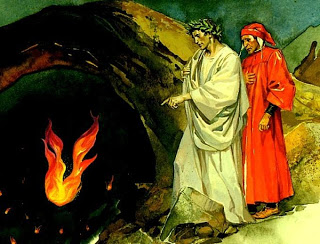
What is meant by the trespass of God’s established limits? God, being God, knows all, sees all, is all. There is nothing God doesn’t know in past, present and future. There is no time with God therefore He knows all. He is omniscient which means He is all knowing. Not only does he have the knowledge of all things but He has the wisdom to know how to use this knowledge. We can have head knowledge of something without having the wisdom to use it correctly. For instance, I have the head knowledge that I should stop my car at a stop sign. But wisdom uses knowledge to stop the car at the stop sign and look both ways before proceeding. I could have the knowledge and be stupid, ignore the knowledge and run the stop sign.
Because God knows all things and has the capacity to work complexities that we cannot even dream of, He alone has all the knowledge AND the wisdom to use the knowledge correctly. As created beings, we do NOT have this capacity. God is the Creator and we are the created. Our physical brains are not up to the task of having all the knowledge God has, nor the capacity to understand, work and use the knowledge to do good. Our brains would probably just short circuit and explode if we suddenly had access to God’s omniscience. Because we live in time, we have no way of knowing the future. Because our minds are biologically, physically, limited there is no way of remembering everything and then logically and progressively putting it altogether to complete a good work. God is weaving something stupendous out of every life and every detail in every life of His Children.
Not only are we limited but we have the issue of sin which taints us. If we could somehow suddenly become capable of handling God’s level of knowledge and wisdom, our sinful selves would use it destructively.
So God knows what He is doing in establishing limits for man. There are things we cannot and should not know. An example would be life and death. Life and death are God’s domain and we shouldn’t be trying to go beyond God’s established limits or we will end up with Frankensteins. When a child is conceived, it means God has decided for that child to be conceived and He has His reasons and purposes for this little human being. Only God knows the future of this child. The Bible says that He plans, designs and creates each human being and knows all the days of that child. Women are encouraged to take the life of this child into their own hands and decide whether this human being should live or die. So a limited and sinful woman thinks she knows what is best and what the future holds. She thinks the child is better off dead and gets an abortion. She’s really thinking she’s better off by killing the child but she justifies it with the cover of a fig leaf. This is not the sole sin of the mother because there are men and women out there encouraging these women to abort their children. They fund Planned Parenthood. They council women to get an abortion. They take their daughters to the abortion clinics and pay for it. The fathers of the children either take them and pay for the abortion or they refuse to be involved thus making the woman feel she has no choice (another fig leaf). People on television and in movies who say, “It’s your body and you should do what you think is best” are complicit. Newspapers, and other media, who promote “choice” as an option are involved. Those who donate to abortion clinics. Those corporations and labs who purchase fetal tissue from abortion clinics are guilty. Those who walk in “pro-choice” parades and “protests” are supporting abortion. The men who get women pregnant and then sigh in relief when she “chooses” to have an abortion are guilty. Staff in abortion clinics, volunteer and paid, are guilty. Abortion providers are guilty. Insurance companies who pay for abortions and corporations who have to provide such coverage, are guilty. Voting for pro-abortion candidates is complicity. America is saturated with the blood of innocent children. Millions upon millions of babies have been aborted by women who took the decision out of God’s Hands and played God by killing another human being.
Another example of trespassing on the limits God establishes is deciding on the death of another person. Abortion is just the tip of the iceberg. When someone decides another human being, whom God created, is better off dead, we have taken the life of a human being out of God’s Hands and decided to play God. Deciding an elderly person is no longer of any use to society and a drain of resources and therefore we should kill this person is euthanasia. Believing a person is better off dead than alive, is playing God. Whether that person is handicapped, mentally handicapped, elderly, terminally ill, a different race (as in Hitler), an addict, a poor person, illiterate shouldn’t matter. We shouldn’t be deciding who lives and who dies. That’s God’s decision. When we trespass on the limits God sets and begin deciding who lives and who dies, we are trying to play God. We think we know what’s best and we think we can see into the future. This is the same lie Adam and Eve fell into. We want to bypass God and do it ourselves because we think we know so much.
What about life? There are limits God sets on our life. If it were up to me, no one in my family would die because I love them and it hurts too bad to be separated from them even though I will see them in Heaven. But God establishes the length of our days and He knows when it’s best for all involved to bring someone home. There are those who think they should extend the life of their loved ones artificially no matter what. They begin to play God by doing whatever they can to extend life. They create their own Frankensteins. Did you know that the organ business is extremely profitable. So much so that organized crime deals in stolen organs. They kill people for organs to sell to people who need organ transplants. Funeral homes will sell body parts under the table and out the back door for more money than a family pays for the exorbitantly priced funerals. They get money two ways. And for those who choose cremation, there is no evidence of body part theft so funeral homes can make money coming and going and don’t think they don’t. Hospitals and doctors make money off of sick and injured people. They aren’t in it for the ministry any more. It’s all about the money and as long as they get paid, they don’t mind extending someone’s life beyond God’s limits. Once they stop receiving money (from insurance companies, families and government) they are ready to pull the plug. They will begin counseling the family to remove life support because it becomes more expensive than profitable to keep them alive. People who are in comas but are sustainable as long as there are feeding tubes. The hospitals will counsel the family to remove the feeding tubes and let the patient starve to death. There is a balance and we will only find that balance by seeking God for His wisdom and knowledge.
The whole point is to realize we are limited and we are therefore dependant upon God. We should seek Him and ask Him for direction on the issues we are dealing with. We should rely on and trust in His knowledge and wisdom and therefore obey when He directs us. This is born in relationship and based on faith.
Isaiah 5:21 Woe to those who are wise in their own eyes and clever in their own sight.
Proverbs 3:5-7 (BSB) 5 Trust in the LORD with all your heart, and lean not on your own understanding; 6 in all your ways acknowledge Him, and He will make your paths straight.7 Be not wise in your own eyes; fear the LORD and turn away from evil.
James 1:5 Now if any of you lacks wisdom, he should ask God, who gives generously to all without finding fault, and it will be given to him.
Psalm 32:8 (KJV) I will instruct thee and teach thee in the way which thou shalt go: I will guide thee with mine eye.
The flame already was quiet and erect again,
Done speaking, and, as the gentle poet allowed
Leaving us, when behind it another one
Was drawing near, the confused sound it made
Drawing our eyes toward its flickering tip.
As the Sicilian bull (which bellowed loud
For the first time when he who gave it shape
With his file’s art was forced to give it his voice,
Justly) would use a victim’s cries, sealed up
Inside its body, to bellow – so that, though brass,
It seemed transfixed with pain when it was heated:
So, having at first no passage or egress
From fire, the melancholy words were transmuted
Into fire’s language. But after the words had found
Their passage through the tip, and it vibrated
As the tongue had in trying to form their sound,
We heard it say, “O you toward whom I guide
My voice, and who a moment ago intoned
In Lombard, ‘Now continue on your road,
I do not ask you more’ – though I may be
Late in my coming here, don’t be annoyed
To stop and speak; you see that I am free
Of annoyance, though I burn. If you just fell
Into this viewless world from Italy,
Sweet land above, from which I carry all
My guilt, then tell me: is it peace or war
That occupies the Romangnoles? – I hail
From the hill country between Urbino and where,
High up the ridge, the Tiber has its source.”
The Sicilian bull, was allegedly a torture and execution device designed in ancient Greece. Perillos of Athens invented and proposed it to Phalaris, the tyrant of Akragas, Sicily, as a new means of executing criminals. halaris ruled circa 570 to 554 B.C. and was known to Aristotle, who notes his depravity and cites him as an example of bestiality. The bull was said to be made entirely out of bronze, hollow, with a door in one side. According to legends the brazen bull was designed in the form and size of an actual bull. The head of the bull was designed with a system of tubes and stops so that the prisoner’s screams were converted into sounds like the bellowing of an infuriated bull. The condemned were locked inside the device, and a fire was set under it, heating the metal until the person inside was roasted to death. Perillos believed he would receive a reward for his invention. Perillos said to Phalaris: “His screams will come to you through the pipes as the tenderest, most pathetic, most melodious of bellowings.” Phalaris, who was disgusted by these words, ordered its horn sound system to be tested by Perillos himself “which bellowed loud for the first time when he who gave it shape with his file’s art was forced to give it his voice, Justly”. He tricked him into getting in the bull. When Perillos entered, he was immediately locked in and the fire was set, so that Phalaris could hear the sound of his screams. Before Perillos could die, Phalaris opened the door and took him away. After freeing him from the bull, Phalaris is then said to have taken Perillos to the top of a hill and thrown him off, killing him. Phalaris himself is claimed to have been killed in the brazen bull when he was overthrown by Telemachus, the ancestor of Theron. – Wikipedia
Guido da Montefeltro (1223 – September 29, 1298), nicknamed The Fox, was the son of Montefeltrano II da Montefeltro and was born in San Leo. He was Lord of Urbino in Romagna and an Italian strategist. Guido led the Ghibellines of Romagna to victory over the Guelphs at Ponte San Procolo in 1275. Later that year he won a victory over the Malatesta of Rimini at Raversano, driving the Malatesta from Cesena. By the next year Guido was captain of Forlì, with control of all antipapal power in Romagna. Guido commanded the defenders during the siege of Forlì in 1282-1283, against French-commanded forces loyal to Pope Martin IV. Although Guido’s forces inflicted heavy casualties on their foes, eventually Forlì fell to the papal forces, leading most of Romagna to submit to papal control. Guido accepted the authority of Pope Honorius IV in 1286. Guido emerged back into public life in 1288, when he was excommunicated and became captain of the Ghibellines of Pisa. Over the next few years he aided Pisa in its struggle against Florence, and the city of Urbino against Cesena. In 1296 Pope Boniface VIII admitted Guido back into the Church, and gave him back the lordship of Montefeltro. In the same year he retired and entered the Franciscan order. In 1298 Pope Boniface VIII called on Guido for advice in dealing with his struggles against his enemies, the Colonna family, who had disputed the legitimacy of Boniface’s election, and had taken refuge in a fortress in Palestrina. Guido’s advice was to promise the Colonnas amnesty, and then renege on the promise once they had emerged from their fortress. According to Dante’s story, Montefeltro was reluctant to come out of retirement and again get involved because he felt he had left all that behind when he joined the monastery. He thought he was paying for his sins (and we know we can’t pay for our sins with our own “good works”). But Boniface had agreed to absolve him for the sin of his fraudulent counsel ahead of time. He is in Hell because he was not repentant. He relied on a corrupt Pope’s absolution. He relied on human authority rather than on Jesus Christ’s work on the cross. There is nothing we can do to save ourselves. There is no one else but Jesus Christ who saves. He died in the monastery of Assisi. Guido, a fraudulent character who may himself be a victim of fraud, immediately reveals the limits of his scheming mind when he identifies himself because he believes, or claims to believe, that no one ever returns from hell alive. The legend was St. Francis arrived to claim his soul for the saved, but a black Cherub asserted Hell’s superior claim. – Wikipedia

Montefeltro asks for news of his homeland. Dante replies that Romagna suffers under violence and tyranny but not outright war.
Ravenna still remains as many a year,
Polenta’s eagle brooding over the town,
So it’s wings cover Cervia. The land that bore
The Polenta family had ruled Ravenna since 1275. The family arms contained an eagle. Cervia, a small but important town on the Adriatic near Ravenna was subject to the Polenta family for several years. – C.H. Grandgent, 1909-13
The long siege, once, and struck the Frenchmen down
Into a bloody heap, finds itself now
Held underneath the Green Paws once again.
The “city” is Forli. In 1281-1282 it resisted a long siege by the French and the Guelfs sent by Pope Martin IV. In 1282, the inhabitants, led by Guido da Montefeltro, defeated the besiegers. In 1300 it was ruled by the Ordelaffi, who had a lion, green in the upper half, in the family arms. Dante is thought to have been in Forli in 1303 and 1310. – C.H. Grandgent, 1909-13
Both the old Mastiff and new of Verrucchio,
Who treated Montagna in an evil way,
Sink their teeth in, the way they always do.
The “ancient Mastiff” is Malatesta da Verrucchio, Lord of Rimini. The “new Mastiff” is his son, Malatestino. In 1296 Malatesta defeated the Ghibelline forces of Rimini and captured their leader Montagna. The “bad dispoal of Montagna” was when Malatesta murdered a prisoner. They used their teeth as daggers to suck the blood. – C.H. Grandgent, 1909-13
Along the Santerno and the Lamone lie
Cities the Lionet of the White Lair rules,
Who changes sides and shifts his loyalty
From summer to winter. And the town that feels
The Savio bathe its flank, just as it lies
Between a plain and mountains, also dwells
Somewhere between tyranny’s and freedom’s ways.
“Faenza, on the Lamone, and Imola, near the Santerno, were ruled by Maghinardo di Pagano da Susinana, who bore a blue lion on a white field. He was known as ‘the lion’ and ‘the demon’ (Purg. XIV, 118), and was notorious for his many changes of party, being Guelf on the south side of the Apennines, Ghibelline on the north side. Cesena, on the Savio, preserved the forms of municipal self-government, but was ruled, from 1296 to 1300, by a boss, Galasso da Montefeltro, a cousin of Guido.” – C.H. Grandgent, 1909-13
Montefeltro tells Dante his story because he thinks no one can be in Hell and go back to life in the world. He miscalculates and falls to a false premise. We shall see this is not the first time. He tells him that he thought Pope Boniface III’s absolution in advance would save him but he found out different when he died. The devil got him because a man could not receive absolution before sinning. Absolution cannot precede repentance and repentance cannot precede the sin. It is a contradiction and invalid.
“In a most remarkable instance of layering, Dante provides us with a troping of fraudulent counsel in this episode, for the fraudulent counselor Guido da Montefeltro relates that he was fraudulently counseled by Boniface VIII. Boniface gave Guido fraudulent advice When He tells him not to worry about sinning, promising That he will absolve him in advance, before he sins: ‘Henceforth I thee absolve’ (I absolve you in advance now [ Inf. 27,101]). Boniface offers apparently prudential logic based on a false premise, for not even a pope can absolve for a sin that has not yet been committed.” – Digital Dante
After the fire
Roared in its way awhile, it began to stir
Its sharp tip rapidly, first here, then there,
Then formed this breath: “If I believed I gave
My answer to one who’d ever go once more
Back to the world, this tongue of flame would have
No motion. But since, if what I hear is true,
None ever returned from this abyss alive,
Not fearing infamy I will answer you.
I was a man of arms, and after that
Became a corded friar, hopeful to do
Penance by wearing the rope; indeed that thought
Might well have been fulfilled, but the High Priest –
May evil befall him! – led me to commit
Again the sins that I had practiced at first;
And how and why, now listen and I’ll disclose.
My actions, when my form was still encased
In the flesh and bones my mother gave me, were those
Of the fox, not the lion. I was expert
In all the stratagems and covert ways,
And practiced them with so much cunning art
The sound extended to the earth’s far end.
But when I saw that I had reached that part
Of life when we should let our sails descend
And coil the ropes – then what had pleased me before
Now grieved me; penitent and confessed, I joined
An order and – woe to say! – my life as friar
Would have availed me. The Prince of new Pharisees
Nearby the Lateran was making war,
And not against the Saracens or Jews,
His enemies all being Christians: and none
Had been at Acre’s conquest, nor one of those
Who went as merchants to the Sultan’s domain;
And he respected neither the supreme
Office and holy orders that were his own,
Nor in me the friar’s cord which at one time
Made those who wore it leaner. As Constantine
Sought out Sylvester in Soracte, his aim
To have him cure his leprosy – this man
Came seeking me as one who meant to find
A doctor to cure the fever he was in,
Of pride. He asked my counsel, and I remained
Silent, because his words seemed drunk to me.
And then he spoke again: ‘Now understand,
Your heart should not respond mistrustfully,
For I absolve you in advance, henceforth:
Instruct me, so that I can find a way
To level Palestrino to the earth.
I have the power to lock and unlock Heaven,
As you know, for the keys are two, whose worth
Seemed not dear to my predecessor.’ Then, driven
To where the gravity of his argument
Made silence seem worse counsel, I said: ‘Given,
Father, that you are washing me of the taint
Of this sin into which I now must fall –
Large promises with fulfillments that are scant
Will bring your high throne triumph over all.’
And Francis came for me the moment I died,
But one of these black cherubim of Hell
Appeared: and, ‘Do not carry him off,’ it said
‘Do not deprive me: he must be carried down
Among my servants, because he counseled fraud,
And I have hovered near his hair since then,
Until this moment – for no one has absolution
Without repenting; nor can one will a sin
And repent at once, because the contradiction
Precludes it.’ How I shuddered – O wretched me!
‘Perhaps you did not think I was a logician,’
He said, and took me, and carried me away
Montefeltro was sneaky, cunning, deceptive and therefore he calls himself “the fox, not the lion”. He was well known for his scheming and strategies. But as he drew near the end of his life, “I had reached that part of life when we should let our sails descend and coil the ropes”, he began to feel guilty over what he’d done so he “became a corded friar”. He “joined an order”. He joined the Franciscans and became a friar. The Franciscans practised fasting, “which at one time made those who wore it leaner.” He was “penitent and confessed”. But then the “High Priest”, the “Prince of the new Pharisees”, Pope Boniface III sought him out to give him advice on how to defeat his enemies. These enemies were not the Saracens (Arabs or Muslims, at the time of the Crusades) or the Jews (who had Christ crucified). They were not those who helped the Sultan take Acre. The fall of Acre, the last bulwark of Christendom in the East, filled Europe with consternation. They had been fighting the Crusades as a holy war and couldn’t understand why God would allow the Sultan and his Muslims to take back Palestine. I.e. Pope Boniface III wasn’t going after the enemies of Christ. This was strictly politics and power. He was seeking Montefeltro as one who seeks “a doctor to cure the fever he was in, of pride”.
Montefeltro hesitated because he didn’t want to get involved again but the Pope promised the absolve him of the sin. “Your heart should not respond mistrustfully, for I absolve you in advance, henceforth: instruct me, so that I can find a way to level Palestrina to the earth”.
“Boniface VIII, who was waging war at home, close to his Lateran palace, with the Colonna family. In 1297 he excommunicated them and summoned them to surrender, but they entrenched themselves in their strongholds of Palestrina and Zagarolo. Palestrina, about 24 miles from Rome and visible from the Lateran hill, was surrendered to Boniface on false promises, and then demolished. The Colonna family – among them two cardinals – had refused to recognize Boniface’s election.” – C.H. Grandgent, 1909-13
Absolution – act of absolving; a freeing from blame or guilt; release from consequences, obligations, or penalties. state of being absolved. Roman Catholic Theology. a remission of sin or of the punishment for sin, made by a priest in the sacrament of penance on the ground of authority received from Christ. – Dictionary.com
In Roman Catholicism, penance is a sacrament and the power to absolve lies with the priest, who can grant release from the guilt of sin to the sinner who is truly contrite, confesses his sin, and promises to perform satisfaction to God. Forgiveness is seen as originating in Jesus Christ and being subsequently extended to sinners by members of the priesthood. In the sacrament of penance, the act by which a qualified priest, having the necessary jurisdiction, remits the guilt and penalty due to sin. – Britannica.com
As a Protestant, we believe in the priesthood of the believer. We don’t have to have a mediary between us and Jesus Christ. So if we repent of our sins and ask Jesus to cleanse us, He is faithful to do that. The Bible does tell us to confess our sins one to another but it is Jesus who forgives us and other believers should follow suit and forgive.
1 John 1:8-10 (BSB) 8 If we say we have no sin, we deceive ourselves, and the truth is not in us. 9 If we confess our sins, He is faithful and just to forgive us our sins and to cleanse us from all unrighteousness. 10 If we say we have not sinned, we make Him out to be a liar, and His word is not in us.
James 4:11-12 (BSB) 11 Brothers, do not slander one another. Anyone who speaks against his brother or judges him speaks against the law and judges it. And if you judge the law, you are not a practitioner of the law, but a judge of it. 12 There is only one Lawgiver and Judge, the One who is able to save and destroy. But who are you to judge your neighbor?
James 5:16 Therefore confess your sins to each other and pray for each other so that you may be healed. The prayer of a righteous man has great power to prevail.
Romans 3:22-28 (BSB) 22 And this righteousness from God comes through faith in Jesus Christ to all who believe. There is no distinction, 23 for all have sinned and fall short of the glory of God, 24 and are justified freely by His grace through the redemption that is in Christ Jesus.
25 God presented Him as the atoning sacrifice through faith in His blood, in order to demonstrate His righteousness, because in His forbearance He had passed over the sins committed beforehand. 26 He did this to demonstrate His righteousness at the present time, so as to be just and to justify the one who has faith in Jesus.
27 Where, then, is boasting? It is excluded. On what principle? On that of works? No, but on that of faith. 28 For we maintain that a man is justified by faith apart from works of the law.
Matthew 5:16 (Jesus speaking) Let your light so shine before men, that they may see your good works, and glorify your Father which is in heaven.
1 Timothy 5:24-25 24 The sins of some men are obvious, going ahead of them to judgment; but the sins of others do not surface until later. 25 In the same way, good deeds are obvious, and even the ones that are inconspicuous cannot remain hidden.
We are not to do “good deeds” in pride and to be seen by men so that we may be honored. That defeats the purpose. Good works should come naturally from a fresh relationship with Jesus Christ. It should arise out of our love for Him and to do Him any service. We are to humbly serve with the motivation to give Him all the glory. Fruit is grown because of it’s relationship with the tree or vine. It receives nourishment from the roots that are grounded in good soil and watered by good water. The fruit that naturally results is good for health. Jesus Christ is the root. The good soil and water is the Word and the Holy Spirit that is then soaked into the root and distributed to the tree or vine. Fruitfulness results. This fruit is not forced out, not pushed out, not squeezed out… it comes naturally and forms and grows and matures. Then it is seen by others and can be used for health. When we are saved, we are grafted onto the fruit tree, as it were. And the life flows from the root into us, making us strong and begin to develop fruit. It’s a process but should be a continual process to fruitfulness.
Montefeltro had it backwards. He began to think of his death in his old age and was afraid his evil and sin would condemn him to Hell. So he thought he could join a religious group and spend his later days in doing works (fasting, praying, serving, giving, whatever) and pay his way into Heaven. He says he was “penitent and confessed” when he joined the Franciscans. But his faith was not in Jesus Christ but in his own works, in the Franciscan order, and even in the Pope. He believed he could manipulate and work his way into Heaven on his own terms. He believed the Pope could absolve him of the sin he was about to commit. He was tempted because the Pope appealed to his sinful nature. “My actions… were those of the fox, not the lion… I was expert in all the stratagems and covert ways and practiced them with so much cunning art the sound extended to the earth’s far end.” He is still proud of his intelligence, cunning and the fame it brought him. His reputation for cunning proved in the end his eternal undoing. Once the Pope slyly appealed to his evil nature, he then promised to absolve him of the sin “in advance”. How can one repent (which is necessary to forgiveness) if one is willing and working the sin?
Some believe that Montefeltro would have gone to Heaven if the Pope hadn’t tempted him with his faux absolution. But my opinion is that you can’t lose your salvation if it is based on faith in the work of Jesus Christ. As a Baptist in this belief, I believe once saved, always saved. If you have truly repented and accepted Jesus Christ as your Savior, you are born again and cannot lose your salvation. All of your sins are forgiven, no matter when they occur. So, if Montefeltro was truly “penitent and confessed” he was saved and no matter what sins he committed throughout his life, they are forgiven and he would go to Heaven. Once we accept Jesus Christ as our Savior, we don’t live the rest of our lives sin-free. Unfortunately, we still fall into sin at times due to our human nature. But the Holy Spirit convicts us and we ask forgiveness for our sins and Jesus if faithful to forgive us. And there are going to be sins we commit that we forget so we would be sunk if it weren’t for Christ’s overall forgiveness for all sins. So I believe, according to this story, that Montefeltro was not truly “penitent and confessed” and therefore not truly saved. He relied on the outward forms of religious ritual, ceremony, tradition and whatever works he performed (legalism) to save him. “If I give up all my money to a religious organization and I move into a monastery and I do this and that as prescribed by the order and walk slowly with bowed head and wear a certain garment and cut my hair a certain way… I’ll be saved”.
‘who, to be sure of Paradise,
Dying put on the weeds of Dominic,
Or in Franciscan think to pass disguised.’
[John Milton, Paradise Lost, iii. 478-480.]
Repentance is a change of the mind. It means the blindness and denial come off and we see our sin for how ugly it is and how damning it is. We are damned to judgment for our sins. Sins we committed and sins we lust for and desire to commit. Before, we didn’t care that we sinned. But our minds have been opened and we see the horror before us. It is at this point that we know we have no hope without Jesus Christ. He is the revealed Savior and His work on the cross can forgive any, and every, sin. In faith we go to His feet and beg His forgiveness and we are born again. Our spirit is born within us making us once more a three part being: body, mind (soul, personhood, intelligence, our essence) and spirit. We are saved by the work and mercy of Jesus Christ. We are forgiven and covered by His righteousness. The Holy Spirit comes to reside in us to train, develop, mature and empower our baby spirit. The lifelong process of sanctification begins. Jesus has set us free from the bondage of sin that leads to death and judgment. He has made us free and given us eternal life with Him. We do still fall into sin as we still have that human nature that gets tempted. But the Holy Spirit will convict us and Jesus forgives every time we ask Him.
Montefeltro ignored the process of true repentance and forgiveness by Jesus Christ. He trusted in the Pope’s absolution rather than in Christ’s work. He went on to sin believing the Pope had absolved him. His reliance on the Pope was ineffective and didn’t save him,
“for no one has absolution without repenting; nor can one will a sin and repent at once, because the contradiction precludes it.” He was surprised, when he died, to see the “black Cherubim of Hell” come for him, “how I shuddered – oh wretched me!”
“The Pope was carrying on a war… against Christians – the great rival house of the Colonnas. Two Cardinals of this family, being excommunicated by Boniface and their palaces in Rome destroyed, retired to their stronghold of Palestina. Foiled and furious at his inability to capture this place, the Pope summoned the crafty old soldier-monk from his cloister to advise him how to raze it to the ground… Following this advice, Boniface promised the Cardinals that if they submitted, he would grant them pardon and restore their possessions; his fulfilment was ‘short’ enough – he levelled Palestrina with the ground. Six years later the Colonnas took their revenge for this treachery by the famous outrage on Boniface at Anagni” – John S. Carroll, 1904
“Dante evidently meant to point out some of the limits of the Church’s power in salvation. On the one hand, even the pardon of a Pope is a powerless to save a deliberate sinner like Guido from Hell: without repentance God Himself could not do it, much less His Vicar. On the other hand, Buonconte’s salvation (Purg. v. 85-129; Par. xiii. 130-138) proved that the pardon did not depend on the Church, or the intervention of sacraments, or priestly absolution: without confession or shrift, viaticum or extreme unction, there among the lonely hills the dying sinner’s one cry of penitence saved him in the very article of death. So free of bondage even to the appointed means is the grace of God.” – John S. Carroll, 1904
The Cherubim were the Order of angels in Heaven whose special gift was knowledge. The Black Cherubim are the fallen angels that satan took with him by convincing them to follow him in the rebellion against God. They are demons now. “Do not deprive me: he must be carried down among my servants, because he counseled fraud, and I have hovered near his hair ever since then.” Having a hold on his head and mind, the demon is now ready to carry him down to Hell where Minos will determine his place by how many coils he winds his tail (Canto V).
‘Perhaps you did not think I was a logician,’ he said, and took me, and carried me away. This devil sarcastically throws Montefeltro’s sin in his face. Montefeltro had prided himself on being a logician, using the very intelligence and cunning God had given him to evil purposes. Now this “black Cherubim” tells him he’s been outwitted by one who is better at it than Montefeltro was.
So I am lost.
Where you see me wander, in this garment wound,
Bitter to myself.” And as his discourse ceased
The grieving flame departed, its horn’s sharp point
Tossing about and twisting as it passed.
We journeyed on, my leader and I, and went
To the next arch of the ridge: and looking under,
We saw the fosse where they pay the due amount
Who earned their burden by splitting things asunder.
Dante’s cliffhanger at the end. Virgil and Dante move along to the 9th bolgia in the 8th circle of Hell. This is where those who cause discord are punished.
Excerpts of Dante’s Inferno are from a new translation by Robert Pinsky.


No comments:
Post a Comment