

In the last Canto, Dante and Virgil had been in the eighth circle of Hell called Malebolge (evil ditches or moats, ravines, pouches). This is where Fraud is punished. Within this 8th circle of Hell are ten ditches where different Frauds are punished. They were in the seventh bolgia where thieves are punished and they meet five thieves, all from Florence, and witnessed three terrible metamorphoses. In this Canto they begin to climb out of the 7th bolgia and Dante is ashamed that the thieves he saw were from his hometown. They will go on to see what is in the 8th bolgia.

Rejoice, O Florence, since you are so great,
Beating your wings on land and on the sea,
That in Hell too your name is spread about!
I found among those there for their thievery
Five of your citizens, which carries shame
For me – and you gain no high honor thereby.
But if we dream the truth near morning time,
Then you will feel, before much time has gone,
What Prato and others crave for you – and come
Already, it would not have come too soon.
And truly, let it, since it must come to pass:
For it will all the heavier weight me down,
The older I become.
Dante is ashamed of what Florence has become. He speaks ironically at how famous it is, even in Hell. This comes from a place of pain for Dante. This was his hometown and he was exiled from there on the charge of barratry. Each of the five thieves from Florence, whom he met in the 7th bolgia, were not from the lower classes of the cities but of wealthy and great families of the city. What hope was there for a city whose very princes were thieves and companions of thieves?
Isaiah 1:23 (BSB) Your rulers are rebels, friends of thieves. They all love bribes and chasing after rewards. They do not defend the fatherless, and the plea of the widow never comes before them.
Dante has had sad dreams of Florence and what will happen to it and the dreams were morning dreams which were supposed to come true and be prophetic.
Cardianal Niccolo Albertinin da Prato (c. 1250 – 27 April 1321) was an Italian Dominican friar, statesman, and cardinal. Albertini was born about 1250 in the city of Prato, then in the County of Prato, part of the Holy Roman Empire, to parents who both belonged to illustrious families of Tuscany. Albertini’s early education was directed by his parents. At the age of sixteen (1266) he entered the novitiate of the Dominican Order at the Priory of Santa Maria Novella in Florence, and, upon his profession of religious vows the following year, was sent to the University of Paris to complete his studies. He served as lector (instructor) at the studium at Santa Maria sopra Minerva. He was entrusted by his superiors with various important duties and governed several houses. He was made Procurator General of the whole Order of St. Dominic by Blessed Nicolo Bocassini, then Master General, and was afterwards elected Prior Provincial of the Roman Province. In 1299 Pope Boniface VIII appointed him Bishop of Spoleto and soon afterwards sent him as Papal Legate to the Kings of France and England, Philip IV and Edward I, with a view to reconciling them, a seemingly hopeless task. Albertini succeeded in his mission. The pope in full consistory thanked him, and made him Vicar of Rome. Pope Benedict XI was particularly attached to Albertini, with whom he had lived a long time in the same cloister. Shortly after his accession to the papacy (22 October 1303) he made Albertini the Bishop of Ostia, which office he held for almost 18 years. The civil wars that in the 13th and 14th centuries had devastated a great part of Italy, especially Tuscany, Romagna and the March of Treviso, caused the pope again to appoint the new cardinal Apostolic Legate, and to send him to restore peace in those disturbed provinces. Albertini’s authority was also extended to the Dioceses of Aquila, Ravenna, Ferrara, and those in the territory of Venice. He was well received by the people of Florence, but after many futile efforts to effect a reconciliation between the Guelphs and the Ghibellines he left the city and placed it under interdict and its inhabitants excommunicated. Within a week a great fire originated by a dissolute priest. It burnt down more than seventeen hundred houses, towers, and palaces destroying much of the city’s wealth. As some treasures were being rescued, highwaymen stopped the wagons and stole it. The fire greatly impoverished the city and there were other disasters about the same time that the people blamed on the interdict. On 26 October, 1305, Pope Clement V (1305-1314) granted Cardinal Niccolò a canonry and prebendary in the Church of Tours, to be enjoyed in addition to his canonry and prebendary at Chartres. On 29 June 1312, in the name of Pope Clement V, Albertini crowned Henry of Luxembourg as Holy Roman Emperor at Rome. He was later the leading judge in the trial that exonerated the Dominican friar, Bernardo da Montepulciano, from the charge of killing Henry by giving him a poisoned host at a Mass. He crowned Robert of Naples, son and successor of Charles II of Naples, as King of Sicily. As Cardinal Bishop of Ostia e Velletri and Dean of the Sacred College of Cardinals, Albertini served as an elector in the papal conclave from May 1, 1314 to August 7, 1316, the longest papal conclave in history, which elected Pope John XXII. Albertini was Dean of the Sacred College of Cardinals from August 1312 until his death at Avignon. He was buried in the Dominican Church there.
The metaphor of flying begins and ends this canto.
The bird of prey, the eagle, represents Florence. “Beating your wings on land and on the sea” indicates journeying quests by land, sea and air. God shelters His people under His wings but is a bird of prey on His enemies.
The eighth bolgia is where Fraudulent Counselors are punished. These people had God-given intelligence, education, commonsense, cleverness and logical reasoning but they misused these God-given resources to trick and deceive people. They have perverted the intellectual powers God gave them.
I’ve often wondered about people who seem to be so smart and yet they use their intelligence for evil. They become very smart in coming up with schemes; or how to hunt, assault and murder another human being; or how to steal, kill and destroy. If they can ingeniously come up with homemade shanks to kill people while in prison deprived of all normal weapons, why can’t they use that same intelligence, creativity and cleverness to come up with ways to legally and productively make money and help society? If they can organize and run a large drug cartel, why can’t they use their skills to run a legitimate corporation and provide real, and safe, jobs for society? If they can figure out some complex way to steal everything from someone, why can’t they use their intelligence and talents to make a profit in a legal business? If everyone used what God gives them to the best of their ability and for the benefit of, not only themselves, but their fellow man? Who knows what kind of society we could have. But that is what will happen in Heaven and it won’t happen before because of sin.
Climbing that jagged ridge’s rocks and spurs,
I sorrowed then, and when I turn my mind
To what I saw next, sorrow again – and force
My art to make its genius more restrained
Than is my usual bent, lest it should run
Where virtue doesn’t: so that if any kind
Star or some better thing has made it mine,
I won’t myself negate the gift in me.
As many as the fireflies a peasant has seen
(Resting on a hill that time of year when he
Who lights the world least hides his face from us,
And at the hour when the fly gives way
To the mosquito) all down the valley’s face,
Where perhaps he gathers grapes and tills the ground:
With flames that numerous was Hell’s eighth fosse
Glittering, as I saw when I attained,
A place from which its floor could be made out.
And as the one avenged by bears divined
That what he saw was Elijah’s chariot
Carried by rearing horses to Heaven’s domain –
For with his eyes he couldn’t follow it
Except by looking at the flame alone,
Like a small cloud ascending; so each flame moves
Along the ditch’s gullet with not one
Showing its plunder, though every flame contrives
To steal away a sinner. I had climbed up
To balance where the bridge’s high point gives
A better view, and if I didn’t grip
A rock I would have fallen from where I stood
Without a push. Seeing how from the top
I gazed intently down, my master said,
“Within the flames are spirits; each one here
Enfolds himself in what burns him.”

Dante and Virgil see flames in this “dark fosse” (ditch, ravine). Dante, the poet, uses another earthy comparison. They are like lightening bugs, or fireflies, glittering in the distance. Just as a peasant sits on a hill in the summer, when the sun goes down, and looks below and sees glittering lightening bugs. He says it’s the “time of year when he who lights the world least hides his face from us”. I.e. the time of year when the sun is out longer, making the day longer, summer. Then he says it’s the time of day “when the fly gives way to the mosquito”. This would be dusk to dark.
“As he looked at these flamelets, Dante tells us there fell on him a certain sadness, and a solemn sense of responsibility for the use of his genius. These were souls who had perished through the perversion of the great intellectual powers God had given them; and he trembled as he felt within himself the same danger of intellectual perdition. To him even as to them, he knew that God had given great powers of mind, and it is far from improbable that he had frequently known the temptation to which they had yielded. In the troubled politics of his time there must have come many opportunities of using his great intellect of crafty purposes, to bend his fellowmen to his own ends or those of his party. Perhaps Dante was too imperious a soul to be in any real danger of stooping to win men by craft and policy – as witness his breaking away from the Ghibellines and forming a party by himself [Par. xvii. 61-66]; nevertheless, in the presence of these lost minds to which he felt himself akin, he is so impressed with the possibility of a similar perdition that he reins in those high intellectual powers which some ‘good star or better thing,’ such as the grace of God, perchance had given him.” – John S. Carroll (1904)
Do we not desire men of such character today for leaders? But what do we get?
Who is “the one avenged by bears”?
The story of Elijah being taken up to Heaven in a chariot of fire:
2 Kings 2:1-18 (BSB) 1 When the LORD was about to take Elijah up to heaven in a whirlwind, Elijah and Elisha were traveling from Gilgal. 2 And Elijah said to Elisha, “Stay here, for the LORD has told me to go to Bethel.”
But Elisha replied, “As surely as the LORD lives and you yourself live, I will never leave you!” So they went down together to Bethel.
3 The group of prophets from Bethel came to Elisha and asked him, “Did you know that the LORD is going to take your master away from you today?”
“Of course I know,” Elisha answered. “But be quiet about it.”
4 Then Elijah said to Elisha, “Stay here, for the LORD has told me to go to Jericho.”
But Elisha replied again, “As surely as the LORD lives and you yourself live, I will never leave you.” So they went on together to Jericho.
5 Then the group of prophets from Jericho came to Elisha and asked him, “Did you know that the LORD is going to take your master away from you today?”
“Of course I know,” Elisha answered. “But be quiet about it.”
6 Then Elijah said to Elisha, “Stay here, for the LORD has told me to go to the Jordan River.”
But again Elisha replied, “As surely as the LORD lives and you yourself live, I will never leave you.” So they went on together.
7 Fifty men from the group of prophets also went and watched from a distance as Elijah and Elisha stopped beside the Jordan River. 8 Then Elijah folded his cloak together and struck the water with it. The river divided, and the two of them went across on dry ground!
9 When they came to the other side, Elijah said to Elisha, “Tell me what I can do for you before I am taken away.”
And Elisha replied, “Please let me inherit a double share of your spirit and become your successor.”
10 “You have asked a difficult thing,” Elijah replied. “If you see me when I am taken from you, then you will get your request. But if not, then you won’t.”
11 As they were walking along and talking, suddenly a chariot of fire appeared, drawn by horses of fire. It drove between the two men, separating them, and Elijah was carried by a whirlwind into heaven. 12 Elisha saw it and cried out, “My father! My father! I see the chariots and charioteers of Israel!” And as they disappeared from sight, Elisha tore his clothes in distress.
13 Elisha picked up Elijah’s cloak, which had fallen when he was taken up. Then Elisha returned to the bank of the Jordan River. 14 He struck the water with Elijah’s cloak and cried out, “Where is the LORD, the God of Elijah?” Then the river divided, and Elisha went across.
15 When the group of prophets from Jericho saw from a distance what happened, they exclaimed, “Elijah’s spirit rests upon Elisha!” And they went to meet him and bowed to the ground before him. 16 “Sir,” they said, “just say the word and fifty of our strongest men will search the wilderness for your master. Perhaps the Spirit of the LORD has left him on some mountain or in some valley.”
“No,” Elisha said, “don’t send them.” 17 But they kept urging him until they shamed him into agreeing, and he finally said, “All right, send them.” So fifty men searched for three days but did not find Elijah. 18 Elisha was still at Jericho when they returned. “Didn’t I tell you not to go?” he asked.
2 Kings 2:23-25 (NLT) 23 Elisha left Jericho and went up to Bethel. As he was walking along the road, a group of boys from the town began mocking and making fun of him. “Go away, baldy!” they chanted. “Go away, baldy!” 24 Elisha turned around and looked at them, and he cursed them in the name of the LORD. Then two bears came out of the woods and mauled forty-two of them. 25 From there Elisha went to Mount Carmel and finally returned to Samaria.
Bethel was a chief seat of idolatry. Elisha was being mobbed by young men, teenagers, out of which 42 were mauled by the two bears. So it was a considerable crowd threatening and jeering at him and he was alone. Elisha was divinely inspired to curse them and he had no idea what the end result would be. It was God who sent the bears into the crowd. We don’t know if any of the youths were killed or just mauled. But Elisha had been given the commission of prophet by God Himself and it was no small thing for these young people to be mocking and threatening a divinely appointed prophet. They were, in essence, mocking and hating God. They could not be allowed to continue haranguing Elisha until they attacked and killed him. So God sent the bears in to stop it.


The hate rampant in these movements against “hate” is staggeringly hypocritical. While protesting racism they are racist against white people. While protesting injustice they judge, condemn and punish innocent people they don’t even know by attacking, assaulting, burning down their businesses and murdering. While assuming that no one but themselves have ever had hard times and faced unfairness. Our country cannot insure that every single citizen never faces a problem, a hard time or feel good. It’s an impossibility. I’ve faced discrimination and bullying because I was a girl/woman, because I was tall, because I was a reader and not into sports, because I was a brunette and not blonde, because my family wasn’t rich, because I didn’t get to go to college, etc. You learned how to work around obstacles that people throw in your way. Every single human being in this world have experienced unfair treatment, prejudices, sadness, feeling overwhelmed and unable to fight certain fights in life. It’s part of being human. There will never be a perfectly level playing field and there will never be a Utopia where no one ever suffers. Not until Jesus comes back. Why? Because every single human being is born with a sinful nature. Can we learn to do better? I hope so, but it will never be 100%. That’s an unrealistic expectation. Should we stand up when obvious injustice is done. You’d better believe it. It’s knowing that people are watching that keeps things in better balance. But will we ever reach perfection? No. But let’s look at history…. oops, sorry, that’s not supposed to be taught in school any more. Anyway, according to history, there has NEVER been a time in human history, nor any other culture or empire, that has given more people opportunities and protection than in America today. If you study social studies… oops, another taboo subject in school. But if you look at every other country in the world and study their government and the problems their citizens face, you will not find a better place than America. It’s why so many people are literally dying to get here to live. So, of all times, in human history, and in all places in this world, we live in the best that has ever been and yet we have people destroying it because they don’t want justice, opportunity, better quality of life and safety???? They are shouting and shoving signs in the air for justice, equality and opportunities. But they already have it. Meanwhile, their actions are destructive, filled with hate and determined to de-construct any security and safety our country has.
Let’s face it, what they want is impossible. Each individual has a different set of criteria that would make them happy. And that changes tomorrow and changes again the next day. Let’s say Sally Sue wants a $1,000,000, a brand new 3,000 sq ft house in the place of her choice… Miami, FL. She wants a husband who adores her and does everything she wants when she wants it. She never wants to be sick or experience even a headache. She wants children to appear and disappear whenever she wants. She and her husband should never have to work but should get to spend their days on their yacht sipping Mai Tais. Now, let’s say that the American government takes down her wish list and makes it happen for her within 2 weeks (she won’t tolerate having to wait any longer for it). Let’s re-visit Sally Sue in a year and she will already have a new list. Miami, FL is too hot. Her house is too big and she can’t keep it clean. It’s gotten dirty and she and her husband are too drunk on all those Mai Tais to maintain it. Their $1,000,000 has dwindled because they spent too much and their yacht has been used a good bit. It’s now depreciated and the motor needs an overhaul they can’t afford. Those appearing and disappearing children show her no respect and are getting into trouble causing her to have headaches. Her husband is sick and tired of her demands and her constant drunkenness so he’s ready to hit the road and find his own Nirvana. So her demands have changed from a year ago and because Sally Sue got everything she thought she wanted in 2020, she expects the government to meet her new wish list in 2021. She thinks she asked for too little so she has re-made her wish list and expects it to make her happy, healthy and rich. But she’s still the same person.
Our government should provide safety and security and as much of a level playing field for opportunities as is possible in a huge nation filled with millions of faulty human beings. There should be laws that prevent discrimination and there should be enforcement of these laws by a good judicial system. But we had that. What happened to George Floyd, shouldn’t have happened but the police involved were taken into custody and they will go through the judicial system. Because it was videotaped, there is evidence and because there have been protests, it will be pursued circumspectly and to the letter of the law. Peaceful protests were all that was needed. But all the destruction, assaults, murders, and hate should never have happened. It was unnecessary and has made things so much worse. These rioters and mobs have done so much damage to their cause. They have allowed their worst to come out. It’s not been pretty and it’s made things so much worse.
Good policemen are leaving the forces by the thousands and you would too if it were your job and you were being treated so badly with no support and backup. Would you put your life on the line to help people and get crime off the streets? When no one backs you up (cities, counties and states are not supporting their law enforcement and are “de-funding”) and you are in such danger? I wouldn’t. You probably wouldn’t either. BLM and Antifa have made being a policeman a crime. Protecting our families and citizens is now seen as the lowest of the low. The only ones that will be left in law enforcement will be people you really don’t want there. Who would be attracted to a job and career that is despised, hated and so dangerous? Would you? I wouldn’t. So whoever sticks to the job, may be in it for what else they get out of it. What could that be? Money from corruption? Bullies getting to let their bully out? People who like violence for violence sake? These are the very people you don’t want in law enforcement but it will be all that’s left because BLM and Antifa have destroyed law enforcement. Good people won’t want the jobs and that leaves the jobs for the bad people. So the very thing they want, they are destroying. By their own hands they are promoting what they are supposedly protesting. That shows immaturity and stupidity. If we were taught history, we could see this being played out in 1930’s Germany and Japan. It ended in World War II. But, since they aren’t taught real history, and they aren’t taught to think indepth and with logical reasoning, they have no idea what they’ve done. But when it hits them and the ones they love, will they realize what they’ve done? Probably not. Human pride is another sin and we can never admit we were wrong and we are the cause of our own discontent. Many will go to the grave being proud of themselves for having been in the protests of 2020 and causing the death of the United States of America.
Parents, you better beware what your children are taught, what they are getting involved in and what is going on in their minds. They are immature. They are not adults until 21. They haven’t got experience and their education is sadly lacking in history. I love children. But I didn’t have any. I have mothered my nieces and nephews to the best of my ability. But if I had children and they turned into these rioters and mobs, I would be so ashamed. I would still love them, but my shame for their behavior and idiot thinking would be overwhelming. Will parents admit they messed up with their kids? Probably not, look at DeBlasio. Rather than admit they made some mistakes and their kids are out of control, they will come up with justifications for their bad behavior and immaturity. Which is what DeBlasio has done which shows his own immaturity and inability to face facts. A life of privilege is shown in the DeBlasio family. Never having to face consequences. But wait! Isn’t that what his daughter, and now DeBlasio, have claimed they are protesting?!? Oh, yeah, it doesn’t pertain to them. She has broken laws but has suffered no consequences and her father has protected her. That’s privilege and is supposed to be what they are fighting against. It’s so in-your-face and obvious that it’s a joke.
Anyway, we can’t question God about the bears attacking the young people when we study this scripture. We aren’t talking about 6-11 yr olds. We aren’t talking about a dozen kids. We aren’t talking about a mean old man calling curses down on poor little kids. They are called children because they haven’t reached the age of maturity. There were only 42 “mauled” by the bears so there were many more than that against one old man. They were old enough to be a gang and a dangerous one like Antifa and BLM. They were terrorizing an innocent, unarmed old man. He never lifted a hand against them. He asked God for help and God sent help in the form of two bears. These young people made the decision to let their inner bully out and bully an old man thinking they could get away with it. They were from an idolatrous nation who didn’t recognize Jehovah God, the one true God. They grew up in a permissive society that worshiped anything BUT Jehovah God. They had no respect for a man sent by Jehovah God. Instead they intended and attempted to demean him, stop his ministry and laugh at God. If Elisha had listened to them, he would have hung himself in his closet and his ministry would have been over. But God took care of him and took care of those rebellious young people. Let’s ask one more question. What about those young people? Was it really fair for God to send bears to attack them? Do you really think God didn’t know each and every single young person in that mob? Do you really think God didn’t know if there was any in that mob that didn’t belong there and had a heart after God? If there had been even one, God would have rescued that one. Only 42 were mauled out of how many? If God found one teen in that mob, He would have provided a way of escape and turned that youth’s life around. If any were killed by the bears, God either knew they were ready to go to Heaven and He welcomed them home or they never would have accepted God (no matter how much time He gave them) and were lost. They had their chance and blew it. I know God knows who will and who will not accept Him. He knows those who have a heart for God even if it’s not showing at the moment. He knows their future. God will not let one of His children be lost. He will rescue or bring them through whatever they face. But they are not lost or ignored or despised. God is there, He knows all and He can take care of each one of His children as He sees best. You and I cannot judge because we don’t know the intimacies in the heart and we don’t know the future. But God does.
Exodus 20:12 (NLT) “Honor your father and mother. Then you will live a long, full life in the land the LORD your God is giving you.
Ephesians 6:1-3 (NLT) 1 Children, obey your parents because you belong to the Lord, for this is the right thing to do. 2 “Honor your father and mother.” This is the first commandment with a promise: 3 If you honor your father and mother, “things will go well for you, and you will have a long life on the earth.”
Colossians 3:20 (NLT) Children, obey your parents in everything, for this is pleasing to the Lord.
Romans 1:29-31 (NLT) 29 Their lives became full of every kind of wickedness, sin, greed, hate, envy, murder, quarreling, deception, malicious behavior, and gossip. 30 They are backstabbers, haters of God, insolent, proud, and boastful. They invent new ways of sinning, and they disobey their parents. 31 They refuse to understand, break their promises, are heartless, and have no mercy.
2 Timothy 3:2-4 (NLT) 2 For people will love only themselves and their money. They will be boastful and proud, scoffing at God, disobedient to their parents, and ungrateful. They will consider nothing sacred. 3 They will be unloving and unforgiving; they will slander others and have no self-control. They will be cruel and hate what is good. 4 They will betray their friends, be reckless, be puffed up with pride, and love pleasure rather than God.
Titus 3:1-5a (NLT) 1 Remind the believers to submit to the government and its officers. They should be obedient, always ready to do what is good. 2 They must not slander anyone and must avoid quarreling. Instead, they should be gentle and show true humility to everyone.
3 Once we, too, were foolish and disobedient. We were misled and became slaves to many lusts and pleasures. Our lives were full of evil and envy, and we hated each other. 4 But—
When God our Savior revealed his kindness and love, 5 he saved us, not because of the righteous things we had done, but because of his mercy.

“I wanted to ask you who is in that fire
Which at its top is so split into two
It seems to surge from the pyre Eteocles
Shared with his brother?” He answered, “In it go
Tormented Ulysses and Diomedes
Enduring vengeance together, as they did wrath;
And in their flame they grieve for their device,
The horse that made the doorway through which went forth
The Romans’ noble seed. Within their fire
Now they lament the guile that even in death
Makes Deidamia mourn Achilles, and there
They pay the price for the Palladium.”
“Master,” I said, “I earnestly implore,
If they can speak within those sparks of flame –
And pray my prayer be worth a thousand please –
Do not forbid my waiting here for them
Until their horned flame makes its way to us;
You see how yearningly it makes me lean.”
And he to me: “Your prayer is worthy of praise,
And therefore I accept it. But restrain
Your tongue, leave speech to me – Greeks that they were,
They might treat words of yours with some disdain.”
My master waited as the flame drew near
For the right place and moment to arrive,
Then spoke: “O you, who are two within one fire:
If I deserved of you while I was alive –
If I deserved anything great or small
From you when I wrote verse, then do not move;
But rather grant that one of you will tell
Whither, when lost, he went away to die.”
The greater horn of flame began to flail
And murmur like fire the wind beats, and to ply
Its tip which, as it vibrated here and there
Like a tongue in speech, flung out a voice to say:
“When Circe had detained me more than a year
There near Gaeta, before it had that name
Aeneas gave it, and I parted from her,
Not fondness for my son, nor any claim
Of reverence for my father, nor love I owed
Penelope, to please her, could overcome
My longing for experience of the world,
Of human vices and virtue. But I sailed out
On the deep open seas, accompanied
But that small company that still had not
Deserted me, in a single ship. One coast
I saw, and then another, and I got
As far as Spain, Morocco, Sardinia, a host
Of other islands that the sea bathes round.
My men and I were old and slow when we passed
The narrow outlet where Hercules let stand
His markers beyond which men were not to sail
On my left hand I had left Ceuta Behind,
And on the other sailed beyond Seville.
‘O brothers who have reached the west,’ I began,
‘Through a hundred thousand perils, surviving all:
So little is the vigil we see remain
Still for our senses, that you should not choose
To deny it the experience – behind the sun
Leading us onward – of the world which has
No people in it. Consider well your seed:
You were not born to live as a mere brute does
but for the pursuit of knowledge and the good.’
Then all my companions grew so keen,
To journey, spurred by this little speech I’d made,
I would have found them difficult to restrain.
Turning our stern toward the morning light,
We made wings of our oars, in an insane
Flight, always gaining on the left. The night
Showed all the stars, now of the other pole –
Our own star fallen so low, no sign of it
Rose from the sea. The moon’s low face glowed full
Five times since we set course across the deep,
And as many times was quenched invisible,
When dim in the distance we saw a mountaintop:
It seemed the highest I had ever seen.
We celebrated – but soon began to weep,
For from the newfound land a storm had grown,
Rising to strike the forepart of the ship.
It whirled the vessel round, and round again
With all the waters three times, lifting up
The stern the fourth – as pleased an Other – to press
The prow beneath the surface, and did not stop
Until the sea had closed up over us.”
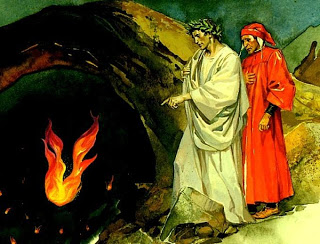
Every flame conceals a sinner. These shades sinned by being evil counsellors. They had been gifted by God with great ability, intelligence, charisma, cleverness. But they misused what God had given them. They used it in evil schemes and machinations. They talk people into doing things they shouldn’t. They use their tongues to do evil. The symbolism of flames involved in those who abused the tongue by giving evil counsel. If you read the full story of the Prophet Elijah, you will read about his fearless warnings to King Ahab. He gave the true word from God to King Ahab but Ahab listened more often to his idolatrous wife, Jezebel, who attempted to kill Elijah and all the prophets of the Lord. Elijah is the type of a good counsellor, and his reward was a fiery chariot to Heaven. The sinners in this bolgia are Evil Counsellors, and their doom is an eternal imprisonment within a narrow tongue of fire in the 8th circle of Hell in this dark fosse.
James 3:3-12 (BSB) 3 When we put bits into the mouths of horses to make them obey us, we can guide the whole animal. 4 Consider ships as well. Although they are so large and are driven by strong winds, they are steered by a very small rudder wherever the pilot is inclined.
5 In the same way, the tongue is a small part of the body, but it boasts of great things. Consider how small a spark sets a great forest ablaze. 6 The tongue also is a fire, a world of wickedness among the parts of the body. It pollutes the whole person, sets the course of his life on fire, and is itself set on fire by hell.
7 All kinds of animals, birds, reptiles, and creatures of the sea are being tamed and have been tamed by man, 8 but no man can tame the tongue. It is a restless evil, full of deadly poison.
9 With the tongue we bless our Lord and Father, and with it we curse men, who have been made in God’s likeness. 10 Out of the same mouth come blessing and cursing. My brothers, this should not be! 11 Can both fresh water and salt water flow from the same spring? 12 My brothers, can a fig tree grow olives, or a grapevine bear figs? Neither can a salt spring produce fresh water.
Dante, the poet, gives two examples of Evil Counsellors, chosen, as is Dante’s custom, from a classical story first, Ulysses, and then a Christian story second. Dante wants to speak to one of the flames that seems to divide into two. He says the flame reminds him of Eteocles and Polynices who were two brothers who quarrelled over the succession to the throne of their father, Oedipus of Thebes. They killed each other in the war of the Seven against Thebes. They were cremated on one funeral pyre but their hatred was such that the flames which consumed their bodies divided and refused to mingle and their ashes separated.
Virgil says it is Ulysses and Diomedes. They are characters in the two most important epic poems in the western tradition: The Iliad and The Odyssey by Homer. Ulysses is the Roman name for Odysseus, the hero in The Iliad and The Odyssey. Both are the stories of Ulysses travels and adventures. Ulysses’ was the son of Laertes and Anticlea; his wife was Penelope; and his son Telemachus.
Circe was a daughter of the god Helios, the Titan sun god, and Perse, one of the three thousand Oceanid nymphs or the goddess, Hecate, the goddess of witchcraft. Some say Circe was exiled to the (fictitious) solitary island of Aeaea by her subjects and her father Helios for killing her husband, the prince of Colchis. Circe was renowned for her vast knowledge of potions and herbs. Through the use of these and a magic wand, she would transform her enemies, or those who offended her, into animals. The best known of her legends is told in Homer’s The Odyssey when Odysseus/Ulysses visits her island of Aeaea on the way back from the Trojan War. Circe is initially described as a beautiful enchantress living in a palace isolated in the midst of a dense wood on her island of Aeaea. Around her home prowl strangely docile lions and wolves. She is actually a predatory female who uses her feminine wiles and sex to lure men who land on the island to her home with her lovely singing while weaving on an enormous loom, but later drugs them so that they change shape into swine. Circe invites the hero Odysseus’ crew to a feast of familiar food, a pottage of cheese and meal, sweetened with honey and laced with wine, but also mixed with one of her magical potions that turns them into swine. Only Eurylochus, who suspects treachery, does not go in. He escapes to warn Odysseus and the others who have remained with the ship. Before Odysseus reaches Circe’s palace, Hermes, the messenger god sent by Athena, intercepts him and reveals how he might defeat Circe in order to free his crew from their enchantment. Hermes provides Odysseus with the herb moly to protect him from Circe’s magic. He also tells Odysseus that he must then draw his sword and act as if he were going to attack her. From there, as Hermes foretold, Circe would ask Odysseus to bed, but Hermes advises caution, for the treacherous goddess could still “unman” him unless he has her swear by the names of the gods that she will not take any further action against him. Following this advice, Odysseus is able to get his men back into human form and free them. After they have all remained on the island for a year, Circe advises Odysseus that he must first visit the Underworld, something a mortal has never yet done, in order to gain knowledge about how to appease the gods, return home safely and recover his kingdom. Circe also advises him on how this might be achieved and furnishes him with the protections he will need and the means to communicate with the dead. On his return, she further advises him about two possible routes home, warning him, however, that both carry great danger. Circe bore Odysseus three sons: Agrius (otherwise unknown); Latinus; and Telegonus. – Wikipedia


Odysseus/Ulysses and Diomedes helped ruin each other. Ulysses and Diomedes had been accomplices. Three of their schemes are mentioned here. The “ambush of the horse” was the Trojan horse scheme in which a wooden horse statue was made to be given as a gift to Troy. Once it was wheeled inside the city, the men who were secreted inside sneaked out and the city was taken. After Troy was taken Aeneas went on to establish the Roman empire in Italy (the “Roman’s noble seed”). Gaeta, a town in S. Italy, north of Campania, thus named by Aeneas after his nurse, Caïeta. Another was the ruse they used to draw Achilles to war, leaving Deidamia to die of grief. Ulysses found Achilles with Deidamia, disguised as a woman, and talked him into partaking in the siege of Troy. He told him that they couldn’t take the city without him but didn’t tell him that an oracle had declared Achilles would be killed at Troy. And the last Dante mentions is the theft of the Palladium, the famous statue of Pallas Athene. It was supposedly Troy’s protection. Ulysses was the one who came up with the schemes and Diomedes was the implementer. Thus they are imprisoned in the same flame.


Virgil warns Dante not to speak and let him do all the talking. It’s not exactly understood why. It could be classical Greeks wouldn’t speak to an Italian who were considered barbarians in Ulysses’ day. Or it may be that they would refuse to speak to a descendant of their ancient enemies. Or it could be that Virgil thought Ulysses would respond better to himself as a fellow Greek, and writer.
Dante, the poet, constructs a story for the death of Ulysses and his remaining men based on his own imagination.
“The only hint given in The Odyssey is the prophecy of Tiresias when Ulysses meets him among the souls of dead heroes in the under-world: ‘And from the sea shall thine own death come, the gentlest death that may be, which shall end thee foredone with smooth old age.’ Although Dante had no direct acquaintance with Homer, some hint of this death of Ulysses from the sea may have reached him through translations of Greek works; and it has been suggested that his imagination wrought the story of the wild adventure ‘out of the Genoese voyages of discovery in search of a Western continent, which resulted ultimately in the discovery of America, but which up to this time had proved fruitless. One such expedition left in 1291, and was never heard of again. With this general idea Dante may have combined the well-known fable, repeated by the crusaders and others, of the Mountain of Loadstone by which ships were attracted and dashed to pieces’ [Moore, Studies in Dante (1st series), 264 n.]. The story as told by ‘the greater horn of the ancient flame’ is of so vivid an interest that it must be given in full. There can be no doubt that Tennyson’s Ulysses is a paraphrase – splendid, no doubt, but still a paraphrase – of this passage. There is the same impatience of dull domestic tameness; the same determination to ‘drink life to the lees’; the same scorn of hoarding the remnant of the years; and the same high resolve.” – John S. Carroll (1904)
Not fondness for my son, nor any claim
Of reverence for my father, nor love I owed
Penelope, to please her, could overcome
My longing for experience of the world,
Of human vices and virtue.
Dante pictures Ulysses as insatiable in his hunger for new experiences. His heroic ambition is really arrogance, pride and hubris.
“So little is the vigil we see remain still for our senses, that you should not choose to deny it the experience – behind the sun leading us onward – of the world which has no people in it. Consider well your seed: You were not born to live as a mere brute does but for the pursuit of knowledge and the good.” What Ulysses wanted is unattainable. Knowledge and wisdom without God. Who else did this?
Genesis 3:4-7a (BSB) 4 “You will not surely die,” the serpent told her. 5 “For God knows that in the day you eat of it, your eyes will be opened and you will be like God, knowing good and evil.”
6 When the woman saw that the tree was good for food and pleasing to the eyes, and that it was desirable for obtaining wisdom, she took the fruit and ate it. She also gave some to her husband who was with her, and he ate it.
7 And the eyes of both of them were opened
Satan made Eve think that she could know the same knowledge and have the same wisdom as God. He made her think God was holding out on her and she could have God’s wisdom and knowledge. I.e. she could become God. Adam listened to her and they both then disobeyed God in eating the fruit of the Tree of the Knowledge of Good and Evil. It was sin and caused the Fall. We want to be God and not have to have God. We want His wisdom and knowledge but without Him. We want to be independent instead of dependent on God. This is rebellion against our Creator and loving Father.
Even though he, and his men, are now older and not up to the rigors ahead, he can’t let it go. He wants to keep striving like he did when he was a young man. He puts his physical state into the back of his mind and wants to relive his youth despite himself. There comes a time when a wise person realizes they can no longer do what they used to do as a youth or even a man in his prime. Last summer, my husband and I joined the family in a day at the lake. We had a big picnic and two boats. The younger ones were skiing. I had told Stan not to even think about it. He was 64 and wasn’t up to trying to ski. Besides, he still works and getting injured in a leisure activity would put him out of work. So they went off in the boat without me. I sat in the shade and read my book. When they got back, they had to help him out of the boat and he was hobbling up to me with a deep purple bruise from his thigh to his lower leg. Yep, he had gotten out of my sight and told them he wanted to try to ski. He injured himself. That could have turned into a blood clot and resulted in his death. Thank God the worst didn’t happen but he suffered for his attempt to relive his youth. When you are young, there are adventures you can try. (You can also end up injured and suffering the rest of your life with those injuries.) A young body can recover better. But there comes a time when you can’t play softball anymore because you will injure your shoulder or break an ankle. You can’t snow ski any more without risking a bad injury. You can’t do gymnastic moves any more. You will want to because you remember how much you enjoyed it when you were young. You will want to relive that exhilarating experience. You want to experience the feeling that you still got it! But commonsense and wisdom should rule. Maturity gives you better sense and wisdom. Or it should. Ulysses did not use his commonsense and wisdom, nor did his men. He wanted to experience one more adventure and it cost them all. They lost their lives. All that they had been through and it still wasn’t enough. They wanted more and it cost them everything. They had tempted fate so many times and could have lived out the rest of their lives in comfort but they wanted to try one more time. “Through a hundred thousand perils, surviving all” . He was selfish in not considering his family: father, wife, son. He was selfish in not considering what was best for his men. He pushed them with a persuasive speech that he knew would get to them. He knew how to tempt them. He wanted to do what he wanted to do and had no consideration for others or commonsense.
The Pillars of Hercules on each side of the Strait of Gibraltar were set as a sign and landmark of the limits of the habitable world, beyond which it may have been regarded as an impiety to sail. Less than eight nautical miles wide, the Strait of Gibraltar is a barrier between northwest Africa and Spain, separating the two continents of Europe and Africa and separating the Mediterranean Sea from the Atlantic Ocean. The promontories that flank the entrance to the Strait of Gibraltar were called the Pillars of Hercules. The northern Pillar, Calpe Mons, is the Rock of Gibraltar. A corresponding North African peak not being predominant, the identity of the southern Pillar, Abila Mons, has been disputed throughout history, with the two most likely candidates being Monte Hacho in Ceuta and Jebel Musa in Morocco. According to Greek mythology adopted by the Etruscans and Romans, when Hercules had to perform twelve labours, one of them (the tenth) was to fetch the Cattle of Geryon of the far West and bring them to Eurystheus; this marked the westward extent of his travels. While on his way to the garden of the Hesperides on the island of Erytheia, Hercules had to cross the mountain that was once Atlas. Instead of climbing the great mountain, Hercules used his superhuman strength to smash through it. By doing so, he connected the Atlantic Ocean to the Mediterranean Sea and formed the Strait of Gibraltar. Plato placed the fictional island of Atlantis beyond the “Pillars of Hercules”. Renaissance tradition says the pillars bore the warning Ne plus ultra (also Non plus ultra, “nothing further beyond”), serving as a warning to sailors and navigators to go no further. – Wikipedia


According to Dante’s story, Odysseus/Ulysses, used his persuasive powers over his men to entice them to go beyond the Pillars of Hercules into the unknown Atlantic Ocean. To Ulysses, his men are his oars, or tools, to use for his own will.
I got
As far as Spain, Morocco, Sardinia, a host
Of other islands that the sea bathes round.
My men and I were old and slow when we passed
The narrow outlet where Hercules let stand
His markers beyond which men were not to sail
On my left hand I had left Ceuta Behind,
And on the other sailed beyond Seville.
‘O brothers who have reached the west,’ I began,
‘Through a hundred thousand perils, surviving all:
So little is the vigil we see remain
Still for our senses, that you should not choose
To deny it the experience – behind the sun
Leading us onward – of the world which has
No people in it. Consider well your seed:
You were not born to live as a mere brute does
but for the pursuit of knowledge and the good.’
Then all my companions grew so keen,
To journey, spurred by this little speech I’d made,
I would have found them difficult to restrain.
Turning our stern toward the morning light,
We made wings of our oars, in an insane
Flight, always gaining on the left.
Instead of applying their oars to escape and go back, they “made wings of our oars, in an insane flight, always gaining on the left”. Their course, at first being westward, became south-westward. Verses 127-129 indicate that the ship had crossed the equator. When they pass the equator, the North Star sinks below the “sea level”. They sailed 5 months. The mountain they see is Mount Purgatory. At first, they are jubilant to sight land, but then a storm comes up. Storms are often used by God in judgment, “as pleased an Other”. The ship of the damned goes down in a whirlpool created by the storm, “it whirled the vessel round, and round again with all the waters three times”. And now Ulysses and Diomedes share the same meager flame in the pit of Hell.
Proverbs 2:2-8 (BSB) 2 if you incline your ear to wisdom
and direct your heart to understanding,
3 if you truly call out to insight
and lift your voice to understanding,
4 if you seek it like silver
and search it out like hidden treasure,
5 then you will discern the fear of the LORD
and discover the knowledge of God.
6 For the LORD gives wisdom;
from His mouth come knowledge and understanding.
7 He stores up sound wisdom for the upright;
He is a shield to those who walk with integrity,
8 to guard the paths of justice
and protect the way of His saints.
Excerpts of Inferno are from a new translation by Robert Pinsky


No comments:
Post a Comment