

Ambrose Ervin Huneycutt married Jane Elizabeth Hinson and they had a son named,
…William Eli Huneycutt (my direct ancestor) who married Eva Malinda Boon, but they also had another son named Alvin S. Huneycutt aka “Alvie” who married Mary Ellen Stafford and they had a son named,
………Lawrence Alexander Huneycutt who married Daisy McSwain and they had a son named,
…………. Elbert Neal Huneycutt
This story is about Lawrence Alexander Huneycutt. He and his son, Elbert, were killed in a coal mine explosion. But we will get to that momentarily.
His name was spelled various ways, L.A. Huneycutt, Lawrence Alexander Huneycutt, L.A. Honeycutt, Lawrence Alexander Honeycutt, L.A. Hunnicut, Lawrence Alexander Hunnicut, L.A. Hunnicutt, Lawrence Alexander Hunnicutt. His son’s name was spelled variously as well, Albert Huneycutt, Albert Honeycutt, Albert Hunnicut, Albert Hunnicutt, Elber Huneycutt, Elber Honeycutt, Elber Hunnicut, Elber Hunnicutt, Elbert Huneycutt, Elbert Honeycutt, Elbert Hunnicut, Elbert Hunnicutt. The children spelled their last names differently using these variations.
1900 U.S. Census of Tyson, Stanly County, North Carolina; Roll: T623_ 1218; Page: 10A; Enumeration District: 128, Lines 38-45, “Alden Honeycutt” (sic, should be Alvie Huneycutt but Ancestry.com has him indexed as Alden Honeycutt)
Alden Honeycutt, Head, W(hite), M(ale), Born Sept, 1861, 38 yrs old, Married 12 yrs, Born in NC, Both parents born in NC, Farmer, rents farm, Can read and write
Mary E. Honeycutt, Wife, W, F, Born Sept, 1871, 28 yrs old, Married 12 yrs, 10 children with 6 still living, Born in NC, Both parents born in NC
Larnce A. Honeycutt (sic), Son, W, M, Born Jan, 1890, 10 yrs old, Born in NC, Both parents born in NC, Farm Laborer
Vance A. Honeycutt, Son, W, M, Born Sept, 1891, 8 yrs old, Born in NC, Both parents born in NC
Mannie Honeycutt (sic, should be Minnie Huneycutt), Daughter, W, F, Born Jan, 1893, 7 yrs old, Born in NC, Both parents born in NC
Iler P. Honeycutt, Daughter, W, F, Born Dec, 1894, 5 yrs old, Born in NC, Both parents born in NC
Olley L. Honeycutt, Daughter, W, F, Born Feb, 1896, 4 yrs old, Born in NC, Both parents born in NC
Marshel R. Honeycutt (sic), Son, W, M, Born Dec, 1898, 2 yrs old, Born in NC, Both parents born in NC
Lawrence A. Huneycutt first married Daisy McSwain (DOB: 4/21/1887 in Stanly County, NC to William A. McSwain and Lucy Lee; DOD: 7/12/1922 in Montgomery County, NC). She is aka Darcey Huneycutt, Daisey Huneycutt, Daisy Honeycutt, Daisey Hunnicutt.
1910 U.S. Census of Winfield Rd., Tyson, Stanly County, North Carolina; Roll: T624_1125; Page: 4A; Enumeration District: 0125; Image: 531; FHL Number: 1375138, Lines 12-18, “Hunley Cuntwill E.” (sic, should be Huneycutt, Will E. but because of the way the census taker wrote Huney cutt with a space between the first and second syllables and his messy handwriting)
Cuntwill E. Hunley, Head, M(ale), W(hite), 33 yrs old (DOB 1876), First marriage, Married 12 yrs (DOM 1898), Born in NC, Both parents born in NC, Farmer of home farm
Lendy Hunley (sic, should be Malinda), Wife, F, W, 33 yrs old (DOB 1876), First marriage, Married 12 yrs, 6 children with 5 still living, Born in NC, Both parents born in NC, Laborer on home farm
Oscar A. Hunley, Son, M, W, 11 yrs old (DOB 1899), Born in NC, Both parents born in NC, Laborer on home farm
Allie Hunley, Daughter, F, W, 6 yrs old (DOB 1904), Born in NC, Both parents born in NC
Dellie Hunley (sic, should be Dallie), Daughter, F, W, 6 yrs old (DOB 1904), Born in NC, Both parents born in NC
Grover Hunley, Son, M, W, 4 yrs old (DOB 1906), Born in NC, Both parents born in NC
Emmia Hunley (sic, should be Vernia), Daughter, F, W, 1 yrs 7/12 mos old (DOB 1908), Born in NC, Both parents born in NC
Bud and Bessy Floyd
Felt J. and Fannie Linger
Harry and Mary Crump
Crett Mary E. Hurrey (sic, should be Mary E. Huneycutt), Head, F, W, 38 yrs old (DOB 1872), Married 19 yrs now Widowed, 10 children with 9 still living, Born in NC, Both parents born in NC, Farmer on home farm (widow of Alexander McKinley Huneycutt, brother of William Eli Huneycutt)
Nance Hurrey (sic), Son, M, W, 18 yrs old (DOB 1892), Son, M, W, Single, Born in NC, Both parents born in NC, Laborer on home farm
Minnie Hurrey, Daughter, F, W, 17 yrs old (DOB 1893), Born in NC, Both parents born in NC
I. Loe Hurrey (sic), Daughter, F, W, 15 yrs old (DOB 1895), Born in NC, Both parents born in NC
Olla Hurrey (sic), Daughter, F, W, 14 yrs old (DOB 1896), Born in NC, Both parents born in NC
Marshall Hurrey, Son, M, W, 11 yrs old (DOB 1899), Born in NC, Both parents born in NC
Jenenia Hurrey (sic), Daughter, F, W, 7 yrs old (DOB 1903), Born in NC, Both parents born in NC
Johnnie Hurrey, Son, M, W, 6 yrs old (DOB 1904), Born in NC, Both parents born in NC
Leaured Hurrey, Son, M, W, 4 yrs old (DOB 1906), Born in NC, Both parents born in NC
Launce A. Hunycutt (sic, should be Lawrence A. Huneycutt), Head, M, W, 20 yrs old (DOB 1890), First marriage, Married 1 yr, Born in NC, Both parents born in NC, Farmer of home farm (son of Alvin and Mary Huneycutt)
Daisey Hunycutt (sic), Wife, F, W, 22 yrs old (DOB 1888), First marriage, Married 1 yr, 1 child with 1 still living, Born in NC, Both parents born in NC
Lucy Hunycutt, Daughter, F, W, 7/12 mos old (1909), Born in NC, Both parents born in NC
WWI Draft Registration
FHL Roll Number: 1765691, DraftBoard: 0, Handwritten at top #602, No. 21, Lawrence A. Honeycutt, 27 yrs old, DOB: 1/31/1890 in Iredell County, NC
Address: Capelsie, NC
Occupation: Laborer in cotton mill for Capelsie Cotton Mill, Capelsie, Montgomery County, NC
Dependents: Wife and 4 children
Married, Caucasian
“Wife and 4 children to support”
32-1-35-A
Medium Height, Stout Build, Brown Hair, Black Eyes
Signed by Lawrence A. Honeycutt on 6/5/1917 in Troy, Montgomery County, NC
1920 U.S. Census of Troy, Montgomery County, North Carolina; Roll: T625_1311; Page: 4A; Enumeration District: 81; Image: 889, Lines 39-44, “Larnce Hunnicut” (sic)
Larnce Hunnicut, Head, Rents home, M(ale), W(hite), 32 yrs old (DOB 1888), Married, Can read and write, Born in NC, Both parents born in NC, Laborer in cotton mill
Daisy Hunnicut, Wife, F, W, 33 yrs old (DOB 1887), Married, Can read and write, Born in NC, Both parents born in NC, Laborer in cotton mill
Lucy Hunnicut, Daughter, F, W, 10 yrs old (DOB 1910), Born in NC, Both parents born in NC
Loise Hunnicut, Daughter, F, W, 8 yrs old (DOB 1912), Born in NC, Both parents born in NC
Elber Hunnicut (sic), Son, M, W, 5 yrs old (DOB 1915), Born in NC, Both parents born in NC
Ceacil Hunnicut (sic), Son, M, W, 3 yrs 4/12 mos old, Born in NC, Both parents born in NC
Lawrence Alexander Huneycutt and Daisy McSwain had 7 children:
1) Lucy Ellen Huneycutt (DOB: 9/17/1909 in Anson County, NC; DOD 2/10/1964 in Goldsboro, Wayne County, NC) married James Edgar Thomas, Sr.
2) Lois Virginia Hunnicutt (DOB: 8/6/1911 in Stanly County, NC; DOD 12/4/1938 in Troy, Montgomery County, NC) married Samuel Neil Lamonds.
3) Elbert Neal Honeycutt (DOB: 1/26/1914 in Montgomery County, NC; DOD: 3/28/1931 in Chatham County, NC)
4) Cecil William Huneycutt (DOB: 8/6/1916 in Montgomery County, NC; DOD 12/15/1993 in Davidson County, NC) married Frances Louise Westmoreland.
5) Paul A. Huneycutt (DOB 1/5/1920 in NC; DOD 9/18/1989 in ? )
6) Infant Son Huneycutt (DOB 1918; DOD 1919)
Daisy accidentally fell and the baby died in utero. Unfortunately, she didn’t give birth for a few days and by then she had peritonitis and she died 7/12/1922.
NC Death Certificate #142, Registration District #62-5830, Certificate #14, Darcey Hunycutt (sic), DOD: 7/12/1922 in Troy, Montgomery County, NC
Female, White, Married to L.A. Huneycutt, DOB: 4/21/1887 in Stanly County, NC, 34 yrs, 2 mos, 21 days old
Occupation: Domestic
Father: W.A. McSwain, born in Stanly County, NC
Mother: Lucy Lee, born in Anson County, NC
Informant: L.A. Huneycutt, Capelsie, NC
DOD: 7/12/1922 at 7pm
Cause of death: Peritonitis general due to injury during childbirth
Burial: 7/13/1922 at Cottonville, NC
NC Death Certificate #582, Registration District #62-5830, Certificate #7, Unnamed Huneycutt, DOD: 6/21/1922 in Troy, Montgomery County, NC
Male, White, DOB: 6/21/1922 in Montgomery County, NC, “Born dead”
Father: L.A. Huneycutt, born in Idle County, NC (sic)
Mother: Daisy McSwain, born in Stanly County, NC
Informant: L.A. Huneycutt, Cander, NC (sic)
DOD: 6/21/1922
Cause of death: “Born dead. Had been dead in utero for few days”
Contributory Cause: “Mother sustaining a fall”
Burial: Laurel Hill Cemetery, NC on 6/21/1922
No undertaker
Lawrence then married Daisy‘s sister, Bertha Emaline McSwain (DOB: 9/11/1896 in NC to William A. McSwain and Lucy Lee; DOD: 8/22/1971 in Onslow, Jackson County, NC) on 7/13/1924 in Montgomery County, NC. She had been married in 1914 to Elmer Mead Thomas (DOB 10/15/1894 in Anson County, NC; DOD 11/21/1953 in ? ; he married 2nd Reine Greenlee). They had three daughters:
Lawrence and Bertha Huneycutt had 3 children:
1) Samuel Lloyd Honeycutt (DOB: 9/15/1923 in NC; DOD 2/19/1997 in Durham, Durham County, NC) married Cornelia Helen Barrett.
2) Lawrence Alexander Honeycutt, Jr. (DOB: 3/27/1926 in Cape Elsie, Montgomery, NC; DOD 4/25/1997 in Burlington, Alamance County, NC) married Lula Belle Crutchfield.
3) Frances Jerlene Honeycutt (DOB: 5/2/1928 in NC; DOD 12/25/2012 in Albemarle, Stanly County, NC) married Crayton Reid Hardin.
1930 U.S. Census of New Hope, Chatham County, North Carolina; Roll: 1681; Page: 3A; Enumeration District: 23; Image: 169.0, Lines 40-47, “Lawrence A. Hunnicutt“
Lawrence A. Hunnicutt, Head, Rents home $12/mos, No radio set, M(ale), W(hite), 40 yrs old (DOB 1890), Married at age 19 yrs old, Can read and write, Born in NC, Father born in NC, Mother born in SC, Miner at coal mines
Bertha Hunnicutt, Wife, F, W, 38 yrs old (DOB 1892), Married at age 18 yrs old, Born in NC, Both parents born in NC
Cecil W. Hunnicutt, Son, M, W, 13 yrs old (DOB 1917), Born in NC, Both parents born in NC
Paul A. Hunnicutt, Son, M, W, 10 yrs old (DOB 1920), Born in NC, Both parents born in NC
Sam L. Hunnicutt, Son, M, W, 7 yrs old (DOB 1923), Born in NC, Both parents born in NC
L. A. Hunnicutt, Son, M, W, 4 yrs old (DOB 1926), Born in NC, Both parents born in NC
Frances G. Hunnicutt, Daughter, F, W, 2 yrs old (DOB 1928), Born in NC, Both parents born in NC
Elma Thomas, Stepdaughter, F, W, 10 yrs old (DOB 1920), Born in NC, Both parents born in NC
Lawrence and Bertha moved to Glen Coal, Oakland, Chatham County, NC about 1925 where he worked in the coal mines. He and his son, Elbert, were killed in a mine explosion. There is a short summary history of the coal mines and the newspaper articles.
NC Death Certificate #176, Registration District #19-2243, Registrar’s Certificate #5, Lawrence Alex Huneycutt, DOD: 3/28/1931 in Oakland, Chatham County, NC
Male, White, Married to Bertha Huneycutt, DOB: 1/31/1889 in NC, 40 yrs old
Occupation: Coal mines
Father: Alvin Huneycutt, born in “don’t know”
Mother: Mary Stafford, born in “don’t know”
Informant: Mrs. L.A. Huneycutt, Route 4, Sanford, NC
DOD: 3/28/1931
Burial: 3/31/1931 at Cottonville
If death was due to external causes (violence) fill in also the following:
Accident, Suicide, Homicide? “Accident“, Date of Injury: 3/28/1931
Where did injury occur? “Chatham County, NC“
Specify whether injury occurred in industry, in home, in public place:
“In coal mines“
Manner of injury? “Killed from glass explosion” (sic, his son was killed at the same time and his death certificate says “killed from gas explosion”)
Nature of injury? “Body burned“
Was disease or injury in any way related to occupation of deceased? “Yes“
If so, specify? “Was looking after pump in mine “
George Brooks, Coroner, Pittsboro, NC
NC Death Certificate #177, Registration District #92-43, Certificate #6, Elbert Neal Huneycutt, DOD: 3/28/1931 in Oakland, Chatham County, NC
Male, White, Single, DOB: 1/26/1914 (sic) , in Stanly County, NC, 17 yrs old (sic)
Occupation: “Coal mines”
Father: Lawrence N. Huneycutt (sic), born in Stanly County, NC
Mother: Daisy McSwain, born in Stanly County, NC
Informant: Mrs. L.A. Huneycutt, RFD #4, Sanford, NC
DOD: 3/28/1931
Burial: 3/31/1931 in Cottonville
If death was due to external causes (violence) fill in also the following:
Accident, Suicide, Homicide? “Accident“, Date of Injury: 3/28/1931
Where did injury occur? “Chatham County, NC“
Specify whether injury occurred in industry, in home, in public place:
“In coal mines“
Manner of injury? “Killed from gas explosion“
Nature of injury? “Body burned“
Was disease or injury in any way related to occupation of deceased? “Yes“
If so, specify? “Was looking after cump in m______ ” (illegible, according to his father’s death certificate this probably should have read “Was looking after pump in mine”.)
The Coal Glen-Farmville Mine Disaster was the worst industrial accident in North Carolina history. Lawrence A. Honeycutt was killed in 1931, 6 years after the 1925 Coal Glen Mine Disaster. But according to the article below, he may have been hired just to watch the pumps that pumped the flood waters out and that pump may have exploded. He may not have been working the coal, per se.
The State Magazine
June 1987 Issue
The Coal Demon
Of Deep River
Tragedy and failure have plagued miners’ efforts for 200 years, but men are ready once again to try their luck.
By MICHAEL HETZER
… In 1921 one of the most important events that ever occurred on the Deep River Coal Bed took place. The Carolina Coal Company was formed with the intention of developing a mine near Farmville across the river from the Egypt Mine. The mining town that would arise was to be called Coal Glen. The Carolina Mine is often called the Coal Glen Mine, or the Farmville Mine.
The Carolina Mine was the most ambitious mining operation ever begun on the Deep River Coal Bed. In 1923, its first year of full-scale operation, its output more than doubled the best of the Old Egypt Mine. Once again the future looked bright for a mine on the Deep River – Coal Bed. But the profits never came. In 1925 the demon dealt its most vicious blow ever.
At seven in the morning on May 25, the morning shift, numbering seventy-four miners, descended into the dark of the Carolina Mine. Two and a half hours later the first of three terrific explosions tore through the mine. Its vibrations were felt as far as a mile away. Families and company officials rushed to the mine entrance Poisonous, yellow gas billowed from the mine entrance, making rescue impossible. It took five days to pull all the bodies from the mine. The story made front page news all across the country.
Fifty-three men died that morning.
The Carolina Mine closed four years later. Ironically, it was not a mine explosion that closed the mine, but water and human carelessness. Rains swelled the Deep River in 1929 and the mine began to flood through an air shaft. The water was pumped free, but no precautions were taken against subsequent flooding. The mine flooded again in 1930 putting an end to the Carolina Mine, after less than mine years of operation. The flood waters, the prohibitive cost of transportation, the accidents, and the market crash of 1929 had conspired to bankrupt the Carolina Coal Company. Another Deep River mine had closed in failure.
The Carolina Mine was opened again between 1947 and 1951 but failed to turn a profit and was allowed to reflood. It has not been opened since…
Coal Glen Mining Disaster
History of Cumnock Coal Mine
Chatham County, NC
The News And Observer, Raleigh, NC, Tuesday, 3/31/1931, Pg 1 and 2
Recover Bodies Of Two Men Imprisoned Under Cave-In At Coal Mine
Rescue Workers Reach Bodies of Father and Son in Carolina Mine After Hours of Incessant Toil
EXPLOSION IN MINE NOW BLAMED INSTEAD OF STORM ON OUTSIDE
Rescue Party Toils Incessantly at Risk of Life and Without Pay To Succor Comrades; Widow, Maintaining Vigil at Mouth of Mine, Clings To Hope To Last; Is Left Penniless With Seven Children By Disaster; Hazardous Task of Sinking 35 Foot Emergency Shaft Requires 24 Hours; Workers Believed They Were Near Goal At Noon Yesterday When Ventilating Fan Failed and Rescuers Were Driven Back By Gas
By Charles Parker, Staff Correspondent
Sanford, March 30 – Another tragic chapter in the history of the Deep River coal field was concluded late tonight with the discovery of the bodies of Lawrence and Alber Honeycutt (sic), father and son, imprisoned under a rock-slide on the 2,600 foot level of the Carolina Coal mine at Coal Glen.
Suspect Explosion
Finding of the men on the 2,600 foot level instead of the 3,800 foot level where they were supposed to have gone to man the lower level pumps raised the question of whether they ever reached their posts, or were caught in an attempt to make their way out.
Discovery of the rock-slide altered opinions as to the cause of the cave-in of the air shaft, originally attributed to the cloudburst Saturday night shortly after the men entered the mine. Evidence now points to a local explosion as the cause of the air-shaft collapse so well as the shuttling off the electric and stoppage of the ventilating fan, also originally attributed to the storm.
B.H. Garner, who was assigned to the pump on the higher level, reported no explosion when he left the mine Sunday without ascertaining the condition of the other two men in the workings with him, although he did state that no water had come up to his pump from the lower level. He attributed this, however, to the fact that the men sometime – moved the pump instead of pumping.
Death Came Quickly
The bodies of the men were brought out shortly after their discovery and taken to Sanford. It was thought they were either killed instantly or died shortly after being imprisoned.
A coroner’s jury is scheduled to investigate the disaster Tuesday.
Discover of the bodies came after a 40 hour effort of volunteer rescuers, first to restor an obstructed air shaft blocked by a cave-in during the cloudburst Saturday night, and then to penetrate the treacherous gas filled diggings to where the Honeycutts were separated from rescuers by a wall of deadly gas which arose when almost simultaneously the electric current driving the ventilating fan failed and the air shaft collapsed during the storm, which blue up an hour after the men took up their post in the mine.
Led by O.A. Wakefield, former superintendent of the mine, the rescue crew composed of miners, most of whom at one time or another have worked in the Carolina Mine before its recent shut down, toiled incessantly from 9 o’clock Sunday when it was discovered that the Honeycutts, who were part of the skeleton night crew of three which manned the pumps to prevent the mine from flooding, had not returned from their post and that the mine, below the 1,300 foot level, was filled with gas.
Held Dim Hope
The rescuers, spurred on by the dim hope that their fellows might be alive – bratticed in a room free from the poisonous gas – risked their own lives in sinking a shaft 35 feet through treacherous murk to the obstructed air shaft without compensation or hope of compensation.
The same storm credited with being responsible for the disaster, one of a series that has stalked the enterprise, locked the secret of the valiant rescue battle in the isolated mining community when it put the only telephone line to Sanford out of commission, and there were never more than a hundred spectators present – a striking contrast to the milling multitudes that flocked from all over the State in May, 1925, when 53 miners were killed in an explosion.
Dawn Crept upon the valiant band of rescuers, erasing grotesque shadows of the weary men cast by a log blaze, and was succeeded by brilliant sunshine before the tons of rock and much had been hauled out of the broken air shaft 35 feet below the surface and the aperture sealed with brattleing cloth.
It was 24 hours after the rescue crew, varying from 40 men Sunday when hope was high, to a mere handful at dawn when there was little hope, completed their task and the… continued page 2
Locate Bodies of Two Men Imprisoned Under Cave-In At Coal Mine
…improvised roof of the shaft rose and fell with the rhythm of human respiration as the life sustaining air once again was forced into the mine.
Venture Into Entrance
At 10 o’clock the rescuers moved up to the tipple at entrance to the slope into which father and son had walked Saturday evening and never returned. A miner ventured a few feet down the slope. Superintendent Wakefield, with a safety lamp, went down the steep incline a short way. He was forced back by the dread gas, but calculated that the draft was forcing it back at the rate of three feet a minute.
At 11 a “trip” with two cars attached to a cable began its clanking descent.
Hope revived in the group about the yawning black entrance – a group centered about Mrs. Honeycutt and seven children, waiting, waiting.
At 11:15 the creaking cable gave notice that the “trip” was returning to the surface. The dripping cable drew the cars out of the darkness at a pace that seemed faster than normal.
The “trip” groaned to a stop in the sunlight.
The men blinked their eyes beneath their still glowing miners head lamps. Solemnly they filed away toward the fan house, toward the newly covered air shaft.
Realization of what had happened spread like lightening.
No longer was heard the whine of the life-giving fan.
An ominous silence dashed hope renewed.
The fan was broken.
It was the last straw.
Even those courageous souls who had looked death in the face as they pecked that opening in the earth with their pitifully inadequate tools to mend the air shaft wilted in the face of mechanical failure.
They had been making good headway.
They had hopes of reaching their comrades in two hours – three perhaps, but not much longer.
Then the belt turning the great fan slipped. Like a vengeful reptile it coiled and lashed, destroying the device upon which rested the last faint hope of succor.
The fan silent, the gas again began to rise. The brave efforts of the morning were gone. For every inch the gas had been driven back it was now rising two.
Family Leaves the Scene
Mrs. Honeycutt, a tall woman with features deserving of better than the carelessly worn black straw hat and a tan coat that was far too scanty, gathered up her family and returned to their unpainted pine dwelling across the road.
That they are penniless she admitted. What they will do she doesn’t know. Four years when they lived in Montgomery county and wrested an uncertain living from employment in cotton mills, Mrs. Honeycutt added to her income by sewing after hours in the mill.
She is a good seamstress, other women of the settlement say, but there is no sewing to be done on Coal Glen this spring. There are no Easter bonnets to be bought. No new hats for the girls who with ill-concealed tears clustered about the mine entrance awaiting some word of Elber.
The mine has been shut down. When the mine is not running there are no pay days in Coal Glen.
Miner Honeycutt carried no insurance. His occupation was considered too hazardous. Young Elber had no insurance. Young Elber feared the mine. It was against the law for him to work in it anyway, not being 18 years old. It wasn’t his turn to go in Saturday night, but Ed Hicks, who was tired after four night straight work, wanted to swap shifts.
Ed Hicks was alive today.
“I had a premonition something was wrong,” said Mrs. Honeycutt, “I went to the mine entrance and looked at 7 o’clock Sunday morning, but saw nothing. Still I was uneasy. When Mr. Garner came out I asked him about Mr. Honeycutt and Elber. He said he didn’t know why they hadn’t come out. I gave the alarm. They started working about 9 o’clock, but I don’t know whether there’s a chance for them. All we can do is to hope.”
The wife of the miner labored under the terrific strain of uncertainty, but she maintained a composure typical of the wives of miners. It is a sort of stoicism that was all the more apparent in 1925 when nearly half the male population of Coal Glen was swept away in one blast. Daily they see their men go into the yawning black mouth. Daily they see them return until that one day which they always thought would not fall to their man or at least for them would be tomorrow. Then they are inured to the living.
“Why B.H. Garner, who operated the pump on the upper level but got no water from the lower level pump operated by the Honeycutt’s did not investigate, or why he left the mine knowing that they had not passed him on their way out, has not been explained.
There are also ugly stories about the shaft being partly caved in before the cloudburst of Saturday night brought the complete collapse. That it was not maintained like it would have been had the mine been in operation.
Anyway, there seems little doubt that the storm was the immediate cause of the disaster.
It caused the cessation of electric current which stopped the big fan temporarily. It caused the cave-in which obstructed the air shaft even after the current had come on again.
Ancient Workings
The Deep River field, in which the Cumnock and the Carolina mines are the principal producers, has been worked at intervals since before the Civil War, producing a good quality of steam coal. Neither min is now being operated, the Cumnock mine being flooded, and the Carolina never fully recovered from the 1925 catastrophe which entailed a loss of more than $175,000.
The mine took on new life in 1928 when State’s prisoners were put in it, but relapsed when Governor Gardner ordered them removed after receiving a report that the mine was highly dangerous. Six Negro convicts were killed and a number of others injured during the short time they were worked.
STATE DOES NOT PROTECT MINERS
Grist Points To Law Without Machinery; Carolina Min Ill Fated
By its failure to set up the machinery necessary for enforcing the law on its statute books for a third of a century, North Carolina affords its citizens engaged in mining no protection despite the fact that the occupation is by nature a hazardous one and its dangers may be greatly increased by worn out or insufficient equipment and machinery, Commissioner of Labor and Printing Frank D. Grist stated yesterday.
Following a major mine disaster in the 1890’s the Legislature of 1897 passed a law requiring State inspections of mines and providing that the inspector “shall particularly examine the works and machinery belonging to any mine, examine into the state and condition of the mines as to ventilation, circulation, and condition of air drainage and general security” – but it placed the duties of the inspector, which demand a technically trained man, on the Commissioner of Labor and Printing. Neither that Legislature nor succeeding ones have seen fit to provide funds for conducting the investigations of mines or of accidents and fatalities occurring in the mines.
Petitioned Legislature
On December 26, 1928, two Negro prisoners of the State were killed instantly, two others so severely injured that they died of their wounds, and seven others seriously injured when a coupling on a train of cars in the Carolina mine, where two men were entombed Saturday, became disjointed sending cars bearing a score or more of Negro convicts dashing back down the steep incline.
At the 1929 session of the Legislature, which convened soon afterwards, Commissioner Grist, after making an examination of the accident, again proposed that the State provide funds for employing a trained inspector competent to pass upon the safety of mines, and also funds for investigating fatal accidents. The bill was killed in the Appropriations Committee.
Since the first serious disaster in the latter part of the last century tragedy has followed tragedy in the mines of the Deep River filed, including Cumnock and Carolina although the ownership has changed hands in the meantime. Although refinanced, the mines have not in recent years been regarded as being abreast of the times in modern equipment and machinery.
Insurance companies licenses in North Carolina refused to write Workmen’s Compensation insurance for the Carolina mine, and Insurance Commissioner Dan C. Boney did not require the companies to offer rates, on the basis of a report stating the mine was so hazardous that companies did not care to underwrite it.
Records of accidents are required by law to be filed with the Commissioner of Labor and Printing, and although Commissioner Grist says his records are incomplete, here is a partial list of reports filed since his last request to the Legislature was denied. The dates are those borne on the face of the report and are not necessarily the same date as that on which the accidents occurred.
Fatalities reported from this group of mines include:
June 4, 1919, “George Sanderford, prisoner came to death while working in mine of Carolina Coal Company. Cause of death, being caught and pinned under coal car when main cable broke. Cause of breaking of said cable unknown to said jury.”
July 19, “Rual Barentine, white, Overcome by black damp”
August 28, “Dan Moore, of Cumnock, white, electrocuted. The verdict of the jury was that Moore came to his death by coming in contact with a live wire, caused by his own negligence.”
January 17, 1920, “William Snuggy came to his death from bying asphyxiated due to carelessness on part of deceased.”
February, 20, 1931, “Verdict reached by jury was that Joe Johnson, deceased, came to death through negligence on his part from grabbing a 440 voltage wire.”
Injuries Also
Reports on the injured:
May 10, 1929, John Harris, Negro prisoner, collar bone broken.
May 24, Richard Satterfield, Negro prisoner, left foot amputated above ankle.
June 12, Raymond Davis, Negro, compound fracture on right leg between knee and hip.
June 13, Bubba Lee Wilson, Negro prisoner, Potts fracture of right ankle.
August 3, T.O. Bishop, white, Greensboro, cracking bone hear hip.
August 14, Fred Foster, Negro, sprain in instep.
August 17, Ed Sloan, white, Greensboro, small bone in instep cracked.
September 4, Sam Howard, white, Roanoke, Va., broken right leg above ankle.
September 5, Porter Alston, Negro, lacerated forehead…
And so on through the list.
Commissioner Grist said that he had not been notified of Saturday night’s disaster except through the perusal of the newspapers. He stated further that he did not intend to go to the scene, since he was not equipped with necessary facilities for making an investigation.
The Chatham Record, Pittsboro, NC, 4/2/1931, Pg 1
TRAGEDY SWOOPS AGAIN AT COAL GLEN
Father and Son Overcome by Gas When Cave-In of Air Tunnel Prevents Suction of Gas by 100 Horsepower Fan. – Two Days of Constant Waiting and Work for Approach to Bodies.
Lightning Stops Motor
DownPour of Rain Causes Caving – Evidence of “Local” Explosion Also Discovered
WIDOW AND 7 CHILDREN LEFT WITHOUT SUPPORT
The ill fate which seems to have attended operation of the Carolina Coal Company’s mine at Coal Glen, 12 miles from Pittsboro, has again swooped down upon the scene and leaves Mrs. Lawrence Hunnicutt and seven children mourning the loss of the husband and the eldest son, Elber, a youth of less than eighteen years.
The electric storm whos mumblings were heard at Pittsboro Saturday shortly after nightfall seems to have been much more intense at Coal Glen. The lights in Pittsboro went off, presumably by the will of the operator at the distant point of control. But down at Coal Glen the lightning itself seems to have cut off the current from the 100 horsepower motor which operates the great ventilating fan for the coal mine. The current broken, the lagging drive wheel threw its belt off, and the fan, which drew the poisonous gas from the mine and sent the life giving fresh air throughout its deep caverns, of the mine, stopped. But such an accident gives its warning by the clanging of a bell. This warning, according to Mr. McQueen, president of the Carolina Coal Company, sounded about 8:30 Saturday evening.
The motor was started again, but another mischief had occurred, or shortly occurred, which gave no warning. The stays of the tunnel through which the gasses are sucked had given way only a few yards from the location of the fan and tons of carbony and rocky earth had tumbled into the tunnel, largely closing the gas exit. And thus, though the fan whirled with its 100 horsepower, the gas was rapidly accumulating in the lower levels of the mine.
At 6 o’clock on that fateful Saturday evening, Lawrence Hunnicutt and his 17-year-old son, Elber, had left their little home, stating that they would be back in an hour. It was their task that night to proceed to the water pumps in the lower depths of the mine and operate them as much as necessary through the night. The pump was on the 3,000 foot level of the mine, as the mine slopes toward Deep River.
But whether they ever reached the pumps on that lower level became a question when their bodies were finally reached late Monday. For the bodies were found at the 2,600 foot level and evidences of a produced the destroying gas in such “local” explosion, which might have quantities as to make their immediate death certain, were discovered.
They had gone, one of them at least, assuring that he would soon return, but when the night had passed and neither father nor son had returned to the waiting mother of the home, she went to the mine’s mouth and looked down into the black throat of the consuming monster, which at one gulp six years ago had destroyed the lives of 53 miners, and which time and again since has taken its toll one by one, by electrocution and a variety of other means. Only a month previously one Johnson had been taken and his brother injured but was returning that very day from a Sanford hospital.
Uneasy, but not yet giving the alam and further disturbed when Mr. Garner from a higher level had returned without having level had returned without having seen the missing men, though somewhat assured by his word that no explosion had occurred to his knowledge before he left, she bore the strain till 9 o’clock Sunday morning, when she alarmed the remnant of the mine force left on the premises since the recent closing of the mine while awaiting the outcome of negotiation for a sale to a company of great financial strength, which might develop the potential wealth of the field in coal and other minerals to that degree which seems readily possible.
With the alarm came the discovery that the air tunnel had caved in… continued on page 3
…and the furious labor of forty men digging toward the closed life-giver. A shaft thirty five feet deep must be sunk through the brittle mass at the cave-in to reach the tunnel and clear it of its circuit-breaking stoppage. The gas is tasteless and utterly without odor and would be seeking its way through the pores of the loosely formed burden above the broken tunnel. Yet at risk to their own lives these men digged desperately at the job through the gracious sunny hours of Sunday and on through the night, only relieving the tunnel of its unwonted accumulation Monday morning, it was just about 24 hours after the beginning of the frantic digging that the tons of earth and rock were removed and the tunnel was ready for rebuilding and sealing against the disturbance of the suction power.
Now the fan may be started again, but hope has become faint. There was nothing to hinder the men’s walking forth so far as material impediment was concerned; the way was open. The only hope that survived was that the men had escaped to a protected pocket and thus escaped the fatal gas.
Mrs. Hunnicutt and the seven children some hers by a former husband, some her husband’s by a former wife, and one of the marriage of herself and Mr. Hunnicutt, had hovered about the mouth of the mine many trying hours. What hope she might have had was dashed when at midday Monday the fan belt broke and the gas, which was being gradually but surely drained out, again began to accumulate. Again the fan is going, but hope is lost. President McQueen professes not the least idea that the men survive when the writer appears on the scene Monday afternoon. The car and brave men, led by former superintendent of the mine Wakefield, for hours would gradually lower and the the brave men would explore as far ahead as they dared. Coroner Geo. H. Brooks was on the scene awaiting the finding of the bodies. This discovery came earlier than otherwise expected because of the location of the victims at a level several hundred feet higher than thought. But whatever of inquest there should be was postponed till Tuesday.
Every indication gave evidence that the men, as expected to be the case, had died painlessly. The bodies were rescued and taken to the little home, just two hundred yards from the fatal mine mouth.
Much solicitude had been felt with respect to the family’s material welfare. Mr. McQueen had gone early in the day and asked about provisions. A supply had been got Saturday evening. But work had been scarce and the conditions of the company such that payment had sometimes been deferred. The family is scantily supplied with clothing, and there is no one left except the mother and a fifteen-year-old daughter to earn a living. There was no compensation insurance. Employment in the mine had been pronounced too hazardous by the insurance companies to accept risks. Again, the overburdened Company will have to make such compensation as it can. But John McQueen, one of the best men in the world, would himself go hungry before he would consent to forego any sacrifice to compensate this wife and the children of her own and those of the dead husband.
Sept. Reid Thompson, who serves also as welfare officer for the county, visited the family and is undertaking to secure clothing for the eight survivors. Unfortunately, the county provides no real welfare fund, and the family, as many other unfortunates, must rely upon the liberality of individuals, and we might say right here that few know how much Supt. Thompson’s own funds goes to the relief work which he sees so badly needed.
Mr. and Mrs. Hunnicutt are originally from Stanly County. They have been at Coal Glen six years and were accounted among the permanent forces of the mine. Fortunately, Mrs. Hunnicutt has worked in cotton mills and hopes that she and her daughter may get work in the mills of her old home county of Albemarle.
Pg 2 DEATH DUE TO EXPLOSION
The coroner’s jury which held an inquest over the bodies of Lawrence and Elber Hunnicutt at Coal Glen Min pronounced the deaths due to an explosion within the mine. However, it is presumable that the explosion in the mine was a consequence of the outside disturbance resulting from the storm.
Asheville Citizen Times, Asheville, NC, 3/1/1931, Pg 9
SEARCHER’S FIND MINERS’ BODIES
L.A. Honeycutt And Son, Elber, Imprisoned By Cave In Of Rock
Coal Glen, March 30 – The bodies of L.A. Honeycutt and his son Elber, 17, were found tonight imprisoned under a cave in of rock 2,600 feet down the shaft of the North Carolina coal mine here.
There was evidence that there had been a “local” explosion, officials of the mine said, but until the bodies were removed and the debris in the shaft cleared, they said they did not expect to be able to ascertain, if they ever are able, what caused the block.
In Since Saturday
Honeycutt and his son entered the Carolina mine Saturday evening and until their bodies were found and removed tonight nothing further had been heard of them.
They were supposed to go down about 3,600 feet to man a water pump while B.H. Garner worked a relay pump on a higher level. Garner said he noticed no water came up from the lower level, but thought the men were moving the pump instead of running it. He left the mine Sunday morning, and reported he had no knowledge of any explosion.
Until the debris is cleared, which will probably take a day, mine officials said it would be impossible to tell whether the men were killed on their way into the mine abou 8 o’clock Saturday night or later.
Work Relaxed
Work of the miners seeking the two men was delayed today when the belt on the giant ventilating fan of the mine broke, damaging the motor running the fan and allowing the mine shaft to fill again with poison gas after a 36-hour battle had opened a block in the main air shaft.
Honeycut and his son, who often expressed his fear of mining and strenuously objected to going into the mine Saturday to relieve Ed Hicks, who had worked at water pumps in the 3,500 foot level of the shaft for four nights, entered the mine after telling Mrs. Honeycutt they would “be back in an hour if the gas is bad.”
An hour after they entered the mine a terrific electrical storm caused current operating the ventilating fan to break, stopping air circulation through the shaft. A heavy downpour of rain at the same time caved in the main shaft of the mine, cutting off any chance of forcing fresh air into the deep mine until the blocked passage was opened.
Air Shaft Opened
Throughout Sunday and under a brilliant moon at night, miners worked untiringly under the direction of O.A. Wakefield, a former superintendent of the Carolina Mines, and this morning succeeded in opening the air shaft by digging a hole 35 feet deep into it and then sealing the well-like entry so that air could be forced through the mine by pressure and suction.
Wakefield, though he had been at work 25 continuous hours at the time, led a little band of miners into the sloping shaft today and got down 950 feet before encountering gas which forced them out.
Mrs. Honeycutt, usually accompanied by several of her nine children, continually was visiting the scene of work at the air shaft and waited at the mouth of the mine for word from the would-be rescuers though she, like nearly every one else, believed there was no chance her husband and son would be found alive.
The tragedy caused little excitement in the small Coal Glen community. In a little more than six years the mine has claimed 55 lives, 53 in an explosion and two convicts killed when a cable broke and allowed a coal car to run wild.
The News And Observer, Raleigh, NC, 4/1/1931, Pg 1
DEATH OF MINERS LAID TO EXPLOSION
Jury of Inquest So Finds In Killing of L.A. Honeycutt and His Son
Sanford, March 31 – The death of L.A. Honeycutt and his son, Elbert Honeycutt, in the coal mine of the Carolina Coal Company at Coal Glen was caused by an explosion resulting from insufficient air, according to the finding of the coroner’s jury announced this afternoon after an inquiry lasting several hours and held in the office of the Carolina company.
It was said by witnesses who knew something of the workings of the mine that the explosion was caused by a spark and that the spark could have been caused by throwing a switch, by a rock falling on a wire, by a short circuit or other occurrences.
Insufficient Air
The insufficiency of air was thought to be due to the electric storm Saturday night cutting off the current thus stopping the fan or by the cave-in stopping or limiting the circulation of air, or both.
The exact wording of the verdict was “the death of the two men was caused by a local explosion on account of insufficient air.”
There was one woman on the jury of inquest summoned by Coroner George H. Brooks, she being Miss Helen Daughtery. The others on the jury were E.E. Williams, H.C. Johnson, Tucker Perry, H.G. Beard, and Albert Seagroves.
Witnesses examined were O.A. Wakefield, foreman of the mine when it was in operation; Fred Hanes, who operated one of the pumps Pete Jones, Dempsey Hausely, colored; Babe Campbell, Smith Poole, Lynn Campbell and a man named Garner. These were all present or former employees of the Carolina Coal Mine.
1940 U.S. Census of Thompson, Alamance County, North Carolina; Roll: m-t0627-02868; Page: 23B; Enumeration District: 1-15, Lines 73-76, “Bertha Honeycutt“
Bertha Honeycutt, Head, Rents home for $2, F(emale), W(hite), 44 yrs old, Widowed, Attended school thru 5th grade, Born in NC, Lived in same place in 1935, Winder in cotton mill, Income $520
Sam Honeycutt, Son, M, W, 17 yrs old, Single, Not attending school, Attended school thru 5th grade, Born in NC, Lived in same place in 1935, Sweeper in cotton mill, Income $169
Lawrence A. Honeycutt, Son, M, W, 15 yrs old, Not attending school, Attended school thru 4th grade, Born in NC, Lived in same place in 1935, No occupation
Frances Honeycutt, Daughter, F, W, 12 yrs old, Single, Attending School, Attended school thru 5th grade, Born in NC, Lived in same place in 1935

Bertha Emaline McSwain Huneycutt died in Jackson County, NC.
NC Death Certificate #28780, Registration District #6780, Local # , Bertha Emaline Honeycutt, DOD: 8/22/1971 in Onslow Memorial Hospital, Onslow, Jackson County, NC
Female, White, DOB: 9/11/1896 in NC, 74 yrs old
Usual Residence: Church St., Saxapahaw, Alamance County, NC
SS#: 241-09-5130
Occupation: Textile worker in textile mill
Father: William A. McSwain, Mother: Lucy Lee, Informant: Mrs. Crayton Hardin, Saxapahaw, NC
DOD: 8/22/1971 at 12:35pm
Cause of death: Cardio pulmonary due to cerebral infraction and cerebral vascular disease
Burial: 8/24/1971 at Moore’s Chapel, Alamance County, NC
News & Record, By Donald W. Patterson Staff Writer Jan 5, 2006
Coal mining in state ended with deadly roars
The earth shook for a mile around. Once, twice, three times.
Plumes of black smoke rose from the ground and drifted toward the Deep River.
In the surrounding cotton fields, women dropped their hoes and ran toward a deep hole, screaming. They knew what had happened.
A series of explosions had rocked the Coal Glen Mine in Chatham County, near Sanford, where their husbands, fathers and brothers worked hundreds of feet below ground.
Fifty-three men died that morning — May 27, 1925.
The mine disaster — reminiscent of the one earlier this week in West Virginia — remains North Carolina’s worst workplace accident.
It gets scant attention today, having been overshadowed in recent years by the flash fire at the Imperial Food Products Plant in Hamlet, which killed 25 on Sept. 3, 1991, and the explosion at West Pharmaceuticals in Kinston, which claimed six lives on Jan. 29, 2003.
“Here it is 80 years later and people don’t remember it,” said Paul F. Wilson, chairman of the theater department at Methodist College in Fayetteville and a historian. “I would hate to think that these 53 men made the ultimate sacrifice and were completely lost to history.”
Records show that the men ranged in age from 16 to 65.
The oldest , a miner named James Nabors, was one of four victims buried in Guilford County, but Wilson doesn’t know where.
The blast left 38 women widowed and 79 children fatherless.
In some cases, the blast claimed multiple members of one family.
Two of the men buried in High Point were likely brothers — Edward Dillingham, 30, and Walter Dillingham, 27.
Bladen Wright, of Bladen County, lost three sons and a brother.
“Surely,” Wright told reporters, “the Lord wouldn’t take my whole family.”
The accident points out two unusual developments for Piedmont North Carolina in the mid-1920s — that coal mining existed here at all and that the victims included almost equal numbers of blacks (26) and whites (27).
“I can safely say that, based on what I have read, this is the most integrated operation I have come across,” said Wilson, who has created a Web site about the accident. The site says that small-scale coal mining existed in the Deep River Coal Field before the Revolutionary War.
A publication by the North Carolina Collection at UNC-Chapel Hill calls the area “the only noteworthy source of coal in the state.”
Commercial production started in the area in 1852 at the Egypt Mine, just across the Deep River from what would later be called the Coal Glen, or Farmville mine.
The area would eventually become the deadliest non battlefield site in the state.
From 1895 to 1925, about 125 miners died in three separate disasters at the two mines. The last, at Coal Glen, was the deadliest.
The first explosion at Coal Glen happened about 9:30 a.m.
“All at once we heard this big noise, like booooom … ,” Margaret Wicker, told The News & Observer of Raleigh in a 2000 interview.
“It just got plum dark, black like night from all that black dust and smoke.”
The paper described Wicker as “probably the last surviving witness” of the disaster. She was 7 that day in May.
After an initial search for survivors, two more explosions rocked the mine. It took four days to find all the bodies, most buried 1,800 feet down the slanting shaft.
One paper described the scene this way: “Massed around the roped enclosure are the silent hundreds who make up the families of the entombed men. … They wait there quietly, numbed by the unthinkable horror that lies beneath their feet. … Beyond them eddies a vast assemblage of people who (have) come hundreds of miles to see a tragedy.”
The explosion brought about two major changes.
It sped the passage of North Carolina’s Workers’ Compensation Act, passed in 1929, and it helped end coal mining in the state.
The Coal Glen Mine closed in 1930 and reopened briefly in the late 1940s. The shaft later flooded.
“The quality of the coal wasn’t that great,” Wilson said. “It just wasn’t profitable. Nobody hated to see it go.”
The State Magazine, February 1981
The Coal Glen Mining Disaster
Farmville, Chatham County, N.C.
May 27, 1925
The Egypt Coal Mine Jinx By Lynn Brisson

Men, mules and coal carts deep inside the Egypt Mine, where tragic explosions time and time again closed down operations. (Photo courtesy of Harvey Kennedy of Sanford, N.C, whose family operated the general store in the mining community.)
Many lives have been lost and millions spent, but the Deep River coal still lies there.
A series of events and tragedies at the Egypt Coal Mine, on Deep River near Sanford, N.C. have convinced people near and far the mine is jinxed, and entrepreneurs think twice about mining this particular coal. And yet, experts have estimated at least one million tons of good quality coal still lie hidden here, even though the area was mined sporadically from the 1850s to the 1920.
Early settlers around Deep River discovered the coal and used it strictly for personal needs. During this early period of settlement a severe draught struck the area and most people in the immediate vicinity were affected, as their crops withered and died. One farmer, Peter Evans, was spared the devastating effects of the drought, so he sold his corn to the local residents. Caravans of buyers could be seen ambling toward his farm and as a result the area was dubbed Egypt and people would tell their friends they were going down to Egypt to buy corn — as in the Biblical story of Joseph. Therefore, when the Peter Evans farm was purchased by Brooks Harris and L. J. Houghten for the purpose of coal mining, the first mine to operate was called the Egypt Coal Mine.
The shaft for the Egypt mine, which was to be a commercial mine, was sunk in the early 1850s, but problems ensued in transporting the coal to Fayetteville, which was the nearest inland port. The state spent millions of dollars building an elaborate system of wooden locks and dams to make Deep River navigable, but they soon became inoperable. Also, during this time the mine exploded and three miners were killed. This was the first recorded accident of the mine, but not the last.
Blockade Runners Supplied
The next attempt to get coal out of the center of North Carolina was to extend the railroad from Sanford into the area of the Egypt Coal mine. The railway station was built near the mine and it stood there until it was razed in 1940. The extension of the railroad was completed during the Civil War and met with considerably more success than had the wooden locks and dams, and soon tons of coal were being shipped by rail. During the Civil War the Confederate army took over mining Egypt mine and the coal supplied blockade runners in Wilmington. Toward the end of the war, all mining was stopped in Egypt mine and its entrance was filled with small rocks and debris in case of enemy capture. In addition, Deep River swelled and flooded the entire mine.
Many people believed the Egypt area had a promising future even though Deep River seemed intent on plaguing the mine. In 1888 a map was constructed which showed plans for a town with extensive streets and lots to be built near Egypt mine. One can only guess why this town never materialized; it is presumed the reason is linked with the continuing problems of the mine.
In the early 1890s, the prospect became bright to put Egypt mine back into operation. The mine had changed ownership and eager, hard-working men laboriously pumped the mine free of water only to have the mine closed again within the year by a fire. This, however, only created a small delay. All went well for about a year until heavy rains flooded the mine once more. Spirits were dampened, but the miners were not to be outdone by nature. They again pumped the water out and commenced mining. Then another explosion occurred, leaving one dead and one seriously burned, but mining continued at full speed toward the worst tragedy of Egypt mine.
Explosion
It is reported that in November 1895, a tramp came from Pennsylvania to Egypt mine with the ambition to be a miner. He observed the mine’s operation and swiftly left for Alabama saying he was too alarmed about the careless way gas was handled to work there. Before leaving, he predicted the mine would explode and kill everyone in it. Less than one month later, on December 12, 1895, the open flame of a miner’s light ignited coal dust and gas, which in turn triggered a simultaneous explosion of dynamite in the mine. The earth trembled under the force of the explosions and local residents thought they were experiencing an earthquake. The sad truth was learned as thirty-nine bodies were found and two were permanently missing.
Problems followed fast on the heels of the tragedy as victims’ families sued, miners refused to work and money ran short. Then it happened again. On May 23, 1900, the mine exploded and twenty-three died. Bankruptcy followed within two years and again the waters of Deep River found the mine.
Tragedy At Coal Glen
There remained large amounts of coal in the area and men still dreamed of becoming wealthy. In 1915 the necessary steps were taken and the mine was reopened and operated sporadically until 1926 when another explosion killed two more. Ownership changed during the time to the Carolina Coal and By-product Co. and Egypt mine was merged with the nearby Coal Glen mine whose tunnels ran within six hundred feet of the tunnels of Egypt mine. Coal Glen had also suffered its share of tragedy, for on May 27, 1925 a series of explosions within the mine left fifty-three men dead.

This was the scene at Coal Glen Mine after the series of explosions on May 27, 1925, which left 53 miners dead. The men congregated here are trying
to decide how to excavate the trapped miners. It was the worst mining disaster in North Carolina’s history. (Photo courtesy of Harvey Kennedy)
It was the worst mining disaster in North Carolina’s history and one which local residents still remember with sadness. Hopes ran high after the two mines merged, but two days before they were to open, both mines flooded. All the water was pumped out by March 1929 only to have them flood again. Discouraged men sought to pump the mines free of the ever-present water and one man died in the attempt. In October of the same year, water again claimed the mines. The Egypt mine was never reopened and the Coal Glen shaft has been flooded since 1953.
Government Help
Several studies have been made of the area around the Egypt mine, some private and some government funded. In 1883 a report was issued stating the area was rich in gold, coal, iron, copper, and soapstone. Although the supply of the other minerals has been virtually depleted, much of the original wealth of coal remains today.
Since the late 1920s the only substantial mining of the area occurred during World War II. Governor Melville Broughton fought hard in Congress for money to fund an exploratory mineral project in North Carolina and for development of the Deep River coal field. He and Congressman Harold D. Cooley convinced Congress that North Carolina’s coal and minerals could help relieve the nation’s grave steel shortage, and supply metal needed by the war department and by the nation’s farmers.
The coal and minerals were expected to produce sponge iron, coke, gas, and many by-products. Congress listened and awarded the state $340,000. Subsequently, H. A. Brassert was employed to make a survey of the state’s resources. After a preliminary study, Brassert decided the Sanford coal region should be given top priority in the investigation for state resources. By the summer of 1943, Brassert sent his first report to Governor Broughton.
The nation awaited Brassert’s report with great interest for people feared the steel shortage would extend the war. They had high hopes the coal in North Carolina could be used for coke to smelt iron ore. In his report, however, Brassert documented his expert opinion that the Sanford area coal would be more useful as fertilizer than for coke.
Despite the disappointment of that report, records show that approximately 11,000,000 tons of coal were mined from the extensive Deep River coal field in the 1940s. Nevertheless, the Egypt coal mine remained inactive.
No Future Plans
State geologists reported in 1971 that the coal of the Deep River coal field was good quality, but it contained an unusually high sulfur content. As a result, it was doubtful whether it could pass the Environmental Protection Agency’s regulations concerning sulfur emission.
According to Benjamin McKenzie, current geologist with the N.C. Department of Natural Resources and Community Development, the future is not promising for the Egypt coal mine. In lieu of the present energy crisis and the nation’s rekindled interest in coal, the coal in North Carolina would be important principally to our area. The real future of coal is considered to be in the west where it can be located in vast beds forty to fifty feet thick. Also, the Deep River area is difficult to mine, due to extensive natural gas and faulting of the land. If the area is ever reopened to mining, the Egypt mine is not likely to be used since old mines are expensive and dangerous to reopen.
Currently funds are being sought to pilot a project to extract the natural gas, which was the cause of so many calamities in the past, from the mining area. A delay in this funding is occurring due to difficulties in obtaining lease rights to drill the necessary holes.
Although there are no future plans to reopen Egypt mine, many tons of coal still lie around and under Deep River. Many attempts have been made to extract this coal and many lives have been lost, but a fortune still awaits anyone who can break the seeming jinx of the Egypt Coal Mine.

Egypt Coal Mine, shown here, encountered problems from the time the shaft was sunk, in the early 1850’s, until it was claimed by water and closed in 1929. More recently, government experts have explored the possibility of again putting the Deep River coal field to use, buit the future is not promising for Egypt Coal Mine. (Photo courtesy of Harvey Kennedy)
The State Magazine
June 1987 Issue
The Coal Glen Mining Disaster
Farmville, Chatham County, N.C.
May 27, 1925
The Coal Demon Of Deep River By MICHAEL HETZER
Tragedy and failure have plagued miners’ efforts for 200 years, but men are ready once again to try their luck.
Near the banks of the Deep River, six miles northwest of Sanford, a cycle is about to begin anew. There is coal here, 100 million tons of it, geologists estimate. For more than two hundred years men have been trying to bring it to the surface. Millions have been spent, more than a hundred lives have been lost and for all the cost less than 1 million tons of Deep River Coal has seen sunlight. Today a new generation of men with a new generation of tools are ready to try again. Strip mining operations by the Chatham Coal Company are scheduled to begin here in the near future.
There is a demon in the Deep River Coal Bed–or so we might believe. The history of mining here, the site of the only major coal mining operation in North Carolina history, is one of tragedy and failure. No one has ever made a profit from Deep River Coal. The demon has guarded its black treasure with all the ferocity of a dragon atop its mound of jewels. The graves that surround the Old Egypt and Carolina Mines can attest to that.
The Great Age Of Dinosaurs
The story of Deep River Coal begins 200 million years ago during the great age of dinosaurs. All the land masses of Earth were then joined in the super-continent of Pangaea. Much of the land that is today North Carolina was then blanketed by enormous swamps and chains of shallow lakes.
The climate was warm and humid. Plant life, especially ferns, thrived. But the normal cycle of plant decay / fertilization was being short-circuited in the soupy ground of the swamps. Fallen plants did not decay; they fossilized, storing in the ground the energy they had collected from the sun. These beds of fossilized plant matter grew in depth as century after century of plant life took root in the peat formed by its ancestors. These peat beds were the predecessors to all of the world’s great beds of coal, including the Deep River Coal Field. All that was needed to convert the peat to coal was pressure.
It came in the form of weight. As time passed and the reign of the dinosaurs ended, a layer of sediment covered the peat, perhaps washed down some ancient river. This overlaying sediment was, itself, covered later with new sediment Pressure began to mount on the ancient bed of peat, now buried far underground. The peat was turning to coal.
In the beginning it was a very soft coal: sub-bituminous, geologists call it. But as the pressure grew it was squeezed even tighter into bituminous and then finally into anthracite coal. The western part of the Deep River Coal Bed was anthracite, the best coal. The eastern part was the lesser bituminous coal.
The Deep River Coal Bed awaited the coming of man.
Mining Begins
It is unclear when mining began on the Deep River Coal Bed. it seems certain though that by 1775 at least one mine, the Horton Mine, was in operation near the present town of Gulf. Nearby, on land that is now the town of Cumnock, George Wilcox established a forge and bloomers along the Deep River. There is a report that Mr. Wilcox forged cannon balls and shot for the Revolutionary War but this has been questioned. What seems more likely is that the coal was mined in the area on a small scale for the next seventy-five years to supply local needs.
In 1852, with the Civil War just eight years away, the first attempts at high production mining along the Deep River began. The main shaft of the Egypt mine was sunk. It struck a vein at 430 feet and mining operations were started. The market for the coal was mainly to the east so work began on a slack-water navigation route through the Deep River. A railway was also begun from Fayetteville. The future looked bright indeed as the first coal from the Egypt mine was brought up in 1855.
But the coal came up slowly, transportation along the Deep River never materialized and the railway line was behind schedule.
Then came the Civil War. The Confederacy, in need of coal, expedited construction of the railway and brought it within two miles of the Egypt mine. Egypt coal finally had a market.
Day and night shifts were instituted in the mine. Miners were actually Confederate soldiers who could avoid combat by working in the mine–a job considered as dangerous as fighting. Other mines were pushed into operation as well: The Black Diamond Mine, the Taylor Slope and the Carolina Mine–the mine that would, in another sixty years, be the scene of the worst industrial disaster in North Carolina history.
The Endor Iron Furnace was built along the banks of the Deep River to forge cannon balls and shot for the Confederacy. The Furnace still stands today, crumbling from assaults made on it, not by Union Soldiers, but by flood waters of the Deep River. It can be found by following a short trail off the end of Iron Furnace Road. Squirrels and snakes now find refuge within the walls that have not known the glowing heat of molten iron for more than a century.
Deep River coal failed to live up to its early promise. Transportation costs drove up its price to a point where it couldn’t compete on the open market. The coal that did find its way to Fayetteville was used by the Confederate Navy’s blockade runners. But the coal had an unfortunate property: it left a trait of yellow smoke when burned. Stories abound of sailors who lost their lives after their location was disclosed by the dreaded yellow trail of Deep River coal. It would seem the wrath of the demon extended even into the Atlantic.
In 1870, after nearly twenty years of operation, the Deep River Coal Bed had failed to yield a profit. Less than a hundred thousand tons of coal had been produced. The Egypt mine closed, a failure.
Boom Years
But just eighteen years later the mine was reopened by a new company with new ideas. The mine began immediately to turn a profit. The mining town of Egypt, NC was proposed, looking like so many other mining towns in Pennsylvania.
The mine employed some eighty miners. Wages were considered good and miners from the great mines of Pennsylvania and West Virginia moved south into the promising town of Egypt. About half the miners were black and another quarter were foreigners who came from Scotland, England, Italy and Poland. It may seem strange now, but the town of Egypt (later Cumnock) once had a very cosmopolitan air.
Many of the miners were “loaders.” It was their job to shovel into carts the coal that blasted free with dynamite set by the engineers. Rooms were hollowed out and the coal carried away in carts pulled by mules. After a miner filled a cart, he affixed a tag which identified him to the clerks up top. Pay was by the cart load.
In 1895 the mine produced a personal record of $41,350 worth of coal. Then the demon struck back.
Egypt Mine Disasters
At 8:30 a.m. on December 19, 1895 an explosion ripped through the Egypt Mine. There were sixty-seven men in the mine at the time. The cause was almost surely natural gas ignited by a flame in a miners helmet. The dreaded after-damp, the miner’s name for the suffocation that occurs after a mine explosion, did the rest. Forty-six men lost their lives that day.
The disaster crippled severely the Egypt Coal Company and it nearly went under. But the company limped along, its Coal of 500 tons per day still unachieved, when the demon struck again.
On May 22, 1900 an explosion similar to the one in 1895 killed another twenty-two miners. The set-back was too much for the ailing company. In 1902 the Egypt coal mine was closed once again.
The mine never again achieved the modest prosperity it knew during the few short years before the disaster of 1895. It was reopened in 1915 and operated in a small way by the Norfolk Railroad to supply the railroad until it was closed–this time for good–in 1922.
All that remains today of the Old Egypt Mine is a small crater located about five hundred yards from the Cumnock Bridge off Cumnock Road. The story of the Egypt Mine will end once and for all when it is swept away by strip mining operations this spring.
The Short Lived Carolina Mine
In 1921 one of the most important events that ever occurred on the Deep River Coal Bed took place. The Carolina Coal Company was formed with the intention of developing a mine near Farmville across the river from the Egypt Mine. The mining town that would arise was to be called Coal Glen. The Carolina Mine is often called the Coal Glen Mine, or the Farmville Mine.
The Carolina Mine was the most ambitious mining operation ever begun on the Deep River Coal Bed. In 1923, its first year of full-scale operation, its output more than doubled the best of the Old Egypt Mine. Once again the future looked bright for a mine on the Deep Rivet- Coal Bed. But the profits never came. In 1925 the demon dealt its most vicious blow ever.
At seven in the morning on May 25, the morning shift, numbering seventy-four miners, descended into the dark of the Carolina Mine. Two and a half hours later the first of three terrific explosions tore through the mine. Its vibrations were felt as far as a mile away. Families and company officials rushed to the mine entrance Poisonous, yellow gas billowed from the mine entrance, making rescue impossible. It took five days to pull all the bodies from the mine. The story made front page news all across the country.
Fifty-three men died that morning.
The Carolina Mine closed four years later. Ironically, it was not a mine explosion that closed the mine, but water and human carelessness. Rains swelled the Deep River in 1929 and the mine began to flood through an air shaft. The water was pumped free, but no precautions were taken against subsequent flooding. The mine flooded again in 1930 putting an end to the Carolina Mine, after less than mine years of operation. The flood waters, the prohibitive cost of transportation, the accidents, and the market crash of 1929 had conspired to bankrupt the Carolina Coal Company. Another Deep River mine had closed in failure.
The Carolina Mine was opened again between 1947 and 1951 but failed to turn a profit and was allowed to reflood. It has not been opened since.
The Demon And The Future
The entrance to the Carolina Mine can be found today in the parking lot of the General Timber Lumberyard off Farmville Mine Road. It has been incorporated into a garden near the company’s office building. All that can be seen inside the shaft is some old equipment and a track disappearing into water about fifteen feet down.
The real testament to the tragedy history of mining on the Deep River Coal Bed is located three hundred yards from the Carolina Mine shaft, at the entrance to the lumberyard. It is the Farmville Cemetery. Miners who fell victim to each of the three major explosions are represented there. There is a plaque, dedicated to the victims of the Carolina Mine disaster, standing among the graves. Its engraving begins with the terrible date: May 27, 1925 . . .
Now men stand ready once again to mine the Deep River coal; drawn back by the black wealth formed there in the swamps some 200 million years ago. Will they succeed where so many others have failed? Will the demon allow it?
There are geologists who think the curse will continue. They cite the same problems that have always existed with this coal: abundant natural gas which is highly explosive, an unfortunate dip in the contour of the coal bed making it difficult to reach, and geological faults in the coal seams.
The Chatham Coal Company, like others before them, are confident they can surmount these problems; that they can best the demon of Deep River Coal. Maybe they will. For there will be no further tunneling into the coal bed here. This time the coal will be brought up using modern strip mining techniques.
We are left to wonder: What will the demon think of that?
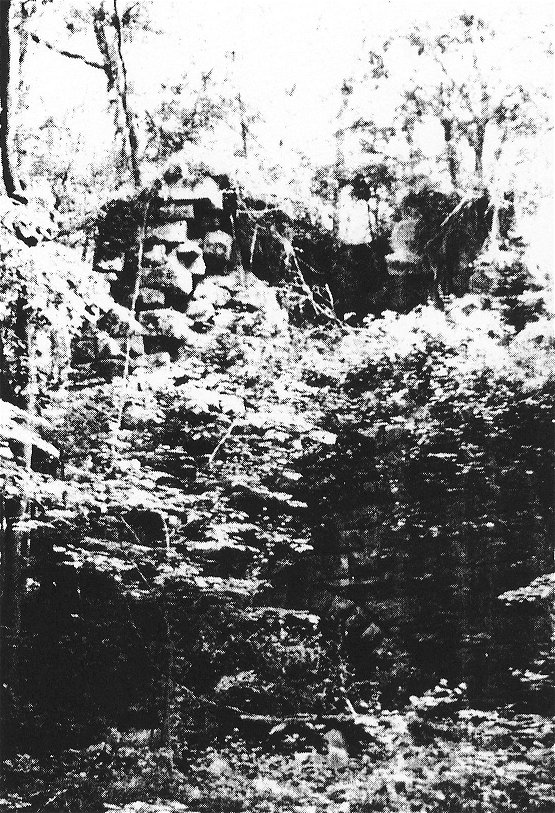
The once-mighty Endor Iron Furnace, where cannon balls and shot were forged for the civil War, stands crumbling near the banks of the Deep River. The cave-in on one corner is new, the result of flooding this winter by the Deep River. The Furnace was built by Confederate soldiers during the Civil War. Iron ore came up the Deep River during the short period when slack water navigation was possible. (Photo by Michael Hetzer)
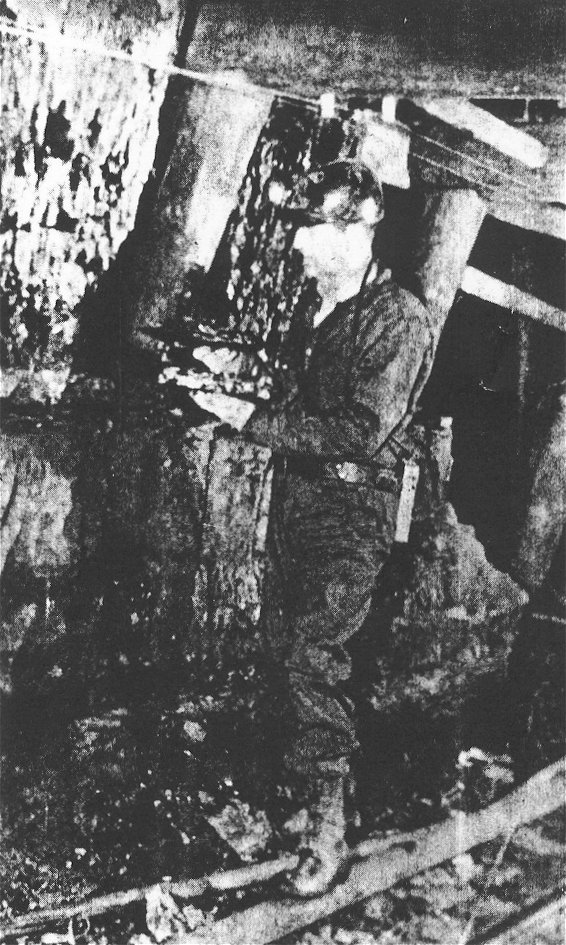
A miner inspects coal pulled from the seam In a cutting chamber of the Carolina Mine in 1949. Note the heavy wood timbers, cut from neighboring forests, that reinforce the roof. The entrance slope and the operating tunnel were reinforced with corrugated steel during this time. (Photo Courtesy of Hal Tysinger)
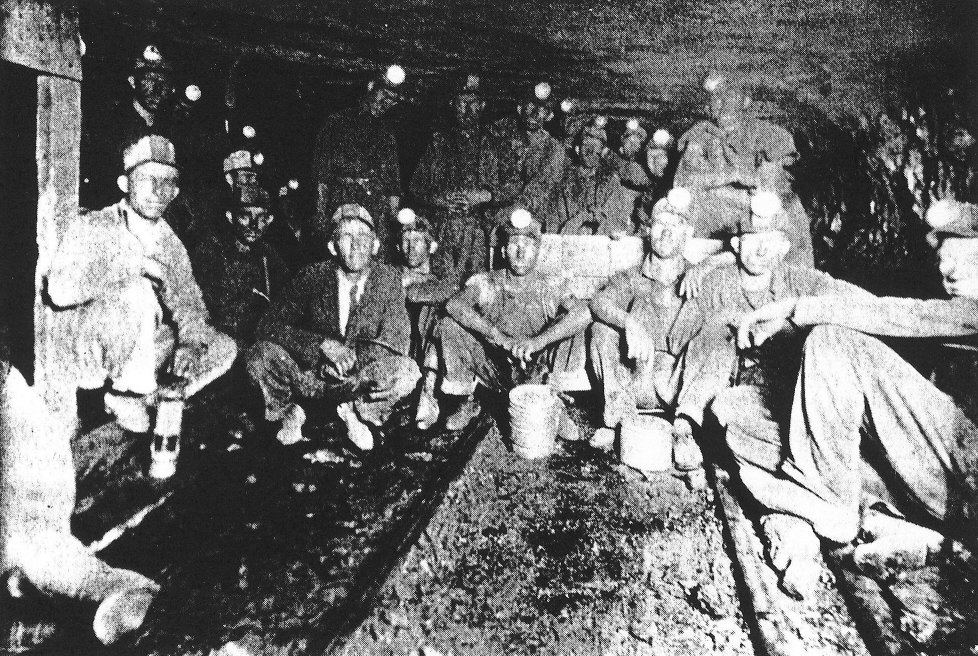
Miners take a break in the Carolina Mine before the terrible explosions. Who would live? Who would die? (Photo Courtesy Hal Tysinger)
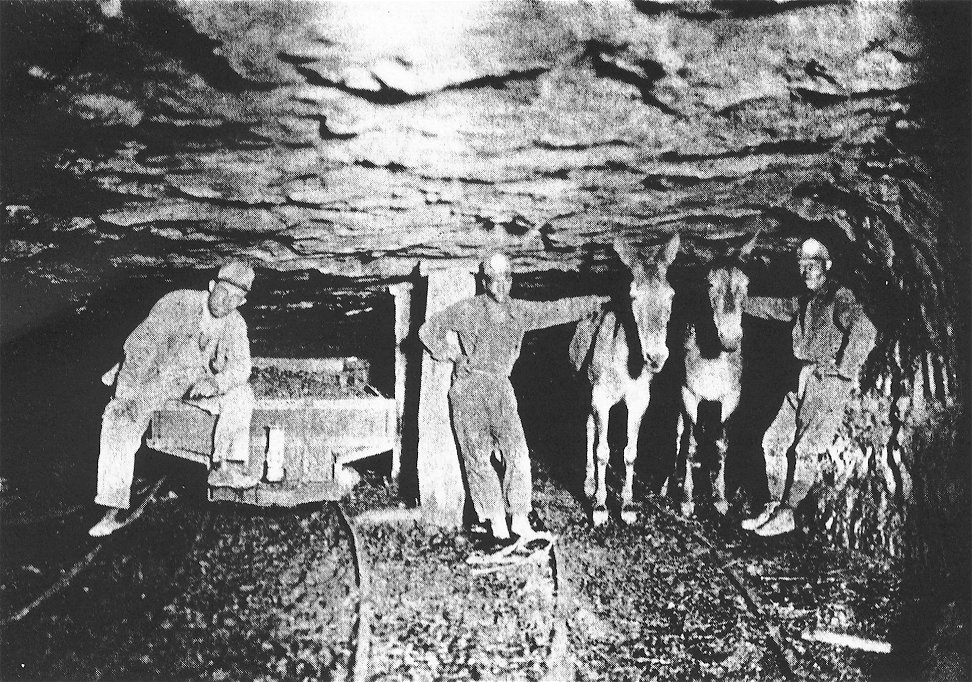
Men and mules inside the Old Egypt Mine. Men were not the only workers in the mine with difficult lives. A Mule might spend its entire life beneath the Earth, engaged in the most strenuous labor, never seeing daylight. When he died the very tunnels he helped create became his tomb. (Photo Courtesy of Hal Tysinger)
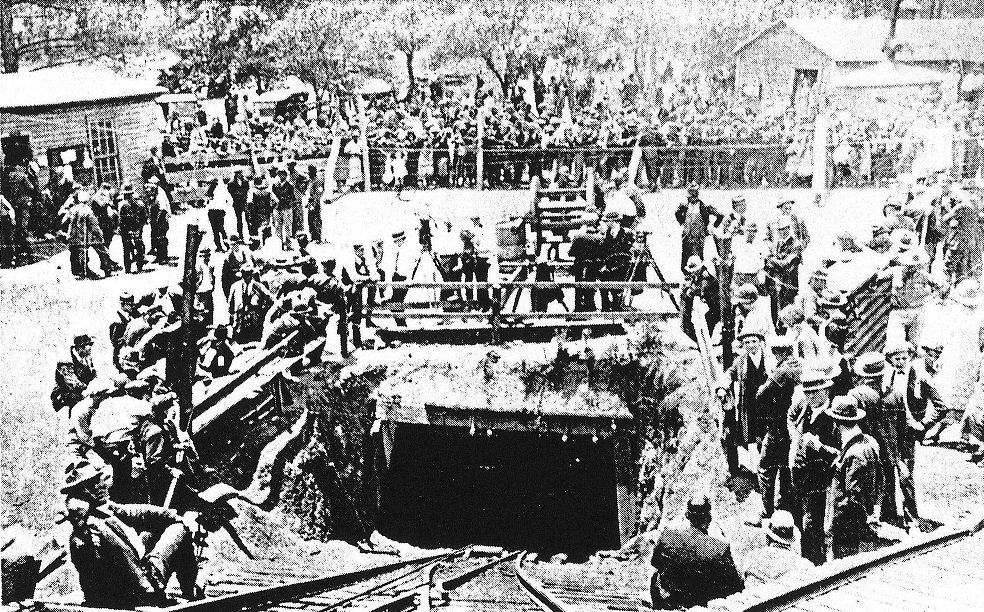
HOPE ABANDONED FOR ENTOMBED MINERS
The picture and caption appeared in papers nationwide on May 28, 1925 when 53 men perished in an explosion at the Carolina Mine, and distraught families, rescuers, journalists, and curious spectators descended on the tiny village of Coal Glen. It was North Carolina’s worst industrial accident.
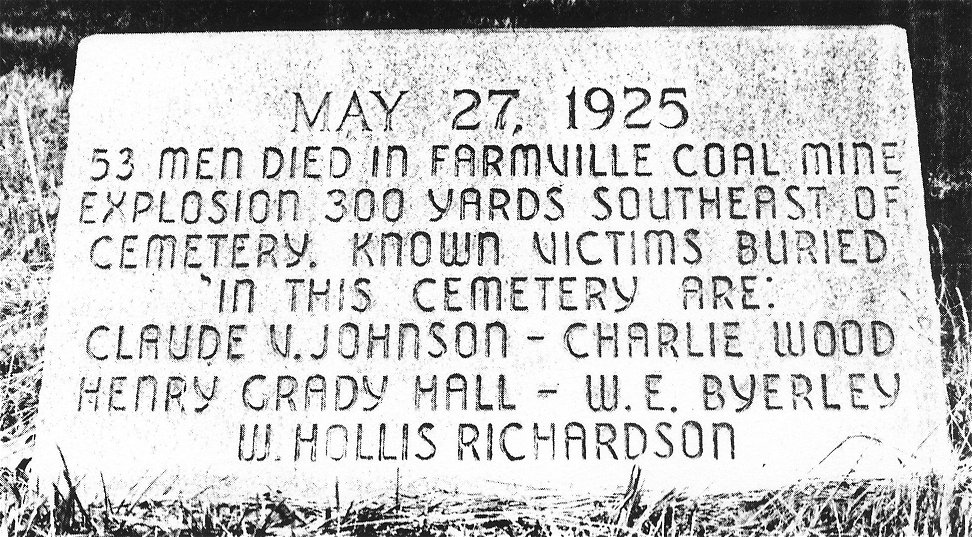
Gone but not forgotten. More than anywhere else on the Deep River coal Bed, the Farmville cemetery gives a true sense of the tragic history of mining here. It can be found at the end of Farmville Mine Road, near the town of Cumnock, It is by no coincidence that it is located only three hundred yards from the mouth of the Carolina Mine. victims of the 1985, 1900 and 1925 disasters are buried here, along with a plaque erected to memorialize the victims of the 1985 explosion. (Photo by Tamara D. Horne)
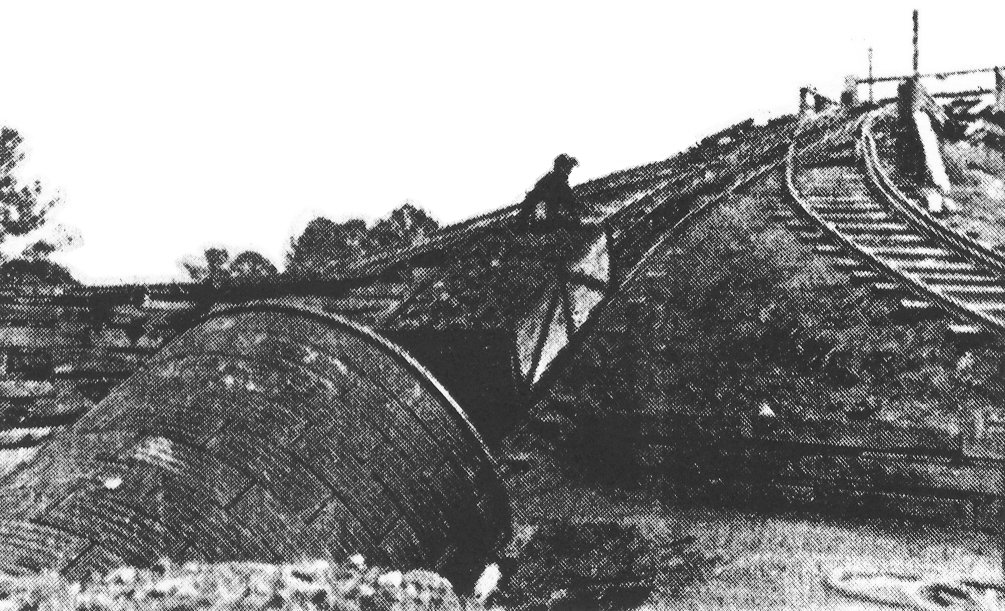
A miner rides atop a cart of coal at the mouth of the Carolina Mine in 1949. This cart might have come from 1,500 feet under the Deep River. Though the mine entrance was on the Chatham County side of the Deep River, the coal was cut from Lee County–on the other side of the river. (Photo Courtesy of Hal Tysinger)

All that remains of the once-bustling Carolina Mine, scene of the worst industrial disaster in the state’s history. The entrance has been preserved in the parking lot of the General Timber lumber company. A look into the mine reveals some old workings and track disappearing into water about fifteen feet down. (Photo by Tamara D. Horne)
Some accounts say the state’s worst mining disaster killed as many as 71 men — the number of miner’s lamps that were missing on that day.
The cause of the explosion was thought to have been a spark from a lamp that ignited some methane gas. The search and rescue/recover efforts lasted two full days. The Coal Glen Mine (a.k.a. Farmville Mine) continued to operate until 1951.


No comments:
Post a Comment